Australia instrumentalizes 'sports diplomacy' and defense pact to counter China; expert sees anxiety behind bid to shore up fading dominance
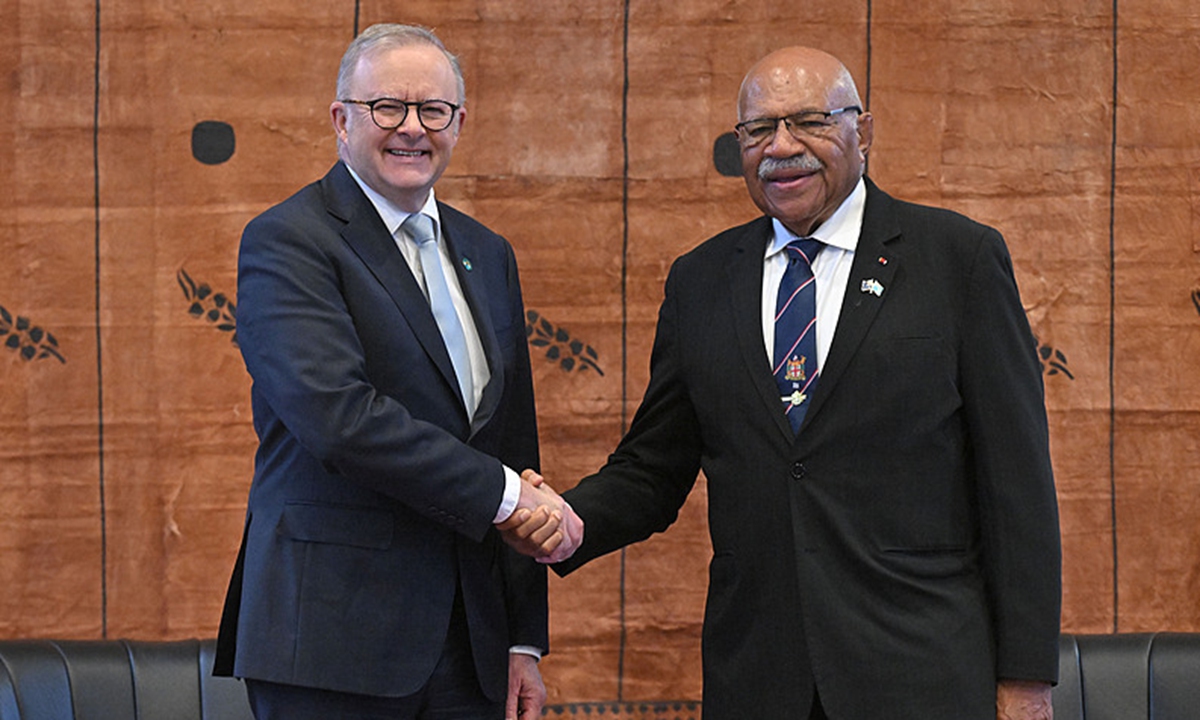
Australia's Prime Minister Anthony Albanese (L) and Fiji's Prime Minister Sitiveni Rabuka (R) shake hands during a welcome ceremony in Suva, Fiji, on July 2026. Photo: VCG
Three Pacific island leaders are scheduled to attend security talks in Australia while also attending a rugby league final, as Australian Prime Minister Anthony Albanese reportedly mounts a sports-diplomacy push to curb China's influence. Separately, Albanese inked a defense deal with Fiji on Monday, viewed as a "rebuff to China." An observer said that Canberra is packaging sports outreach, security agreements and other tools into a full-fledged mechanism to counter China's influence, driven by Canberra's anxiety over the unraveling of its long-standing position across the Pacific.
AFP reported that Papua New Guinea Prime Minister James Marape and Tonga's Prime Minister Lord Fakafanua will travel to Australia on Wednesday, with at least one other Pacific leader also expected for bilateral security talks on the day.
According to AFP, the Australian Prime Minister will host these leaders at the final State of Origin rugby league match between Queensland and New South Wales states.
"Through one of Australia's favorite sporting codes, we are bringing our Pacific family closer together," Albanese said in a statement on Sunday.
Officials have privately said rugby league and rugby union, where Australian and Pacific players have significant success, offer a soft-power edge over China, which does not have a history of playing the codes, per the report.
When sport, which promotes exchanges, ties and regional identity, is packaged with elements of soft‑power competition and embedded into security negotiations, it turns from a bridge for communication into a strategic bargaining chip, reflecting the instrumentalization of sports diplomacy, Chen Hong, Director of Asia Pacific Studies Centre, East China Normal University, told the Global Times on Monday.
The AFP report also said that Prime Minister Albanese "mounts a sports diplomacy push to curb China's influence."
Chen said with new partners including China offering Pacific island nations a broader range of cooperation options, Australia clearly realizes it can no longer take the Pacific island countries' political alignment and security dependence for granted. It is therefore attempting to re-entrench its central position in the region by tapping into carriers brimming with cultural connotations, Chen added.
Concurrently, Albanese signed an agreement, named the Ocean of Peace Alliance, alongside Fiji Prime Minister Sitiveni Rabuka in Suva, on a one-day trip to the Pacific island on Monday, The Australian reported.
Under the mutual defense provision, the agreement states: "Each party recognizes that an armed attack on any of the parties within the Pacific would be dangerous to each other's peace and security as well as the security of the Pacific, and declares that it would act to meet the common danger, in accordance with its domestic processes," The Australian reported.
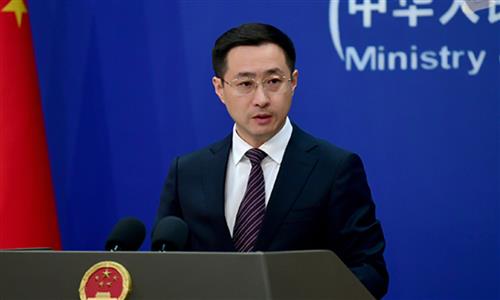
When asked to comment on Australia and Fiji signing a mutual defense treaty and a new agreement to develop ties, which is part of Canberra's campaign to shore up its influence in the South Pacific and to limit China's influence, Chinese Foreign Ministry spokesperson Mao Ning said on Monday that China always upholds the principles of mutual respect, equality, mutual benefit, openness and inclusiveness in carrying out cooperation with Pacific island nations, adding that "we do not engage in geopolitical rivalry or seek selfish political gains."
"It is hoped that the country concerned will truly respect the independence of Pacific island nations, focus on their sustainable socioeconomic development, and avoid targeting any third party or harming the interests of any third party," Mao said.
Chen said the agreement signed by the two sides is also part of Australia's attempt to build a system of concentric circles with itself as the security hub, in which it defines the risks and vets external cooperation.
Another report by The Australian claimed that the defense treaty will be "a major diplomatic win" for Australia in its so-called "knife fight" with China.
Judging from Australia's multiple moves targeting China, the country has been attempting to continuously package issues such as sports and security agreements into a broader mechanism to counterbalance China, the expert pointed out.
These attempts also reveal that Australia's anxiety does not stem from any single cooperative initiative, but rather from the unraveling of its long-standing dominance across the Pacific, Chen said.
In the long run, Australia's logic of competition for dominance in the region will not only marginalize issues that truly affect people's livelihoods, such as climate, health, and development, but also squeeze the space for Pacific island nations to pursue their own independent and balanced diplomacy, Chen added.
Ideal cooperation between major powers and island nations should not ask how to exclude the other side, but rather how to provide local people with more stable lives, Chen said, adding that true security in the interest of the Pacific is a space for peace and development led by the island states themselves.
RELATED ARTICLES