Safeguarding national sovereignty, security and territorial integrity with hard power of strategic missile: Hai Feng
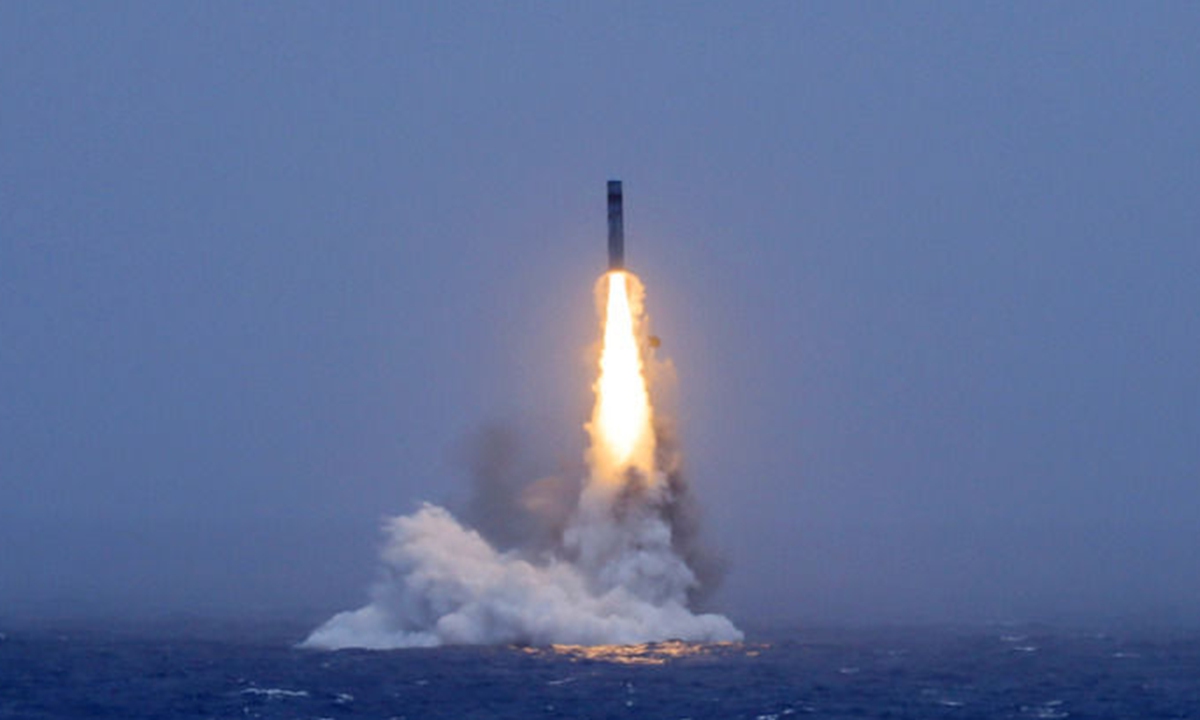
The Chinese People's Liberation Army (PLA) Navy successfully conducted the test launch of a strategic missile by a submarine on July 6, 2026. Photo: Xinhua
One strategic nuclear submarine of the Chinese People's Liberation Army Navy on Monday successfully launched a strategic missile carrying a dummy warhead toward relevant high seas of the Pacific Ocean, which landed precisely within the designated waters. While the official statement was restrained, the message was crystal clear: This was a routine part of China's annual military exercises, had been notified to relevant countries in advance, complied with international law and international practice, and was not directed at any specific country or target.
The more concise the announcement, the more confidence it demonstrates. What truly matters is reliable capability and systematic national power. The reason this test launch of a strategic missile by a submarine has attracted such close attention is that it represents not just a single weapon, but a country's comprehensive maturity in capabilities, such as strategic deterrence, blue-water projection and second strikes. For a major country like China - with an extensive coastline, a complex security environment and a great mission of national unification - this capability is not merely a token gesture, but a cornerstone for maintaining peace, deterring adventurism and stabilizing the situation.
Today, discussions of reunification can no longer remain at the level of abstract slogans. The great cause of national reunification must be built on a solid, realistic foundation. This foundation, first and foremost, is hard power. Any political will for reunification - without sufficiently powerful naval and air forces, without sufficiently reliable strategic deterrence and without a sufficiently comprehensive industrial system, scientific and technological capabilities, and joint operations framework - may be repeatedly eroded in the face of external interference and internal provocations. Conversely, as China develops an increasingly mature strategic nuclear submarine force, a more stable capability for operations in the high seas and a clearer anti-access capability, national reunification will no longer be merely a call of historical justice - it will also become an irreversible trend within the actual balance of power.
Stronger hard power is significant not merely for its ability to "fight," but more importantly for its ability to "prevent war." Certain external forces are fond of portraying China's legitimate, transparent and restrained defense development as a "source of regional instability," as if the world would be thrown into turmoil simply because China is growing stronger. This logic itself turns black into white. What truly undermines stability is not China's enhancement of its defense capabilities within the scope of its national security, but rather the fact that certain countries have long treated the Asia-Pacific as a chessboard for geopolitical games, are keen on creating bloc confrontations, incite their proxies to take risks and even use the Taiwan question as a lever to constrain China's development. The more capable China is of defending its core interests, the less room there is for external forces to misjudge the situation and take reckless risks, and the more stable the external conditions for peaceful reunification will become instead.
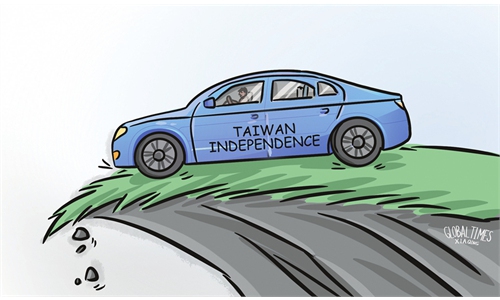
However, hard power alone is not enough. Advancing national reunification in the new era also requires articulating the "soft arguments" with greater depth, clarity and international persuasiveness. Taiwan is part of China - this is not something anyone has "claimed," but a fact confirmed by both history and legal principles. The one-China principle is a fundamental norm of international relations and a prevailing consensus of the international community. China's commitment to advancing reunification is not about expansion, conquest or altering the post-World War II international order; on the contrary, it is precisely about upholding that order. Because the postwar international system affirmed China's sovereignty and territorial integrity, opposing "Taiwan independence" separatism. It is, in essence, upholding the authority of international law and opposing the use of force as a way to mask separatism and opposing interference as a way to undermine order.
This is also why we need to demonstrate both hard power and articulate soft arguments. Hard power tells the world that China has the capability to smash any form of separatist schemes and foreign interference; soft arguments inform the world that China's reunification aligns with historical justice, legal justice, and the international order's justice. The combination of the two is the true mark of a mature great power strategy. Relying solely on reason without the backing of strength leaves one's arguments easily ignored; meanwhile, relying only on a display of power without the ability to shape the narrative makes one vulnerable to distortion by certain forces. What China needs to do today is to make the world see ever more clearly that China's pursuit of reunification is for national rejuvenation, for long-term regional peace and stability, and also to free the Asia-Pacific from being repeatedly held hostage by the logic of a few hegemonic powers.
It is worth noting that the international landscape is also undergoing profound changes. Discussions surrounding China-US relations, the global order, and regional security are on the rise, which in itself indicates that the world is re-evaluating China's weight. Whether others are willing to admit it or not, China has become an important force shaping regional and global order. At such a stage, we must grasp strategic initiatives more than ever: on one hand, continuously strengthening national defense and technological capabilities; on the other persistently shaping a favorable external environment conducive to China's reunification. This "favorable environment" is not something others bestow, but is secured through China's comprehensive national strength, diplomatic determination, capacity to shape public opinion and rules-making ability.
Reunification is a systematic project. It requires historical patience as well as real power; it demands not only national emotions but also state capacity. China's successful test launch of a strategic submarine-launched missile sends a clear signal that its ability to safeguard national sovereignty, security and development interests is continuously strengthening. No one should underestimate China's resolve to defend its core interests, nor misjudge its determination to achieve complete reunification.
Only with greater hard power can there be more confidence in national reunification; only with more compelling soft arguments can there be a stronger foundation for international understanding. By doing both well, we can better shrink the space for "Taiwan independence" separatist forces, weaken external intervention excuses and steadily shape a favorable external environment for national reunification. The wheels of history are rolling forward; China must be and will be reunified.
The author is a commentator on international affairs. opinion@globaltimes.com.cn
RELATED ARTICLES