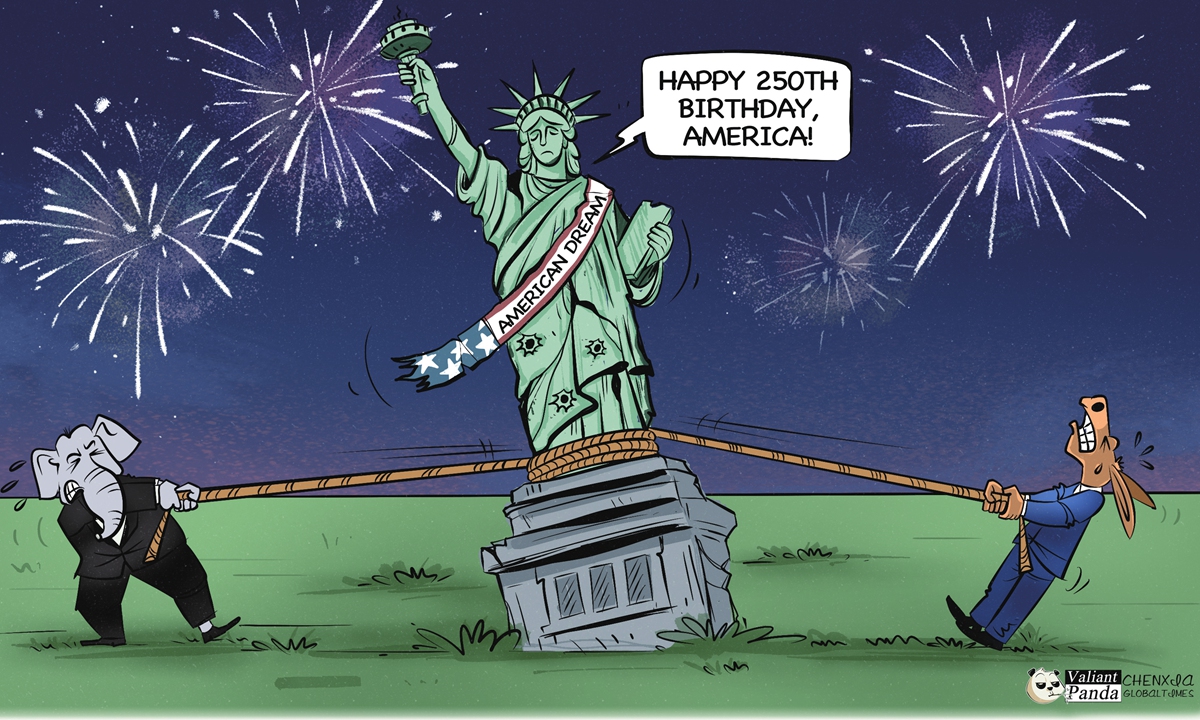
Illustration: Chen Xia/GT
If the Founding Fathers time-traveled to July 2026, would they recognize the nation they created? They would see the most spectacular and dazzling fireworks in history lighting up the sky. But if they picked up a newspaper, they'd discover the editorials telling a very different story - like a legendary heavyweight champion, celebrating his 250th birthday, staring into the mirror and quietly muttering, "Can I still win the next title fight?"
Over the past few days, The New York Times, The Washington Post, and The Wall Street Journal have all published editorials marking US' 250th anniversary. Beneath the celebration, a common undertone runs through them: champagne at the party, with a distinct aftertaste of midlife crisis.
The New York Times began with high praise for US' historical achievements, then delivered a sobering diagnosis of the country, listing five hard questions with no easy answers.
The Washington Post captured US' divisions most vividly. It ran two completely contradictory pieces: one lamenting how the 250th anniversary celebrations descended into bitter polarization, and the other enthusiastically listing 25 reasons to be optimistic about America's future, though the latter reads more like an attempt to talk itself out of its own doubts.
The Wall Street Journal directly hyped the so-called "China threat" in its editorial "A (Mostly) Happy 250th American Birthday," claiming that China "can reach the US homeland with its cyber, space and AI weapons." This is the instinctive reaction of American incumbent elites: When they don't want to face their own institutional fatigue and social fractures, the easiest response is to project fears onto an external rival.
The media can dress things up with optimism, but poll numbers don't lie. Multiple surveys have recently painted a sobering picture. Gallup reported in late June that Americans' pride in the US has hit its lowest point since Gallup's first measurement in 2001. According to a Reuters/Ipsos poll, 38 percent of Americans doubt the US will still exist as a single country in 250 years. In other words, while watching the fireworks, nearly two in five Americans were quietly wondering whether their country will even make it to 500.
250 years ago, the founding of the US was a bold institutional experiment. It broke from the old monarchical order and created a new republican system. After the Cold War ended, the "end of history" thesis led many Americans to believe they weren't just the winner - they represented the final destination of human social evolution.
Yet over 30 years later, the US has fallen from the confident peak of "the end of history" to the uneasy feeling that they've reached "the end of the end of history." It's no longer the country that sits on top of the world handing out answers. Now it has to ask itself some tough questions: Why do the institutions and elections still work on paper, but increasingly fail to produce real shared prosperity? Why does the US remain strong, yet find it so hard to feel confident? Amid such predicaments, blaming China, however, has become the easiest way out.
But China has never set a goal of "surpassing or defeating America." China pursues mutually beneficial ties. The trade wars, tariffs, technology restrictions, and repeated provocations on the Taiwan question - all the actions heightening tensions - have come unilaterally from the American side.
American elites may point the finger at China as much as they like, but the approach is ultimately self-defeating - it does nothing to improve the everyday lives of ordinary Americans.
China is not a threat - it is a mirror. It reflects not only US' own history of struggle and rise, but also the very areas where it needs to see: from feeding and housing 1.4 billion people, to its vast high-speed rail network, from the largest poverty alleviation campaign in human history to a governance model that turns hundreds of millions of individuals into a powerful collective force for progress.
Some American elites can continue pretending their country is strong while shifting blame outward whenever problems arise, but deep down they know the biggest challenges come from within. They can keep trying to contain China, or they can choose to pursue win-win cooperation. History has already delivered its verdict on the first path. The second requires imagination and innovation that go beyond zero-sum thinking. At 250 years old, does the US still have that imagination and innovative spirit?
RELATED ARTICLES