Japanese mask brand’s Weibo account restricted after promotion on July 7 anniversary sparks outrage in China
By and Xing Xiaojing Published: Jul 07, 2026 06:29 PM

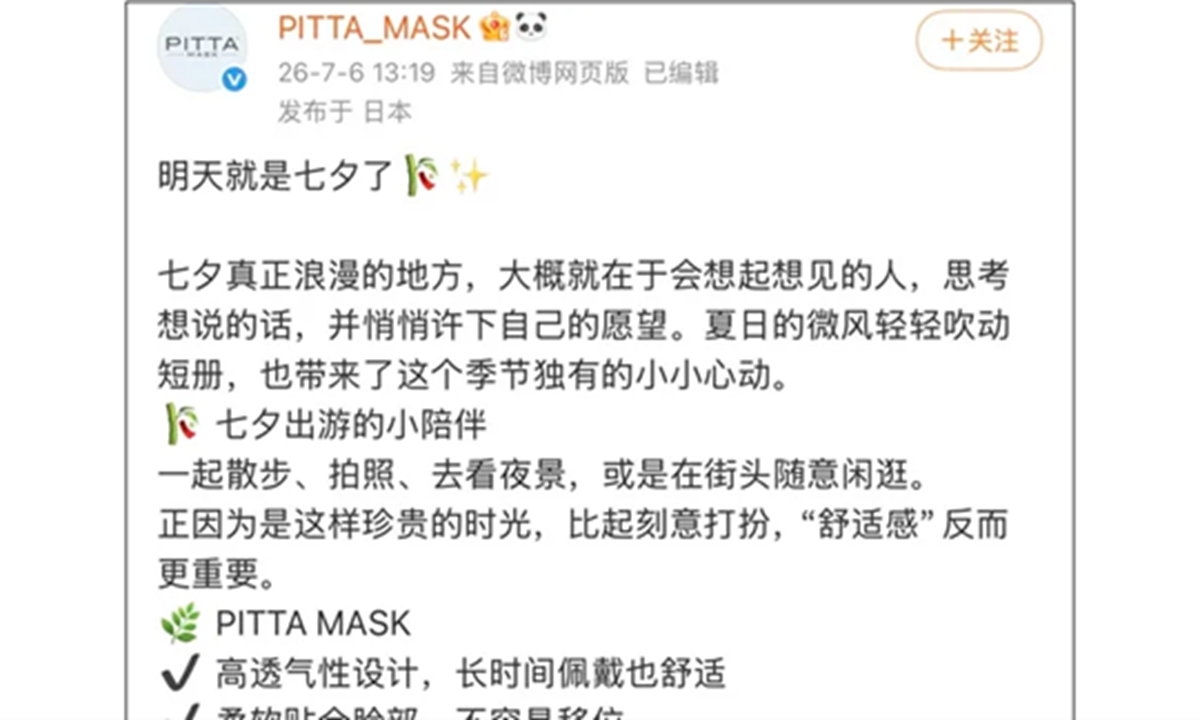
Screenshot circulating online shows a now-deleted promotional post published on Japanese mask brand PITTA MASK's Weibo account.
On Wednesday, Japanese mask brand PITTA MASK was suspended from posting on Sina Weibo after sparking outrage among Chinese netizens over a promotional post that referred to July 7, the anniversary of the July 7 Incident, a date associated with Japan's past invasion of China, as Qixi, China's traditional Valentine's Day. Other posts from the brand's Weibo account can no longer be viewed.
The brand posted a promotional message on its official Weibo account on Monday, July 6, saying that "tomorrow is Qixi," and that "the true romance of Qixi perhaps lies in thinking of the person one longs to see," according to the Beijing Daily.
However, July 7 marks the anniversary of the 1937 Lugou Bridge Incident, widely recognized as the start of Japan's full-scale invasion of China and China's whole-of-nation resistance against Japanese aggression.
Qixi Festival, or Chinese Valentine's Day, falls on the seventh day of the seventh lunar month on the Chinese calendar.
The Global Times reporter found on Tuesday that the original promotional post could no longer be found on PITTA MASK's Weibo account, while screenshots circulating online showed content conforming to that reported by Beijing Daily. The brand has not issued any further statement regarding the controversial post. A media inquiry sent via Weibo has not received a response as of press time. The Global Times has also reached out to the company's Japanese parent firm, ARAX CO., LTD., for comment. No response had been received as of press time.
A hashtag page with the hashtag of "What is the purpose of a Japanese brand treating the July 7 Incident as Qixi?" has been viewed nearly 3 million times. Many Chinese netizens have expressed anger over the brand's post.
Some netizens also flooded the brand's Weibo account with comments, saying the company could not simply delete the post and act as if nothing had happened.
A netizen named "Hanchao" questioned whether the move was a genuine mistake, saying, "For a brand operating in the Chinese market, did you not even check the date of China's Qixi Festival? This year's Qixi clearly falls on August 19. Why would a Japanese brand post on July 6 that 'tomorrow is Qixi' and package July 7 as a romantic marketing occasion? Was it ignorance, or was it intentional?"
Netizen "Chuxiaomin" commented that "This is not about cultural differences, nor can it be dismissed as simple insensitivity. It is a blatant provocation rooted in a refusal to confront history."
But the deeper issue lies in the long-term spread of historical revisionism in Japan, driven for decades by right-wing forces. In such an environment, Japan's wartime aggression and grave crimes before its defeat have too often been downplayed, whitewashed or pushed out of public memory, creating a broader indifference toward history that continues to hurt the feelings of the Chinese people, said the netizen.
RELATED ARTICLES