IN-DEPTH / IN-DEPTH
Chinese inclusive AI solutions empower Global South, chart equitable global AI governance: director of China-SCO Countries AI Application Cooperation Center
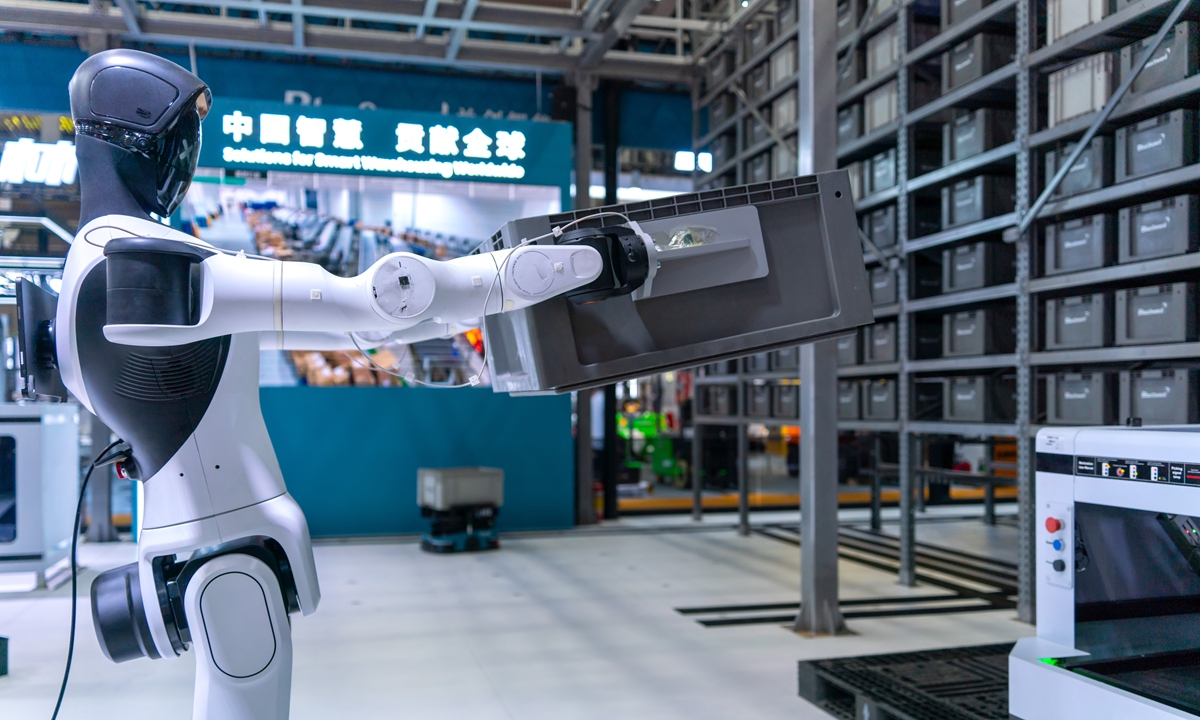
A humanoid robot demonstrates sorting operations for warehouse logistics scenarios at the full industrial chain booth for robots in Shenzhen, South China's Guangdong Province, on April 22, 2026. Photo: VCG
Editor's Note:In an era marked by unprecedented global transformations, the world stands at a critical crossroads, grappling with deepening deficits in peace, development, security and governance. As humanity faces unparalleled challenges during this tumultuous period, Xi Jinping, general secretary of the Communist Party of China (CPC) Central Committee and Chinese president, has put forth a solemn call to action through the Global Development Initiative (GDI), the Global Security Initiative (GSI), the Global Civilization Initiative (GCI) and the Global Governance Initiative (GGI). The four pivotal initiatives address the pressing issues of our time, offering viable pathways and robust support for building a community with a shared future for humanity.
Rooted in the rich historical experiences of the CPC's century-long struggle and infused with the wisdom of China's traditional culture, these initiatives are expected to unite the world in the pursuit of common progress and stability. To offer a deeper understanding of the four major global initiatives and elaborate on their global significance, the Global Times is launching a series of articles.
In this installment, Global Times reporters Lin Xiaoyi and Chen Zishuai sat down with Pan Jingyu, director of the China-SCO Countries AI Application Cooperation Center at the Zhongguancun Dialogue on AI Cooperation, recently held in Beijing, to discuss how China leverages multilateral cooperation platforms to carry out extensive international collaboration on artificial intelligence, supports Global South countries in scaling up their technological capacity-building and contributes to bridging the global AI divide.
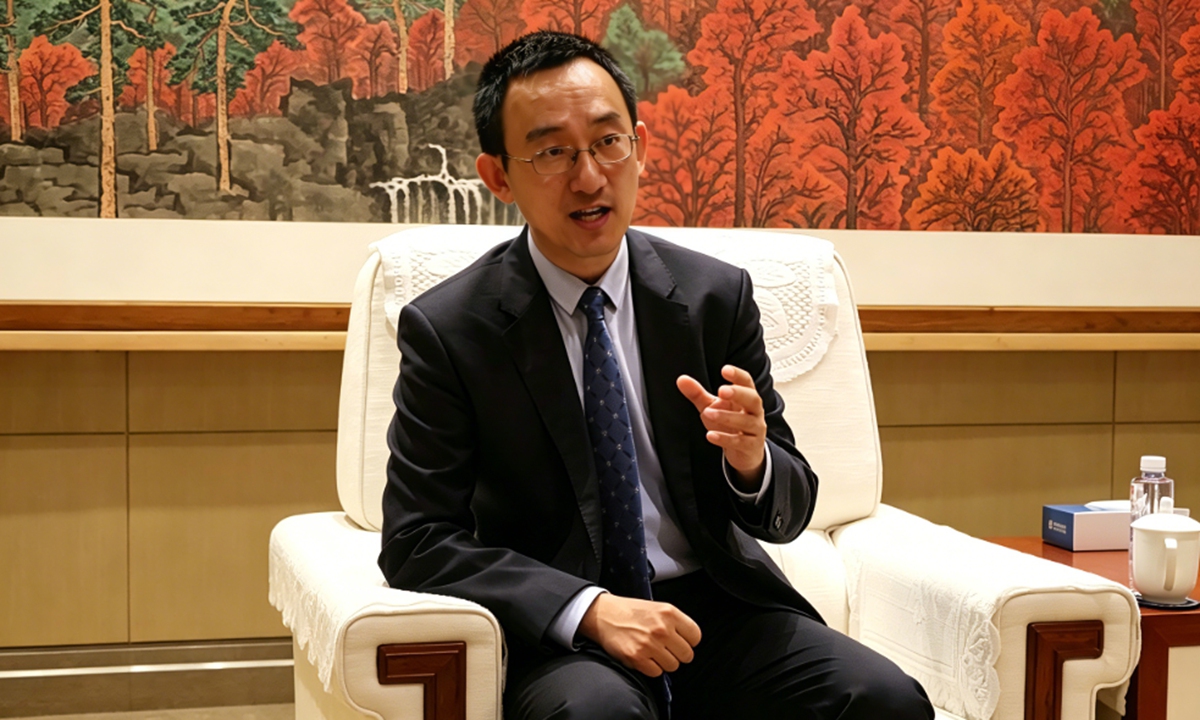
Pan Jingyu, director of the China-SCO Countries AI Application Cooperation Center, during an exclusive interview with the Global Times in Beijing on July 2, 2026 Photo: Lin Xiaoyi/GT
As artificial intelligence reshapes the global landscape, the emerging China-SCO Countries AI Application Cooperation Center is positioning itself as a key bridge between China's technological prowess and the development needs of the Global South. In an exclusive interview with the Global Times on the sidelines of the Zhongguancun Dialogue on AI Cooperation, Pan Jingyu, director of the center, outlined how China leverages multilateral frameworks to export mature AI solutions while addressing governance challenges, offering a distinct vision against the backdrop of global digital divides.The dialogue, held at the Zhongguancun Exhibition Center in Beijing on Thursday, brought together the UN China, domestic AI industry players, universities and research institutions, building a high-level multilateral platform linking China's AI innovation capacity with global sustainable development demands.
The China-SCO Countries AI Application Cooperation Center stands as a prime institutional platform to turn such cross-border dialogue into tangible cooperation.
The center was launched to implement Chinese President Xi Jinping's pledge at the "SCO Plus" Meeting in September 2025 that China was ready to "build with all sides the artificial intelligence application cooperation center, and share the dividends of progress in AI."
While the center's primary mandate covers SCO member states, it is also actively expanding cooperation with Global South countries and international organizations to better align technology supply with local demand, promote localized and inclusive AI adoption, and support partner countries' digital transformation, livelihood improvement and sustainable development.
During the interview, Pan laid out the center's next three-year work framework centered on resource sharing, capacity building and coordinated rule-making, with four core service lines. It delivers customized AI technical packages for digital agriculture, smart education, industrial manufacturing and urban governance via demand-driven matchmaking between Chinese innovators and overseas partners. Joint research on AI safety, algorithm transparency and data protection will align regional governance standards, while systematic training programs cultivate local civil servants, engineers, researchers and youth. Regular high-level dialogues, forums and project roadmaps sustain long-term institutionalized exchange mechanisms.
Pan sees the current moment as a "critical window" for co-shaping global AI rules, standards and capabilities among Global South countries. But demand from developing countries, he argues, is "dual-track": on one end, the rigid need for scenario empowerment - plugging AI into agriculture, education, health, manufacturing and cross-border logistics; on the other, the inclusive need for capacity building - affordable computing power and homegrown talent.
Wide gaps exist across these nations. "A one-size-fits-all approach won't work," Pan said. "We reject technological hegemony or uniform standards imposed from outside." Instead, the center upholds the core philosophies of inclusive technology and localized application, consistently adhering to openness, inclusiveness, equality, mutual benefit and shared gains for all.
Pan noted that a top priority of the center is conducting in-depth demand surveys among partner countries. By delivering flexible, customizable technical solutions, the center enables technologies to adapt to local development stages and real-world scenario requirements.
From the center's extensive work with overseas partners, Pan said it is clear that partner countries hold strong expectations for introducing China's advanced, pragmatic, open and secure AI technologies, with government and business representatives across regions showing keen enthusiasm for collaboration.
Latest data from Stanford University shows that China released 30 benchmark AI models in 2025, ranking second globally, while its open-source large models top global platform usage volumes. "A host of outstanding Chinese innovative AI models have drawn widespread international attention. Their high cost-performance ratios, innovative open-source ecosystems and robust technical performance have broken the monopoly long held by a handful of global tech giants, opening an alternative path for the Global South to achieve leapfrog digital development," Pan said. Pan also referenced the white paper "More Just and Equitable Global Governance: China's Principles, Proposals and Actions," released by the State Council Information Office on June 17, 2026. "It calls for true multilateralism, a people-centered philosophy and tangible actions," he said, citing the Zhongguancun Dialogue on AI Cooperation as a vivid case in point. These core propositions translate into concrete, on-the-ground moves to ensure AI delivers tangible benefits to all humanity.
He highlighted that during the event, UN agencies elaborated on their key priorities covering sustainable development, public health, gender equality and capacity building. Meanwhile, Chinese delegations showcased their technological strengths in large language models, robotics, smart education, medical AI and cybersecurity. "We also gathered numerous actionable insights on aligning global demand, cutting-edge technologies, capital support and industrial resources," Pan said, adding that the center plans to roll out a set of small-scale, high-impact, practical, and replicable pilot projects and connect them with international resources worldwide.
Looking ahead, Pan reaffirmed the center's role as a critical bridge. "We will further keep acting to match Chinese AI innovation with worldwide development needs," he said. "Jointly, we can forge a fair, open, secure and inclusive development pathway for artificial intelligence."
RELATED ARTICLES