US faces broad opposition to proposed tariffs on 60 economies over 'forced labor' claims
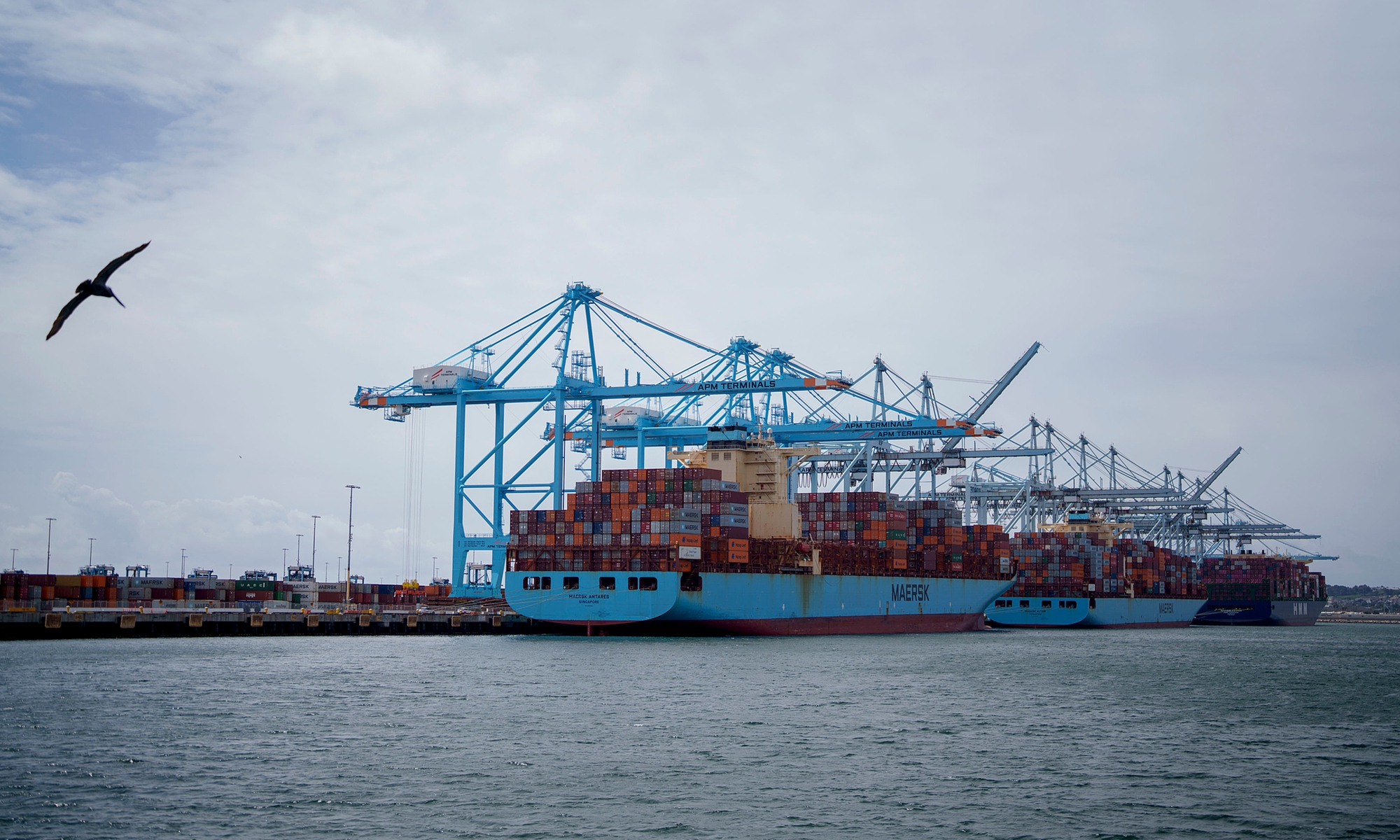
Cranes load containers onto ships at the Port of Los Angeles in Los Angeles, California, US, on Thursday, March 6, 2025.Photo:VCG
Numerous enterprises and industry groups from the US and other economies have submitted opposition to proposed US tariffs on the pretext of so-called "forced labor" trade practices, voicing their concerns over supply chain disruptions and rising costs in public comments submitted to the US Trade Representative (USTR).
Public hearings on the USTR's proposed new tariffs are scheduled to begin on Tuesday local time, as part of a Section 301 investigation targeting 60 economies over alleged "insufficient enforcement of forced-labor import bans," according to the USTR's website.
The USTR launched the probe on March 12 and on June 2 proposed additional tariffs on imports of 10 percent for 16 economies including the EU, Canada and UK, or 12.5 percent for 44 economies including the Chinese mainland, Japan, India, South Korea and Singapore, based on "the failure of various economies to impose and effectively enforce a prohibition on the importation of goods produced with forced labor," according to documents released by the USTR.
As of Monday, the deadline for written public comments, there were a total of 1,512 public comments submitted to the USTR, according to its website.
Lotus Brands Inc., a US personal care company, said in the submitted comment that tariffs tend to be highly destructive of economic development.
"My company suffered serious, almost catastrophic damages from the prior round of tariffs that were imposed on goods that we are unable to obtain in the US. The US itself produces a lot of economic value from forced labor, so it seems to be purely an excuse to try to slap that label on virtually all our major trading partners, to the harm of the US businesses and the economy that relies on free trade," Santosh Krinsky, founder of Lotus Brands, said in the comment.
Krinsky noted that "we are not sure our company will survive another round of such tariffs due to the extreme losses we suffered and the general harm to the economic well-being of the people who buy our goods and services, as in the end tariffs are paid either by companies, such as mine, or by the end consumer to the extent that costs get passed along."
Wisconsin-headquartered LaCrosse Technology said in the comment submitted that it supports the proposed exclusion of articles subject to Section 232 tariffs. It cited the Chinese mainland and Vietnam, to which its comment pertains.
"Additional forced labor tariffs on top of the rates - a combined effective tariff of approximately 45 percent from existing Section 301 and IEEPA measures - would cause serious supply disruption and economic harm without addressing forced labor practices, as LaCrosse Technology's Chinese supply chain is SMETA and BSCI-certified (supply chain management system that ensures factories and producers uphold ethical labor standards)," read its comment.
LaCrosse Technology also requests that USTR consider including some harmonized tariff schedule subheadings, which cover non-sensitive consumer goods such as thermometers, alarm clocks, rain gauge parts, and capillary thermometers that have no domestic US manufacturing alternatives.
Schneider Mills, a North Carolina-based textile manufacturer, said in its comment that the question is not whether the company prefers to purchase American-made machinery. "We do. The question is whether American manufacturers should be penalized when no American-made machinery exists."
California Attorney General Rob Bonta on Monday co-led a coalition of 22 attorneys general in objecting to the proposed, unlawful tariffs on 60 economies based on allegations that these economies fail to enforce a prohibition on the importation of goods produced with forced labor, according to a statement posted on website of the Office of the Attorney General of the State of California Department of Justice.
Apart from the abovementioned opposition, companies and industry associations from the 60 economies listed by the USTR also expressed their opposition.
For example, the Canadian Federation of Agriculture wrote in the comment that "expanding tariffs to Canada-US-Mexico Agreement (CUSMA)‑compliant agricultural and agri‑food products would have serious and unintended consequences."
Canada-US agricultural trade is highly integrated and depends on predictable, timely cross‑border movement. Even modest tariffs could disrupt supply chains, increase input costs, and reduce competitiveness, particularly as many agricultural products cross the border multiple times during processing. These impacts would place additional pressure on farmers and agri‑food businesses on both sides of the border, the federation said.
The Lima Chamber of Commerce of Peru requested in its comment that the USTR "refrain from imposing any additional tariffs or other restrictive measures on Peruvian exports."
"Any differentiated treatment resulting in higher tariff levels or other more restrictive measures applicable to Peru would be unnecessary and would not be consistent with the cooperative and mutually beneficial nature of the longstanding bilateral relationship between our countries," the chamber said.
"The US' section 301 tariff initiative is essentially a unilateral trade practice. Washington arbitrarily defines so-called unfair trade practices based solely on its own judgment, which fundamentally violates multilateral trade norms and lacks legitimate basis," Zhou Mi, a senior research fellow at the Chinese Academy of International Trade and Economic Cooperation, told the Global Times on Tuesday.
Zhou noted that this opposition demonstrates that the US-initiated tariffs are unpopular worldwide.
"By imposing and exporting its self-made forced-labor standards globally, the US infringes on other economies' judicial independence and sovereign values. Moreover, the probe has no credible factual basis. Evidence gathered is biased and unsubstantiated, rendering the proposed tariffs completely groundless," Zhou said.
China's Ministry of Commerce in early June voiced opposition to the US move of adopting unilateral trade restrictive measures against China under the pretext of so-called "forced labor," urging the US to meet China halfway and maintain steady economic and trade relations between the two countries.
Senior officials from some economies, including Australia, the EU and South Africa, also expressed opposition to the US' planned tariff policy in early June following the latest US tariff plan.
RELATED ARTICLES