China opposes US trade restrictions on China under pretext of ‘forced labor’
US tariff plan to drive up domestic inflation, disrupt global economic order: expert
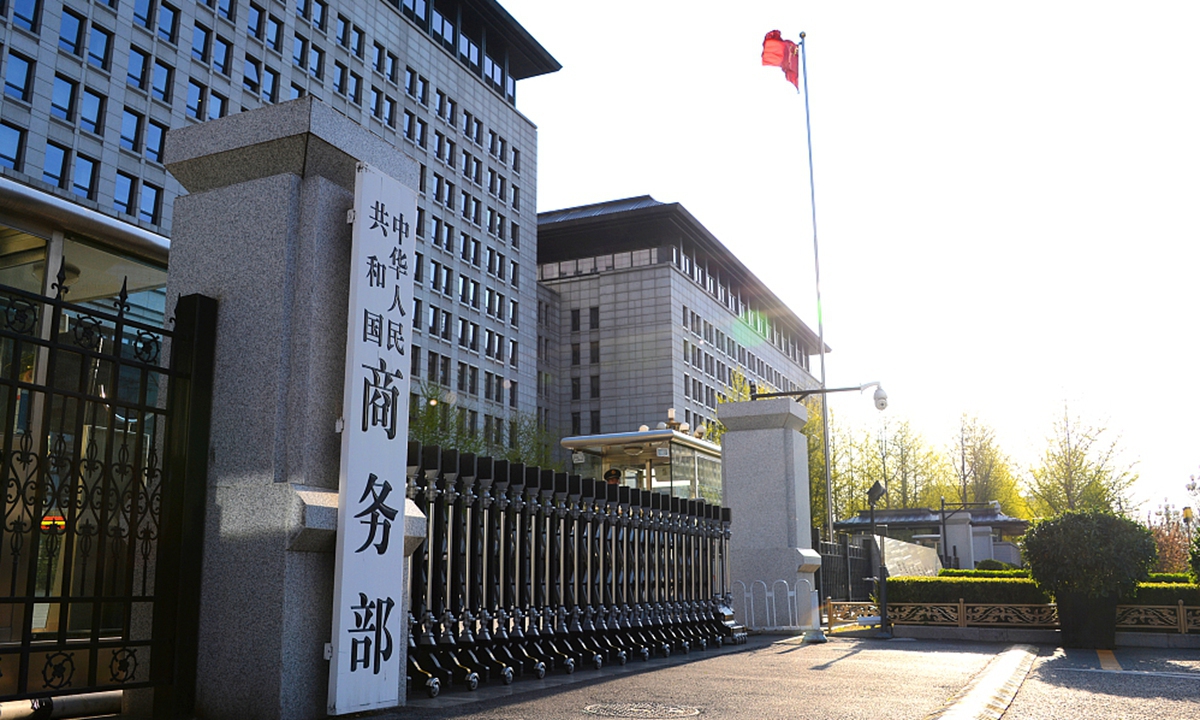
Ministry of Commerce
China's Ministry of Commerce (MOFCOM) on Thursday voiced opposition to the US move of adopting unilateral trade restrictive measures against China under the pretext of so-called "forced labor," urging the US to meet China halfway and maintain steady economic and trade relations between the two countries.
"China's position on the Section 301 investigation has been consistent. China opposes all forms of unilateral restrictive measures, including the series of trade restrictions imposed on China under the pretext of 'forced labor.' We have repeatedly expressed our solemn position on this matter," China's Ministry of Commerce (MOFCOM) spokesperson He Yongqian told a press conference on Thursday.
The remarks were made in response to a question regarding the US proposal to impose additional tariffs on economies allegedly involved in forced labor.
"We urge the US to work with China in the same direction and jointly maintain the stability of China-US economic and trade relations," the MOFCOM spokesperson noted.
Jamieson Greer, the US trade representative, said on Tuesday night that investigations found that the 59 economies, along with the 27-nation European Union, had failed to enact or effectively enforce laws prohibiting imports made with what it called forced labor, The New York Times reported.
The administration, invoking a legal provision known as Section 301, proposed a 12.5 percent duty on imports from countries including China, Brazil, South Korea, Switzerland and Britain. Goods from the European Union, Canada and Mexico would face 10 percent import taxes, the report said.
Some economies have also responded to the US' planned tariff policy.
Australian Prime Minister Anthony Albanese said that any tariff on Australian exports to the US was "unjustified and inconsistent" with the free trade agreements between the two allies, according to ABC News.
"There is an ideological disagreement where the United States administration has broken with what was a decades-long understanding that tariffs are not positive for the country that is imposing them," Albanese said. "They increase the cost of goods and services in the country that is applying them to its consumers, and … free trade is in the interests of the global economy."
The European Commission said that the tariffs were unjustified and reiterated its commitment to the trade deal sealed with Washington last year that capped the US tariff rate on most EU goods at 15 percent, Reuters reported.
Bernd Lange, who chairs the European Parliament's trade committee, said that the results of the US investigation were "utterly absurd" given a 2024 EU law to ban imports of forced labor products, according to Reuters.
South African Trade, Industry and Competition Minister Parks Tau has asked Washington to provide evidence that South Africa is importing goods produced with forced labor, while India said that it was engaged with Washington on the Section 301 proceedings, according to media reports.
"There will be deep concerns in the international business community that the US (forced labor law could) become a global template," said Andrew Wilson, deputy secretary-general of the International Chamber of Commerce. "Anyone can make a claim, get a shipment impounded and the company has to prove no forced labor in the supply chain," Wilson said in the Reuters report.
The essence of the latest US tariff plan represents another pretext for exercising unilateralism, and it is more widely regarded as a technical maneuver to extend the existing tariff policy, rather than a genuine effort to address the forced labor issue, He Weiwen, a senior fellow at the Center for China and Globalization, told the Global Times on Thursday.
According to Reuters, the proposal from the office of the US Trade Representative comes from a Section 301 unfair trade practices investigation designed to help rebuild the Trump administration's emergency tariffs, struck down by the US Supreme Court in February.
He Weiwen said that the US move may again disrupt the global economic and trade order, noting that it undermines the rules-based global trading system and further fragments global supply chains.
"For the US, the new tariff will further drive up domestic inflation, especially under the influence of factors such as energy prices — essentially adding fuel to the fire. Additionally, while it may increase tariff revenue in the short term to help alleviate the fiscal deficit, in the long run, these gains are likely to be offset by declining trade volumes and economic slowdown," the expert warned.
Bloomberg reported on Thursday that Greer said China received advanced notice on the forced-labor announcement and that consultations will continue. "… And our expectation is that as we go through these Section 301 investigations we'll continue to have conversations with China to try to mitigate the challenges we identify at the same time having an appropriate tariff level as part of that mitigation," said Greer.
China's Foreign Ministry spokesperson Mao Ning on Wednesday said that "No one stands to gain from a tariff war or a trade war. Economic and trade issues should be worked out through dialogue and consultation on the basis of equality, respect and mutual benefit."
Mao noted that there is no such thing as "forced labor" in China, and we oppose using it as a pretext for political manipulation.
He Weiwen added that the Chinese and US economic and trade teams previously reached a consensus on tariff arrangements through consultations in South Korea, urging the US side to honor its commitments and create a favorable atmosphere for expanding China-US economic and trade cooperation.
He Yongqian said during Thursday's press conference that based on the consensus reached in previous economic and trade consultations, China and the US have agreed to establish a trade council. Under the council, the two sides will discuss a framework for reciprocal tariff reductions on products of equivalent scale.
The Chinese side believes that this arrangement represents a correct step by the US in its tariff policy toward China and holds positive significance for stabilizing and expanding bilateral China-US trade. The economic and trade teams of both sides will maintain close communication to finalize the specific arrangements as soon as possible and promote their implementation, said the MOFCOM spokesperson.
RELATED ARTICLES