2026 WAIC set for July 17 with over 300 global product debuts in Shanghai
By Published: Jul 07, 2026 10:19 PM
A concept picture of AI city File photo: VCG
China will host the 2026 World AI Conference (WAIC) and High-Level Meeting on Global AI Governance in Shanghai from July 17-20, Chinese officials announced at a press briefing in Shanghai on Tuesday. The conference is set to be an important platform to showcase the world's most cutting-edge artificial intelligence (AI) technology and China's homegrown innovations, ranging from large language models (LLMs), AI agents to industrial open-source ecosystems, while also fostering global cooperation on key issues such as AI safety, global governance and bridging AI divides, observers said.
The event, themed "Intelligent partners, co-creating the future," will consist of six major segments: forums and conferences, exhibitions and displays, awards and competitions, application experiences, innovation incubation and talent recruitment.
Total exhibition area will exceed 100,000 square meters for the first time, with more than 1,100 enterprises participating and over 3,000 exhibits on display. Among them, more than 300 products will make their global debut, and more than 200 companies will gather in each of the two major tracks - intelligent computing and embodied intelligence.
The conference has already facilitated the implementation of 57 major application scenarios, with a total of 16.2 billion yuan in intended cooperation agreements reached.
Tang Wenkan, director of the Shanghai Municipal Commission of Economy and Informatization, said at the press briefing that multiple innovative AI products will debut at the conference, including the industry's largest-scale super node, the Huawei Atlas 950 physical unit, the MiniMax M3 multimodal large model, the Jieyue Agent Operating System, near-memory computing 3D chips and the world's first AI Agent smartphone, as well as humanoid robots, AI dexterous hands and other innovative gadgets.
"It will be a global benchmark event that sets the tone for the global AI trend," Wang Peng, an associate researcher at the Beijing Academy of Social Sciences, told the Global Times on Tuesday.
He said that as Chinese tech companies have become global leaders in the AI industrial chain, spanning such sectors as LLMs and robotics, the conference will serve as a vital platform to showcase China's homegrown innovations and technological breakthroughs.
Liu Wei, director of the Human-Machine Interaction and Cognitive Engineering Laboratory at the Beijing University of Posts and Telecommunications, told the Global Times on Tuesday that he expects the conference to serve as a key platform providing capital and real-world application scenarios to fast-track the industrial adoption of advanced AI technologies and large-scale production of humanoid robots, "thereby boosting the real economy and fostering new quality productive forces."
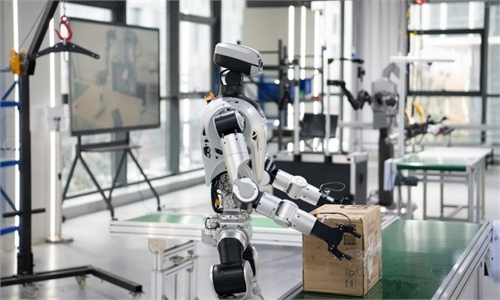
Gan Xiaobin, an official from China's Ministry of Industry and Information Technology, said at the press briefing that the annual production of humanoid robots in China is expected to reach 100,000 units this year, and that humanoid robots have been increasingly making their way into factories and workshops.
Meanwhile, as manufacturing has become the primary "battlefield" for AI-empowered applications, the adoption rate of AI among China's large-scale industrial enterprises has surpassed 30 percent, Gan noted.
Taking account of the strong momentum in AI-powered smart terminals, it is expected that sales of AI smartphones and personal computers would surpass non-AI phones and computers for the first time in 2026, Wang Ruomeng, an official of China's National Development and Reform Commission, the country's top economic planner, said at the press briefing.
China's annual shipments of AI-powered smart terminals, including smartphones and PCs, exceeded 100 million units last year.
Sun Xiaobo, coordinator for AI affairs at the Ministry of Foreign Affairs, disclosed at the press briefing that this year, dozens of countries and international organizations are expected to send high-level representatives to the conference. During the High-Level Meeting on Global AI Governance, global participants will engage in in-depth discussions and exchange views on cutting-edge AI tech development and smarter governance.
"It is expected that international exchanges will focus on critical topics such as global AI governance and security, underlying standards for world models and AI agents, bridging the global digital intelligence gap, fair trade within the AI industrial chain, and the development of norms for the humanoid robotics and digital asset sectors," Liu said.
He pointed out that unlike some Western countries, China has pursued a distinctive homegrown approach to open-source development, which has significantly strengthened its domestic AI capabilities. This open and collaborative model not only accelerates China's AI progress but also contributes to the sustained growth of the global digital and intelligent economy, particular for developing countries.
RELATED ARTICLES