It is 'naive' of NATO to make an issue out of China's missile test: Global Times editorial
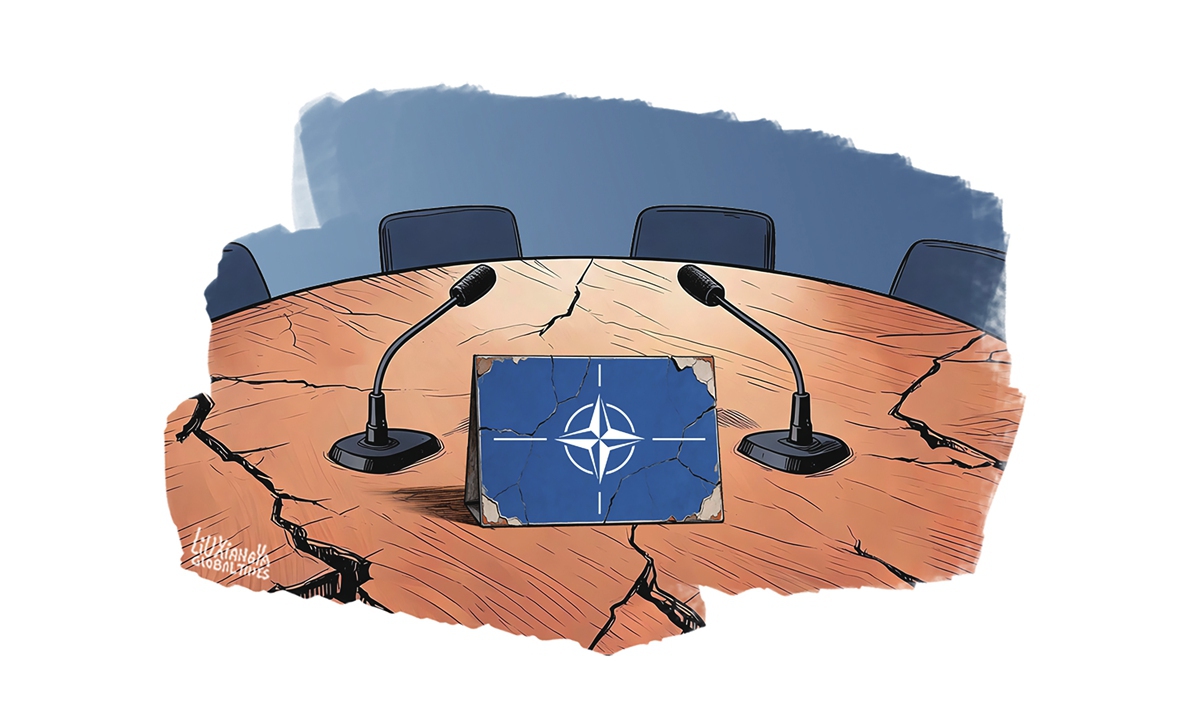
Illustration:Liu Xiangya/GT
NATO's hyping of the "Chinese missile threat" ahead of the Ankara summit is a clumsy attempt to insert itself into the spotlight - a move that appears both naive and pathetic. Fabricating a "China threat" out of thin air is a calculated ploy by NATO to justify its continued existence and to seek a pretext for expanding its reach into the Asia-Pacific. The Pacific is vast enough to accommodate the shared development of all nations, but it should never become a playground for the ghosts of the Cold War.
NATO Secretary General Mark Rutte has recently gone out of his way to insert himself into the spotlight. On the eve of the NATO summit, he even claimed that NATO "cannot be naive" about China regarding the test launch of a submarine-launched strategic missile by China on Monday. A routine military exercise - not directed at any specific country or target - was forcibly shoehorned into NATO's narrative of a "China threat." Rutte's deep immersion in this role compels one to ask: Is China truly "threatening" NATO, or does NATO need to fabricate the "China threat" narrative out of thin air to justify its own existence?
Even more absurdly, Rutte claimed to have discussed the matter via text message with Japan's defense minister, asserting that "what happens in the Indo-Pacific region matters for what happens in the transatlantic region." NATO is a North Atlantic military alliance. The missile landed in the Pacific Ocean, and Asia-Pacific nations - including Japan - were notified in advance; the entire operation violated no country's sovereignty and threatened no nation's security. Why, then, is the NATO secretary general so concerned? Did he want to incorporate the high seas of the Pacific into NATO's "sphere of influence"?
The timing of Rutte's hype regarding the "Chinese missile threat" is no coincidence. The NATO summit held in Ankara, Turkey, on Tuesday and Wednesday was widely viewed as a gathering for NATO allies to demonstrate their loyalty to the US. European nations face significant challenges on multiple fronts, ranging from meeting the defense spending targets set at last year's Hague summit to navigating strategic rifts across the Atlantic. Outside the venue, massive anti-NATO protests erupted, with demonstrators brandishing slogans such as "No to NATO, No to War." NATO is beset by obvious internal and external troubles; like a Cold War relic that should have long since been consigned to the dustbin of history, NATO increasingly struggles to justify its continued existence in the 21st century. It is so anxious as to resort to hyping up routine military exercises conducted by other nations just to "stay relevant," which is both naive and pathetic.
Missile test launches are consistent with international law and common international practice. From NATO's core members, including the US, France and the UK, to countries such as India and Russia, states regularly conduct test launches of land-based intercontinental ballistic missiles or sea-based submarine-launched ballistic missiles. Many of these tests also take place over the high seas or in international waters, and international media generally describe them as "routine exercises." This selective hype makes it clear that the issue is not the missile tests themselves, but NATO's tendency to treat China as an imagined enemy. Whenever China strengthens its national defense capabilities, it is immediately branded a "threat." Such double standards reveal NATO's deeply entrenched Cold War mentality.
What is particularly concerning is the interaction between Rutte and Japan's defense minister, which lays bare NATO's real intentions. NATO's expansion into the Asia-Pacific is accelerating through increasingly institutionalized arrangements. It has signed an Individually Tailored Partnership Programme with Japan and a similar partnership with Australia and New Zealand. Clearly, NATO's concern is not so-called "stability in the Indo-Pacific," but finding a pretext to expand its footprint into the Asia-Pacific - a goal that dovetails neatly with Japanese neo-militarists' ambition to use NATO as a vehicle for advancing their own agenda. Compared with China's military, which has never initiated a war since the founding of the People's Republic of China, it is NATO - with its repeated expansion and military interventions abroad under the banner of "collective defense" - together with resurgent Japanese militarism, that deserves the international community's vigilance.
Who is NATO's "Asia-Pacific show" really for? China remains committed to peaceful development, pursues a defensive national defense policy, adheres to a self-defensive nuclear strategy, and keeps its nuclear arsenal at the minimum level required for national security. It does not engage in a nuclear arms race with any country. China's nuclear force modernization is aimed at preventing extra-regional military blocs such as NATO from meddling in the Asia-Pacific and stirring up conflict and instability on China's doorstep. Comparatively, NATO has repeatedly fanned the flames of conflict and sown division in hotspots around the world, earning itself a well-known reputation as a warmonger. The fact that several leaders from Asia-Pacific countries declined to attend this year's NATO summit speaks for itself. If NATO still believes it has the authority, or the moral high ground, to lecture others about peace, it is badly misreading the times and profoundly naive.
It is time for NATO to end this farce of using China's missile capabilities as a political talking point. Labeling China a "threat" while seeking to extend its reach to China's doorstep is a clumsy performance that will not deceive the people of the Asia-Pacific. The Pacific is vast enough to accommodate all peace-loving nations, but it should never become a playground for the ghosts of the Cold War.
RELATED ARTICLES