Illustration:Liu Xiangya/GT
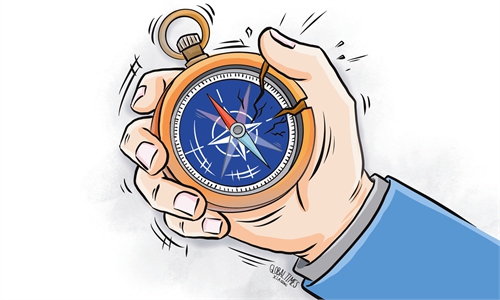
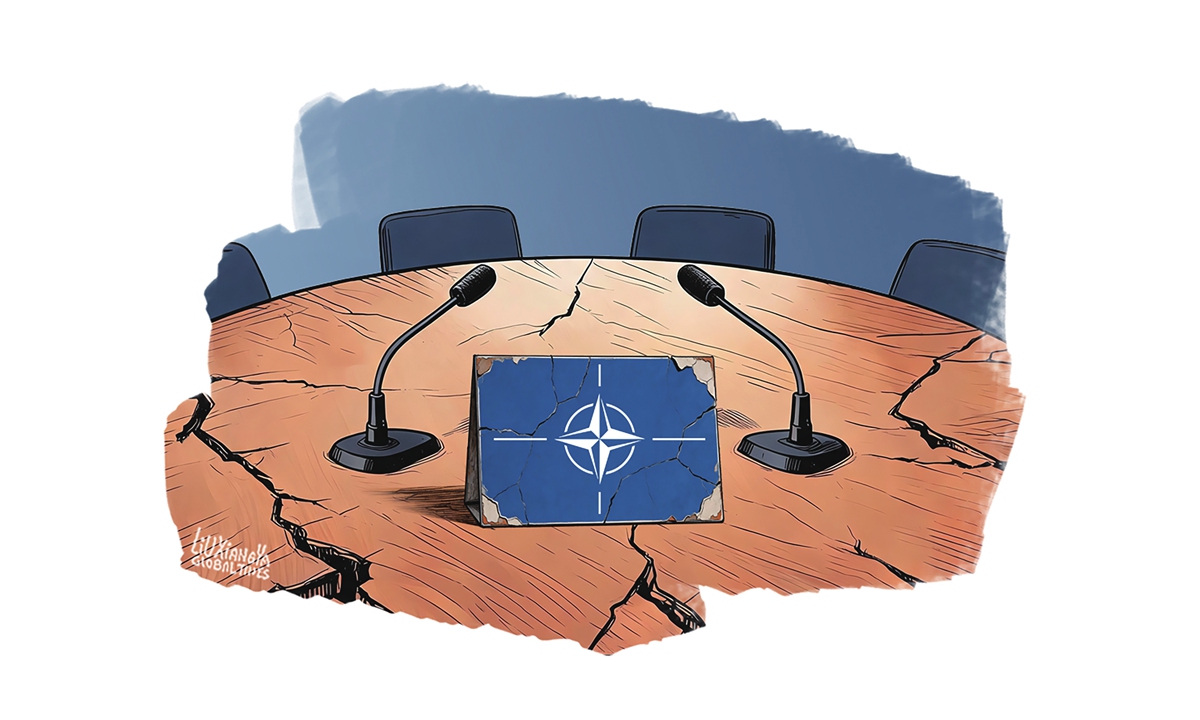
The NATO summit is scheduled to be held in Ankara, the capital of Turkey, on Tuesday and Wednesday. The US growing unilateralism and "America First" strategic orientation have further deepened the contradictions and rifts in transatlantic relations. Meanwhile, intensifying disputes and confrontations between the US and Europe over Greenland and the Middle East conflicts have also posed structural challenges to NATO as a platform for coordinating transatlantic security interests.
Against this backdrop, expectations for this NATO summit have been significantly lowered. As Foreign Policy noted in a recent article, "a dull NATO summit is precisely what Europeans are hoping and praying for," suggesting that the pursuit of stability in diplomatic settings has become its primary objective. This reflects the sharp decline in NATO European members' expectations for the US to play a positive security role. Yet, on the eve of this year's summit, the US president once again reiterated that it would be "ridiculous" for Washington to "continue along this one-sided path when the relationship is not reciprocal," claiming that he would attend the summit only "out of respect" for Turkish President Recep Tayyip Erdogan. Such remarks have kept the summit under the constant shadow of potential diplomatic rupture.
For European countries, the recurring transatlantic crises and the irreversible deterioration of US-Europe relations in recent years have made them recognize that they have little choice but to handle transatlantic ties with great caution, lest US anger paralyze the various mechanisms underpinning the Western alliance. Therefore, Europe has become inclined to accommodate Washington's strategic priorities and primary concerns, in exchange for US consideration of Europe's key interests. Last month's G7 summit reflected this trend: European countries employed diplomatic skills to foster a warming political atmosphere at the summit, and demonstrated a proactive problem-solving stance on the Strait of Hormuz in an effort to persuade the US to adjust its position on the Russia-Ukraine conflict and return to supporting Ukraine. It demonstrated Europe's attempt to explore a new model of alliance management - one based more explicitly on direct exchanges of interests - in order to ensure that major Western diplomatic gatherings produce outcomes satisfactory to all parties.
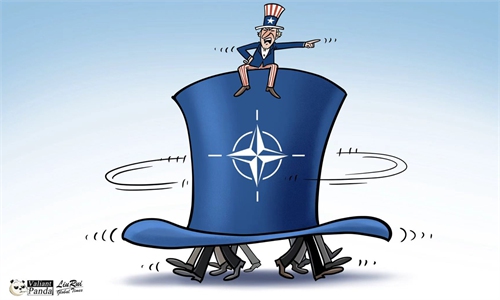
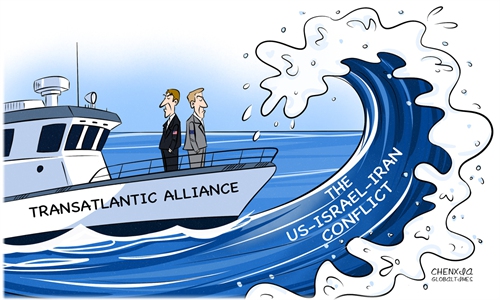
With regard to NATO, the US has continued its long-standing demand that European allies shoulder a greater share of defense responsibilities. Moreover, its understanding of NATO's institutional role has undergone dramatic changes - namely, that Europe's investment in its own security should be linked to America's security commitments to NATO. Meanwhile, following the US-Israel-Iran conflict, Washington has used whether European allies support US military operations and whether they follow the US stance on warship escorts in the Strait of Hormuz as indicators of whether NATO allies are "loyal and useful." This has also altered European countries' perception of NATO, as the alliance is shifting toward "becoming entangled in conflicts" under US pressure.
Therefore, both the host country, Turkey, and NATO's European members have signaled that preserving alliance unity has become their foremost priority. NATO Secretary General Mark Rutte emphasized that the summit's task is to translate allies' commitments into "concrete results." Turkish President Recep Tayyip Erdogan also stated that he hoped the summit would highlight alliance unity and resilience. These statements reveal that concepts once taken for granted under the NATO framework, including shared values and collective defense, have become something of a luxury. The alliance's focus has shifted from "how to jointly respond to external threats" to "how to prevent internal division and uncertainty." In this sense, a "dull summit" may well be the best outcome NATO can hope for at present, and for European countries, it may also represent the most realistic means of safeguarding their geopolitical interests within the alliance.
Looking ahead, both transatlantic relations and relations among NATO members may become dependent on transactional exchanges of interests, while the long-standing trust based on a shared Western identity will become more fragile. Europe's efforts to transform transatlantic relations through greater "interest-based exchanges" and enhanced "strategic autonomy" are also likely to face considerable obstacles. Technically speaking, the "strategic autonomy" advocated by the EU and several major European powers relies on increased defense spending, yet achieving independence from the US in terms of military technology and military systems remains a lengthy and difficult process. At the same time, Washington's seizure of European interests is expanding into new dimensions. The Greenland dispute suggests that Europe's sovereignty and territorial integrity can be challenged by its own principal ally, while US criticism of Europe's position on conflicts in the Middle East implies that Washington expects Europe to serve as a subordinate instrument of American strategic interests. As a result, preserving diplomatic stability within NATO and across the broader transatlantic relationship is likely to become increasingly difficult for Europe.
The author is an associate research fellow at the Academy of International and Regional Studies, and vice director of the Turkey Studies Center of Beijing Language and Culture University. opinion@globaltimes.com.cn