Illustration: Liu Rui/GT
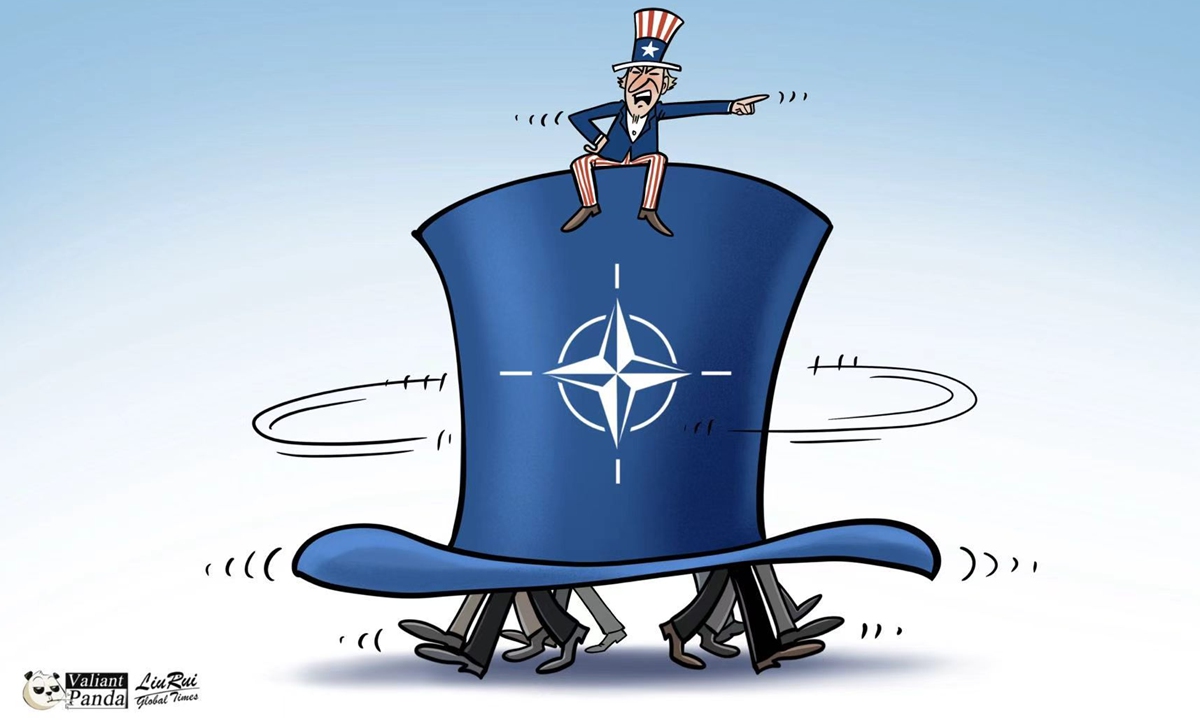
Recently, the US government has sent a signal regarding a potential withdrawal from NATO. The US attributed its consideration of withdrawing from NATO to the obstruction of its Greenland purchase plan. Furthermore, the US criticized its European allies in NATO for their reluctance to participate in the Strait of Hormuz escort mission. These moves have once again thrust NATO into the spotlight, laying bare the alliance's institutional flaws and internal divisions.
NATO is currently facing unprecedented internal and external challenges. Its external challenges primarily involve a widening gap between organizational ambitions and actual capabilities. Beyond addressing the Ukraine crisis on the European front, NATO is also attempting to intervene in regional affairs in the Asia-Pacific and the Middle East.
Internally, NATO faces deepening fractures in cohesion and consensus, largely driven by a widening transatlantic rift. European members prioritize countering Russia as NATO's primary mission, while the US has threatened to scale back its military presence in Europe. Meanwhile, these transatlantic differences may trigger power struggles among other NATO members, largely due to disagreements among European nations over NATO's development strategy.
But these divisions, whether it is the transatlantic divide or internal disagreements between European countries within NATO, are merely symptoms. The core issue lies in the growing contradiction between member states' diverse security interests and NATO's concept of "collective security" amid dramatically changing international dynamics. As a result, NATO members are neither on the same page nor of the same mind, making it very difficult to act in unison.
In this context, NATO's European members find themselves in a very awkward position. After the US-Russia "bypass diplomacy," the Greenland issue and the fallout of the US-Israel-Iran conflict on Europe, European nations are also putting more effort into "defense autonomy." Yet, this conflicts with NATO's mechanisms. With limited defense budgets, European NATO members face difficult choices on which budget allocations serve European "defense autonomy" and which serve NATO system integration when developing their national military capabilities.
Moreover, when the US is entangled in conflicts in other regions, European allies often face a dilemma: prioritizing "European security first" and resisting unconditional alignment with Washington or facing intense pressure from the US, including threats of withdrawal from NATO. Given overall security considerations, European nations struggle to find a compromise solution.
Looking ahead, NATO's future may follow three possible scenarios. First, it may continue as a collective defense alliance but undergo deep restructuring, with European "defense autonomy" becoming essential and a dual security architecture emerging, with "NATO as the main axis and the EU as the pillar." Second, a transatlantic task division occurs: The US more or less abandons its military responsibilities in Europe, while Europe assumes more command and operational roles on the continent. Third, transatlantic military relations may evolve into a mix of cooperation and competition. While European defense autonomy currently supplements NATO, competitiveness - even contradictions - will increasingly grow, with the possibility that NATO might eventually be replaced.
Whichever scenario materializes will depend largely on the evolution of US-European consensus in the security domain, particularly US leadership commitment and the outcome of transatlantic strategic bargaining. If Washington continues to reinforce its "instrumentalized" definition of NATO, and Europe remains unable to truly achieve "strategic independence," then any architecture will only offer a temporary mask over the crisis.
More fundamentally, NATO's current challenges stem largely from its outdated ideology and security concepts: While loudly proclaiming itself a "defensive alliance," it continues to extend its reach into other regions and countries beyond its scope. Such self-contradictory behavior will only accelerate member states' centrifugal tendencies, ultimately leaving NATO either reshaped by an internal overhaul or reduced to an empty shell, hollowed out by the vast gap between rhetoric and reality.
The author is director of the Center for China-Europe Relations at Fudan University's Institute of International Studies.opinion@globaltimes.com.cn
RELATED ARTICLES