NATO chief's hyping of China's routine missile test aims to justify growing Asia-Pacific meddling and fuel bloc confrontation: experts
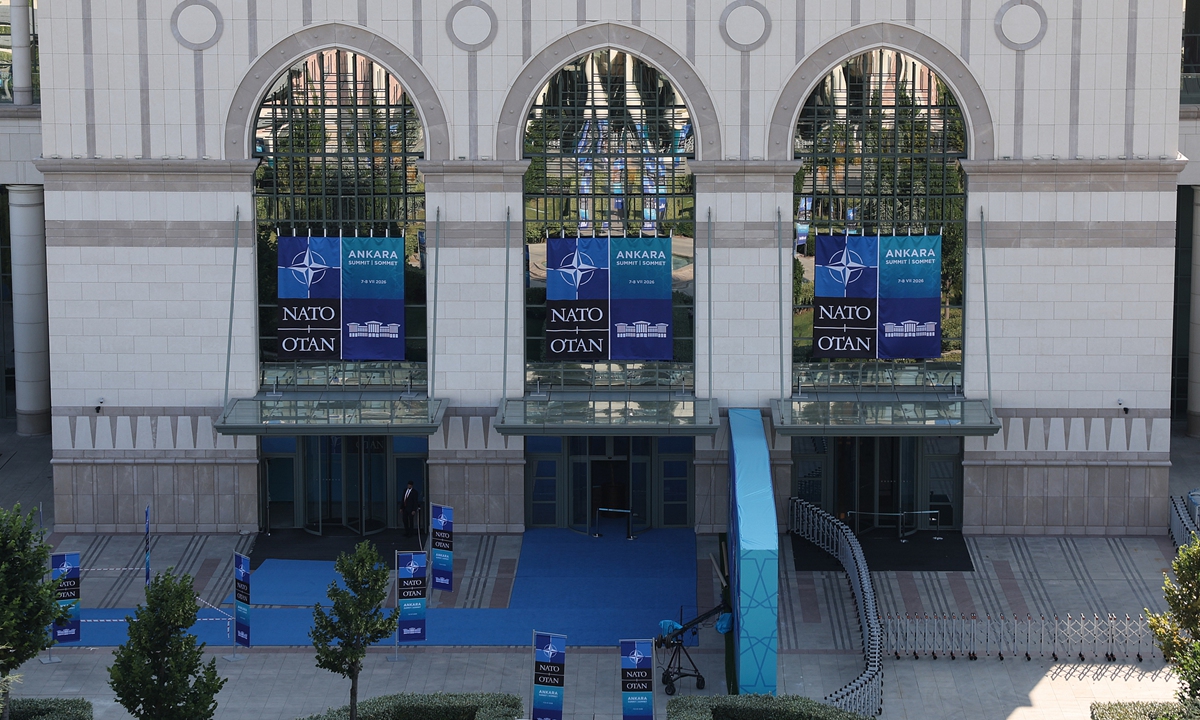
A view of the venue of the NATO Summit in Ankara, Turkey on July 7, 2026. Photo: VCG
Despite the Chinese People's Liberation Army (PLA) Navy's annual submarine-launched strategic missile training on Monday being conducted in accordance with international law, with relevant countries notified in advance and no specific country targeted, NATO, the US and some Asia-Pacific allies have seized on the exercise to hype tensions, with NATO Secretary General Mark Rutte linking Euro-Atlantic security to Indo-Pacific affairs ahead of the alliance's summit in Ankara, claiming that NATO "cannot be naive about China."
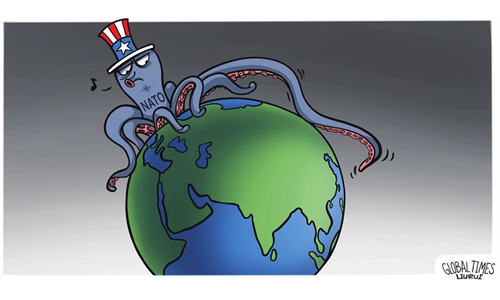
Chinese observers noted that NATO's persistent hyping of the so-called "China challenge" is aimed at justifying its expansion beyond its traditional geographic scope, advancing the militarization of the Asia-Pacific and promoting bloc confrontation. They added that Japan and several other countries' efforts to draw NATO deeper into the Asia-Pacific have long exposed their intention to undermine regional peace and stability.
At a press conference ahead of the NATO summit in Ankara on Monday local time, NATO Secretary General Mark Rutte told reporters that NATO maintains close cooperation with its four "Indo-Pacific partners," claiming that the alliance "cannot be naive about China." He also sought to link China, North Korea and Iran to the Russia-Ukraine conflict, arguing that "what happens in the Pacific is relevant to what is happening in the transatlantic," in an apparent attempt to blur the geopolitical boundaries between the two regions and justify NATO's involvement in Asia-Pacific affairs.
Despite China's repeated clarification that the test launch was a routine PLA Navy annual training activity, conducted in line with international law and practice after relevant countries were notified in advance and not directed at any specific country or target, some Western media outlets still hyped up the issue.
Reports by Reuters, the Associated Press, The Guardian, ABC, The New York Times and CNN used sensational wording such as "anger neighbors," "raise concerns" and "fuel unease," which Chinese experts believed deliberately amplified regional anxiety and distorted China's normal defense activities.
On Tuesday, the US State Department, while acknowledging that the missile was an "unarmed" missile in a test launch, still took the opportunity to accuse China of a "rapid and opaque nuclear weapon" buildup. US allies including Japan, the Philippines, New Zealand and Australia followed suit by voicing "regional concerns,'' forming a coordinated narrative against China. They ignored the facts that China had issued prior notifications and that the drill was defensive in nature, and instead leveled accusations along ideological lines, revealing clear double standards, Cui Hongjian, a professor at the Academy of Regional and Global Governance at Beijing Foreign Studies University, told the Global Times.
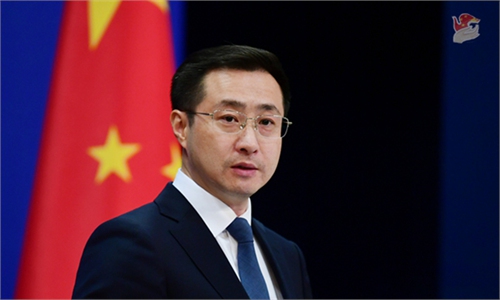
Responding to the hype from some countries, Chinese Foreign Ministry spokesperson Mao Ning said at a regular press conference on Tuesday that "China is committed to the path of peaceful development and follows a defensive nuclear strategy. There is no need for any country to overinterpret the test launch."
Later on Tuesday evening, Chinese Defense Ministry spokesperson Chen Xi also responded to related questions.
Chen said the PLA Navy's strategic nuclear submarines had conducted a submarine-launched strategic missile test, achieving the expected objectives. The test was part of the navy's annual routine training, in line with international law and international practice. China had notified relevant countries in advance, demonstrating the Chinese military's openness and transparency.
"China remains committed to the path of peaceful development, pursues a defensive national defense policy and adheres to a self-defensive nuclear strategy. China keeps its nuclear capabilities at the minimum level required for national security and does not engage in a nuclear arms race with any country. The modernization of China's nuclear forces is aimed at safeguarding national strategic security and maintaining global strategic stability," Chen said.
NATO's China playbook
A review of NATO's stance toward China in recent years shows that hyping up "China-related issues" is a routine tactic, Zhao Junjie, a senior research fellow at the Institute of European Studies at the Chinese Academy of Social Sciences, told the Global Times. In 2019, NATO for the first time identified China as a "strategic concern"; at its 2022 summit, the alliance labeled China a "systemic challenge" to Western security; and in 2024, it further smeared China as a "decisive enabler" of the Russia-Ukraine conflict, continuously escalating its negative rhetoric toward China.
Zhao noted that by promoting the so-called "China threat" rhetoric, NATO is attempting to bridge internal divisions among its members, maintain alliance cohesion by creating a shared external "imaginary enemy," and conceal its own challenges, including internal governance issues, defense spending disputes and strategic differences.
Earlier, responding to Rutte's China-related remarks on the Ukraine crisis, Chinese Foreign Ministry spokesperson Lin Jian said at a regular press conference on June 18 that "NATO needs to address its wrong perception of China and stop inciting confrontation and shifting blame. As a Cold War relic, it needs to seriously reflect on what role it has played and what impact it has had on peace and stability in today's world."
In recent years, NATO has accelerated efforts to build an Asia-Pacific network, deepening cooperation with its so-called four "Indo-Pacific partners" - Japan, South Korea, Australia and New Zealand - through joint military exercises, intelligence sharing and high-level exchanges, in an attempt to create a so-called "Asia-Pacific version of NATO."
Japan's political circles have actively served as a "bridge" for NATO's involvement in the Asia-Pacific. Japanese official Shinjiro Koizumi said in a post on Tuesday that he held an in-person meeting with Rutte while traveling to Türkiye for the summit, during which Rutte said NATO would continue promoting the narrative of "integrated Eurasian security." Zhao said the move showed Japan's active push to expand NATO's presence eastward and bring an external military bloc into the Asia-Pacific to stir up regional tensions.
Cui pointed out that NATO's hype over China's routine missile training was driven by a broader strategic agenda. The alliance, he said, is seeking to move beyond its traditional Euro-Atlantic role by using "Indo-Pacific" issues to expand its global footprint and military presence.
"NATO's hype over the 'China issue' is aimed at maintaining alliance cohesion and diverting attention from its internal disputes amid growing divisions over defense spending, Russia policy and regional priorities. By linking regional hotspots and nuclear issues, the US and Japan are seeking to create a broader narrative of bloc confrontation and build an exclusive military grouping in the Asia-Pacific," Cui said.
The Asia-Pacific's stability is underpinned by multilateral dialogue and consultation, with most countries opposing bloc politics and refusing to take sides. NATO, a Cold War-era military alliance, risks fueling regional tensions and undermining existing cooperation mechanisms by extending its reach into the region and deepening military ties with local countries. Japan's push to bring in external military forces also runs counter to the security concerns of neighboring countries and regional peace and development, Zhao said.
"While the US maintains a large global nuclear arsenal, strengthens nuclear alliances and develops new capabilities, it criticizes China's limited self-defensive nuclear force while ignoring the risks posed by its own nuclear expansion. China has consistently advocated the complete prohibition and destruction of nuclear weapons and maintained a clear defensive nuclear strategy, making claims of 'opacity' groundless," Cui stressed.
Security is a shared right of all countries and should not be monopolized by a few. Routine military exercises should not be politicized, and legitimate defense needs should be respected, Zhao said.
"NATO should abandon Cold War zero-sum thinking, stop stoking confrontation and expanding its influence, and respect the Asia-Pacific's independent path of peaceful development. Regional countries should reject bloc confrontation, uphold a cooperative security approach and resolve differences through dialogue to safeguard long-term peace and stability," the expert added.
RELATED ARTICLES