Chinese meteorological expert says broader impact of Typhoon Maysak exceeds expectations after rare tornadoes hit Central China's Hubei
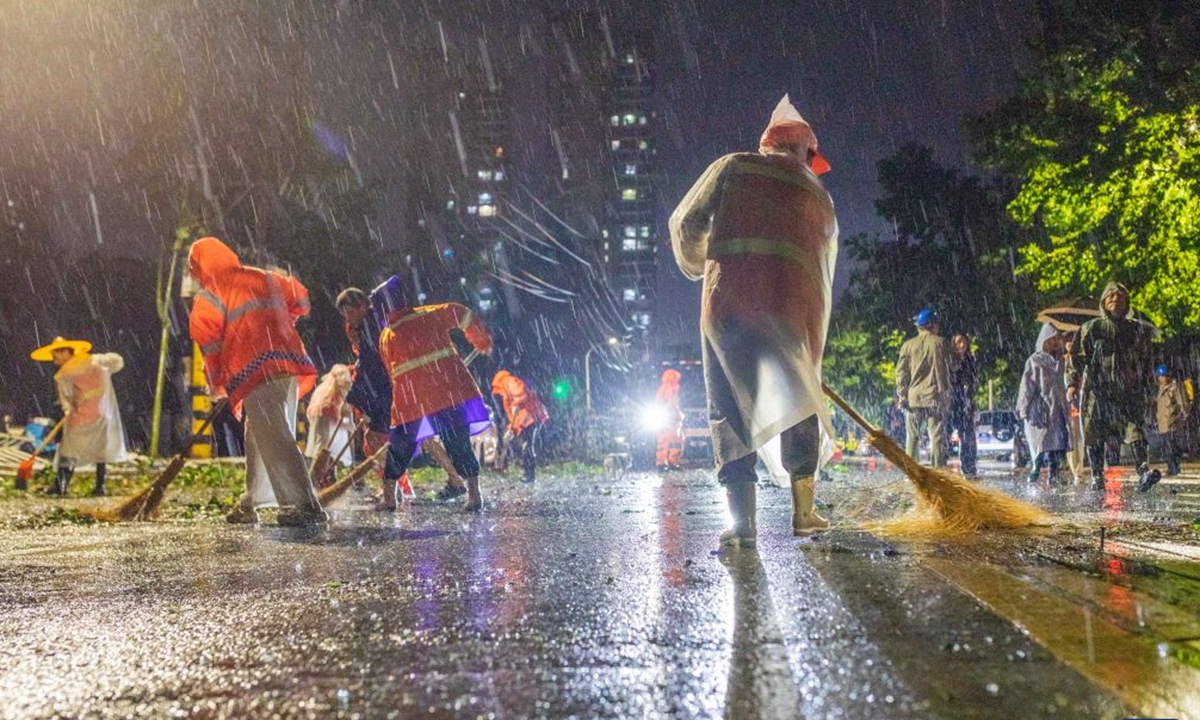
Sanitation workers clear a street in Erzhou city, Central China's Hubei Province, on July 6, 2026. Photo: Xinhua News Agency
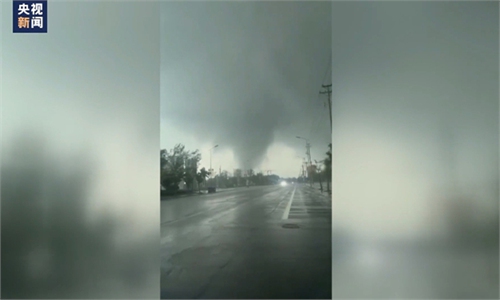
As widespread heavy rainfall and severe convective weather, including rare tornadoes and powerful storms, swept across eastern parts of Central China's Hubei Province on Monday night, Gao Qi, chief forecaster at the Hubei Meteorological Center, and Ren Guoyu, meteorological expert and a professor at China University of Geosciences (Wuhan), explained the meteorological mechanisms behind the severe weather, why the tornadoes were unusually rare in Hubei, and what weather conditions are expected in the coming days.
According to Gao, the severe weather primarily affected eastern Hubei on Monday and Tuesday, bringing widespread torrential rain, thunderstorms, destructive winds and, in some areas, rare tornadoes, according to a report from the province's official newspaper Hubei Daily on Tuesday.
The hardest-hit areas included Tongcheng, Chongyang, Jiayu, Chibi, Macheng, Hong'an, Dawu and Guangshui, where multiple townships recorded torrential rainfall. The heaviest precipitation reached 151.8 millimeters in Maishi Township of Tongcheng, while the strongest hourly rainfall reached 60.1 mm in Shenshan Township of Chibi. Thunderstorms accompanied by gale-force winds also swept across 38 county-level regions, with gusts reaching force 13 on the Chinese wind scale in parts of Ezhou and Xianning. Tornadoes were also reported in several townships.
Explaining why tornadoes developed in Hubei, Gao said the province is situated in an environment rich in heat and moisture on Monday. The remnants of Typhoon Maysak carried abundant tropical moisture deep inland overnight, while a cold vortex moving southward from the northeast direction brought cooler air into the region. The collision of the two air masses created exceptionally unstable atmospheric conditions.
At the same time, sinking dry, cold air interacted with rapidly rising warm, humid air, producing intense vertical wind shear and rotating updrafts that allowed powerful convective clouds to develop rapidly, ultimately triggering tornadoes, Gao explained.
While Gao explained the immediate meteorological conditions that triggered the tornadoes, Ren told the Global Times on Tuesday that the broader impact of Typhoon Maysak had exceeded expectations. Ren noted that after making landfall in South China's Hainan, the typhoon moved across the Beibu Gulf before making another landfall in northern Vietnam and South China's Guangxi Zhuang Autonomous Region, where it brought rare torrential rainfall and severe flooding. It then continued moving northeastward, with its remnants still capable of generating tornadoes before eventually triggering destructive weather in places including Huanggang, Hubei Province.
Ren said the unusually abundant supply of moisture helped explain why the typhoon's remnants retained their strength after traveling such a long distance inland. Moisture transported from the South China Sea, the Beibu Gulf and the Bay of Bengal helped sustain the circulation.
Tornadoes are one of the most destructive forms of severe convective weather and often occur alongside multiple hazardous weather phenomena, including short-duration torrential rainfall, damaging thunderstorms and hail, Gao said, adding that this is also the reason why severe convective weather warnings are designed to cover all of these threats rather than tornadoes alone.
Gao urged the public to closely monitor official weather alerts. Once a red alert for severe convective weather is issued, people should immediately seek shelter inside sturdy buildings. Those caught outdoors should lower their center of gravity, hold on to fixed objects whenever possible and protect their heads and necks. Since tornadoes are often accompanied by intense downpours, residents should also remain alert to rapidly rising water levels in nearby rivers and streams.
Gao said the strongest storm cells were moving across Huanggang on Tuesday morning before gradually weakening as they shifted eastward. While this round of severe convective weather was expected to subside by Tuesday afternoon, Hubei will continue to have abundant moisture and atmospheric instability in the coming days, meaning localized short-duration downpours and thunderstorm gales remain possible.
"It is extremely rare for relatively strong tornadoes to occur in places such as Huanggang in Hubei Province," Ren told the Global Times. He also said the tornadoes that struck Hubei were closely associated with Typhoon Maysak, whose remnants retained unusual strength after moving far inland.
Ren said that Hubei is neither one of China's most tornado-prone regions nor a traditional hotspot for such events. Tornadoes in China occur most frequently in the Yangtze River Delta and its surrounding areas, the Pearl River Delta, and the northern and central parts of the Northeast China Plain, while the Jianghan Plain experiences them relatively infrequently.
According to a separate report by Hubei Daily on Tuesday, the last tornado recorded in Hubei occurred on May 14, 2021, in Caidian district of Wuhan.
Looking beyond this single event, Ren said the drivers behind extreme weather are highly complex, with global warming likely being only one contributing factor. He added that some studies have also linked the increasing frequency of extreme weather to changes in aerosol concentrations. As air quality has steadily improved over the past decade, more solar radiation has reached the Earth's surface, which may also have contributed to the occurrence of more hazardous weather events.
According to updates from the Xinhua News Agency on Tuesday, 11 people were killed and one is still missing after thunderstorms and gales brought by severe convective weather hit Hubei on Monday night, citing provincial authorities.
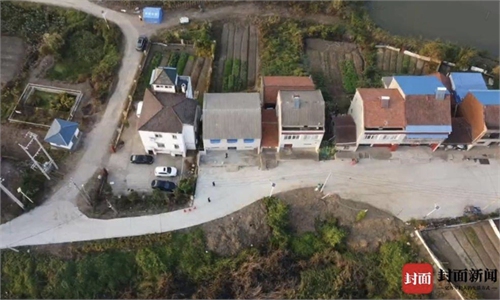
The extreme weather has torn down 22 buildings and damaged another 4,855 in the area, injuring 331 local residents, Xinhua reported, noting that 246 people have been relocated to safety.
RELATED ARTICLES