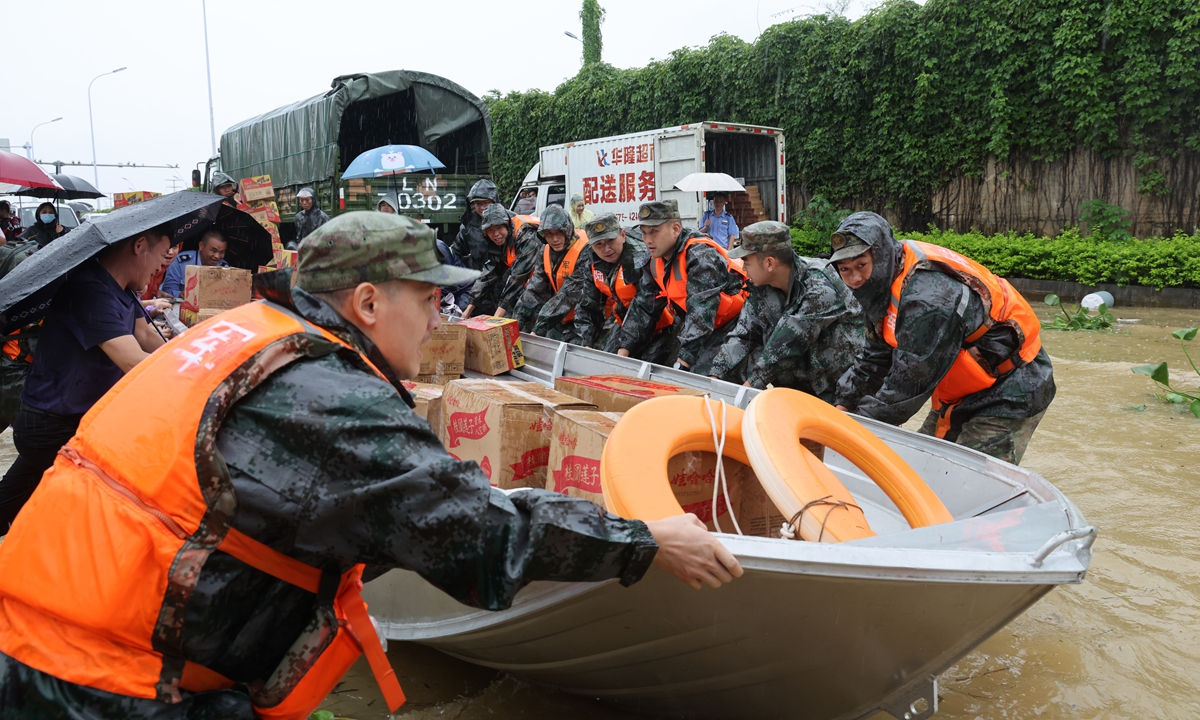
Military units, fire rescue personnel and volunteers work together to deliver emergency supplies to schools cut off by floods in Guigang, Guangxi Zhuang Autonomous Region, on July 7, 2026. Photo: IC
As extreme weather battered several parts of China, including a landslide in Northwest China's Gansu Province that killed 21 people, flooding in South China's Guangxi Zhuang Autonomous Region that left six dead, and severe thunderstorms that left 11 dead in Hubei Province, central and local authorities, together with volunteer rescue organizations, mounted a large-scale emergency response to carry out search, rescue and disaster relief operations.
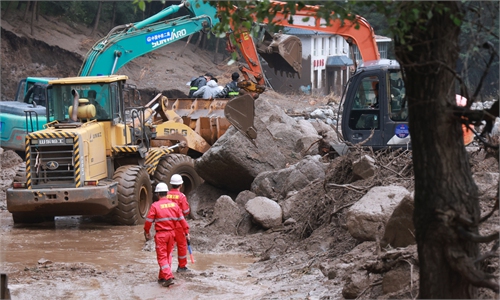
The landslide in Dangchang county, Northwest China's Gansu Province, killed 21 people, local authorities said on Wednesday. The disaster occurred at around 6:56 am on Tuesday in Renzang village, Nanhe township, trapping 33 people. Emergency, firefighting and public security teams were swiftly mobilized to carry out rescue efforts after the incident, according to the Xinhua News Agency.
Longnan municipal government held a press conference on Wednesday morning to brief the public on the latest developments. Search and rescue operations have been completed, officials said. At the event, government officials and journalists stood for a moment of silence in memory of those who lost their lives in the disaster.
As of 12:20 am on Tuesday, severe thunderstorms and strong winds in Hubei Province had affected 14,600 people, leaving 11 dead, one person missing, and 331 injured. Rescue and disaster relief efforts are proceeding in an orderly manner, while authorities continue to verify the full extent of the damage, the Xinhua News Agency reported, citing local authorities.
Following the disaster, authorities in Huanggang quickly mobilized nearly 3,000 rescue personnel from emergency response departments, police, firefighters, urban management authorities, the armed police and stationed military units to carry out overnight rescue and relief operations, according to the China News Service.
Luo Jie, director of the medical affairs department at Huanggang Central Hospital, said the hospital had treated 178 injured people as of 8 am on July 7. Most injuries involved skin abrasions, lacerations and soft tissue contusions. After the injured were transported to the hospital, medical staff immediately opened a fast-track treatment channel, carried out wound cleaning and suturing, conducted necessary examinations and provided targeted supportive care.
On Wednesday, the Ministry of Finance and the Ministry of Emergency Management urgently allocated 50 million yuan ($7 million) in central natural disaster relief funds to support emergency rescue and disaster response efforts in Hubei and Gansu, with the aim of minimizing casualties and preventing secondary disasters, China Central Television reported.
Of the funds, 20 million yuan was allocated to Hubei to support the relocation and resettlement of affected residents, as well as the restoration and reconstruction of damaged homes. Another 30 million yuan was allocated to Gansu to support search and rescue operations, emergency geological disaster response, and the investigation of potential risks from secondary disasters.
In South China's Guangxi Zhuang Autonomous Region, where torrential rains have triggered floods which have killed six people and affected 375,000 people so far, rescue work is continuing.
More than 1,700 engineering and rescue vehicles, as well as over 5,700 vessels and lifeboats, have been deployed. In addition, 40 civil rescue teams, including those from the Red Cross, Blue Shield and Blue Sky rescue organizations, involving more than 300 personnel, have joined the operations, the official said.
A resident surnamed Zhu of Guigang, Guangxi, told the Global Times on Wednesday that some elderly people in her community remained trapped as of Wednesday, with power outages and water shortages still affecting the area. She said some residents had organized themselves to help rescue elderly people who were unable to leave their homes.
Pan Zhenguo, a member of the Blue Sky Rescue Team currently involved in relief efforts in Guigang, Guangxi, told the Global Times on Wednesday that the most challenging phase of the rescue operation had passed, with rescue operations now focused primarily on large-scale evacuations and the relocation of affected residents. Water levels in previously inundated villages have receded significantly, though some areas remain flooded.
Pan also said that, since Tuesday, they had begun receiving disaster relief supplies donated by people from all sectors of society. Since Wednesday, conditions for delivering supplies to affected villages have gradually improved.
He noted that some technology companies had also provided drones to support rescue operations, which have significantly improved the efficiency of disaster response efforts.
China has allocated more than 36,000 additional disaster relief items to Guangxi, the Ministry of Emergency Management said Tuesday, per Xinhua.
The items, including woven bags and rubber boats, were jointly allocated by the office of the State Flood Control and Drought Relief Headquarters and the National Food and Strategic Reserves Administration.
The Ministry of Commerce guided pharmaceutical distribution enterprises to carry out self-resumption of production and emergency supply guarantee to fully meet the demand for medical supplies in disaster-hit areas, according to Xinhua.
Headquarters of pharmaceutical retail enterprises dispatched staff to disaster-hit areas to assist with store silt clearance and disinfection, stocktaking of supplies, emergency distribution and other tasks. Some stores that were flooded have reopened.
Against the backdrop of global climate change, compounded by ocean-atmosphere anomalies associated with El Niño, extreme weather events are expected to become more frequent. In response, societies will need to further strengthen disaster risk governance and resilience, Bao Cunkuan, a professor in the Department of Environmental Sciences and Engineering at Fudan University, told the Global Times.
In coping with disasters, China has established emergency response mechanisms for both single disasters and compound disasters, while its coordinated, top-down governance system enables the rapid mobilization of resources, enhancing emergency response, self- and mutual-aid efforts, and post-disaster recovery, Bao said.
RELATED ARTICLES