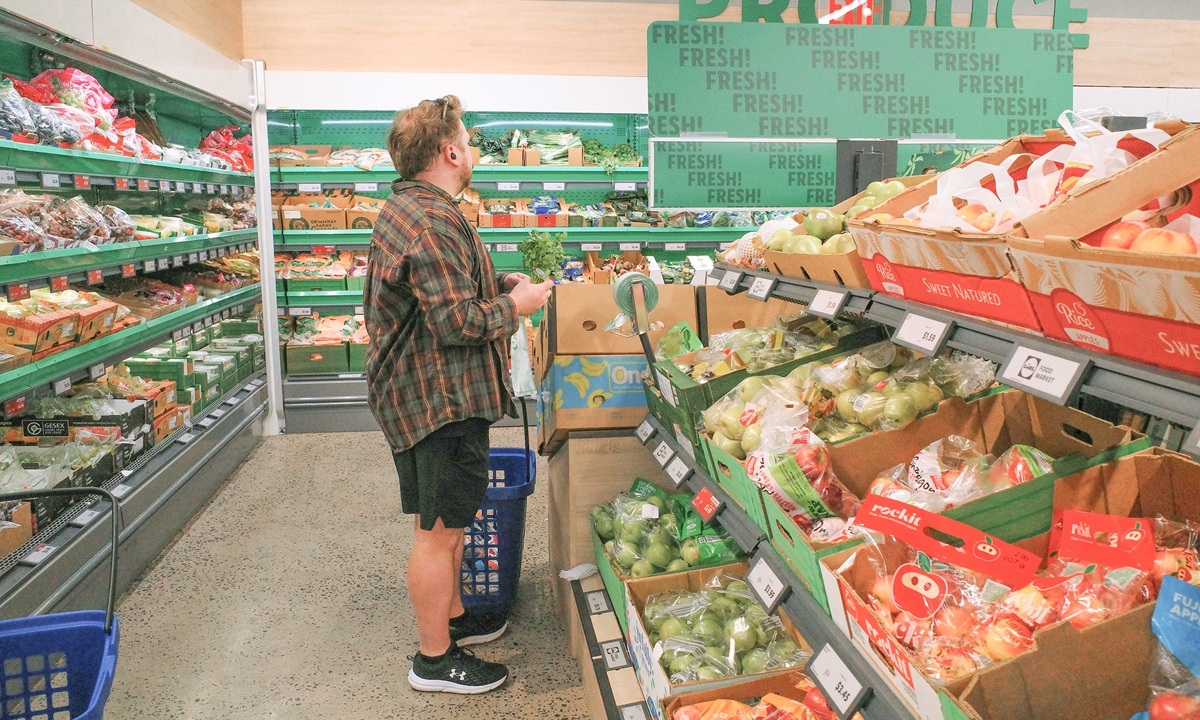
A customer shops at a supermarket in the Crown Heights neighborhood of the Brooklyn borough in New York City, the US on May 1, 2026. Photo: VCG
The US' real goods deficit widened sharply by 18.7 percent to $100 billion in May, the second-largest since the US administration's reciprocal tariffs were imposed in April 2025, according to official data. Chinese experts said the data offered fresh proof that Washington's punitive tariff policies have failed to deliver its intended results.
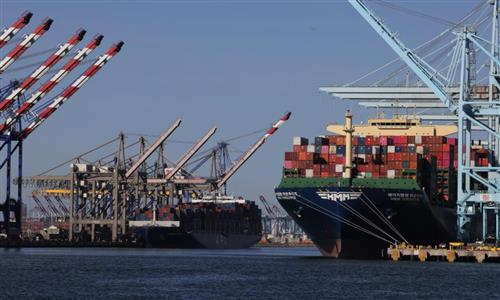
The total goods and services deficit of the US surged 42.2 percent from a revised $54.6 billion in April, as May exports fell $10.5 billion to $317.7 billion while imports climbed $12.5 billion to $395.3 billion, according to data released by the US Census Bureau and the US Bureau of Economic Analysis (BEA). A Bloomberg report said that the trade deficit reached the most in more than a year.
Notably, the US has seen widening deficit with its major trading partners. The US' goods deficit with Mexico jumped $5.3 billion to $20.1 billion in May, while deficits with Vietnam, China and Canada all expanded, BEA data showed. Bloomberg reported that the gaps with Mexico and Vietnam widened to a record in May.
This came after the US launched sweeping tariffs on virtually all US trading partners in April 2025, a campaign explicitly aimed at shrinking the trade gap and reshoring manufacturing.
"The broad trend is clear: the tariff policy has not achieved its intended effect," He Weiwen, a senior fellow at the Center for China and Globalization, told the Global Times on Wednesday. "Tariffs have failed to meaningfully reduce the US trade deficit, and they have not dented global trade either, as world goods exports still grew about 7 percent in 2025."
The expert further pointed out that tariffs have added remarkable inflation to the US, while recent US jobs data has been weak and manufacturing output has shown no meaningful improvement. "In terms of boosting manufacturing, jobs and narrowing the deficit, the core stated goals, the policy should be judged a failure," He said.
The simultaneous widening of deficits with Mexico, Canada, China and Vietnam suggests tariffs have not changed the fundamental structure of US trade, the expert said, adding that roughly 10 percent of US imports are intermediate goods that simply cannot be substituted domestically. "No matter which supplier they come from, that cost will ultimately be paid."
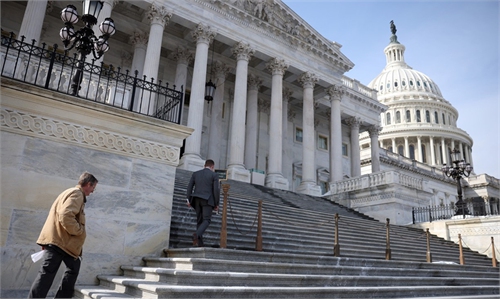
While many of the US' tariffs were struck down by the Supreme Court earlier this year, the administration is seeking other routes to levy imports, the Bloomberg report said.
On June 2, the Office of the US Trade Representative (USTR) proposed additional duties of 10 percent or 12.5 percent on imports from 60 economies, which together account for over 90 percent of US imports, under Section 301 investigations citing those economies' alleged failure to ban goods made with "forced labor," according to the USTR's Federal Register notice. Public hearings on the proposal began on Tuesday in Washington, the same day the trade data was released.
The proposal has met resistance in the public comment process. Numerous enterprises and industry groups from the US and other economies have submitted opposition to the proposed US tariffs on the pretext of so-called "forced labor" trade practices, voicing their concerns over supply chain disruptions and rising costs in public comments submitted to the USTR. As of Monday, the deadline for written public comments, there were 1,512 comments submitted, according to the USTR website.
"Washington knows unilateral executive power has limits after the Supreme Court ruling, so it is now stretching statutes that already have legislative backing like Section 301, Section 232 and Section 122, to reassemble essentially the same tariff levels under different names," He said. "Each new mechanism is just another vehicle for the same tariff policy. The direction is certain: tariffs will not come down."
Adding to the uncertainty, the US recently decided against renewing its trade deal with Canada and Mexico, opting for annual reviews instead in a shift Bloomberg said could fuel additional uncertainty for firms in the months to come.
RELATED ARTICLES