China’s high AI penetration offers a new perspective on global industrial cooperation
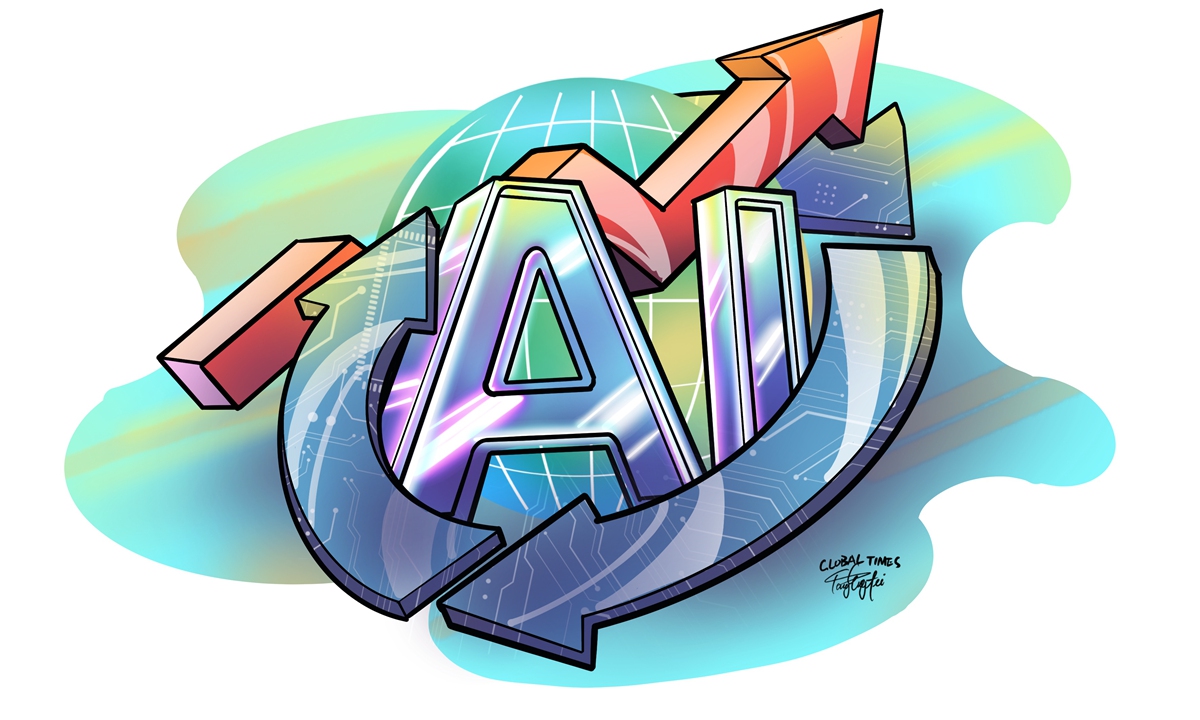
Illustration: Tang Tengfei/GT
At a recent press conference, an official from China's National Development and Reform Commission (NDRC) cited a figure that illustrates the scale of artificial intelligence (AI) adoption in China: the penetration rate of AI in the country's key industries has exceeded 80 percent, according to CCTV News. Behind the statistic is a broader trend - AI is increasingly being embedded in industrial and business processes, with widespread adoption already established across many sectors in China.Recent discussions around AI have often centered on frontier breakthroughs, from large models to breakthroughs in cutting-edge technologies. These advances are expanding the capabilities of the technology and pushing the boundaries of what AI can achieve. Yet a less headline-grabbing aspect of AI development is equally important: how AI is applied across a broader range of industries. Integrating AI into traditional sectors could help businesses improve efficiency, raise productivity and generate broader economic benefits.
For many economies, particularly developing countries, one important question in the AI era is how to bring AI into traditional industries. This applies not only to manufacturing, but also to services, where AI could help improve efficiency. In many cases, adopting AI does not require the most advanced technologies available. Rather, it depends on solutions that are affordable, practical and suited to local needs, allowing a broader range of industries to benefit from the opportunities created by AI.
In this area, momentum is building not only in China but also in many other economies. Although approaches vary across markets, companies share a common focus: finding practical ways to apply AI in manufacturing, services and other sectors. Such efforts could create new opportunities for cross-border cooperation, as businesses develop solutions suited to different industrial needs and market conditions.
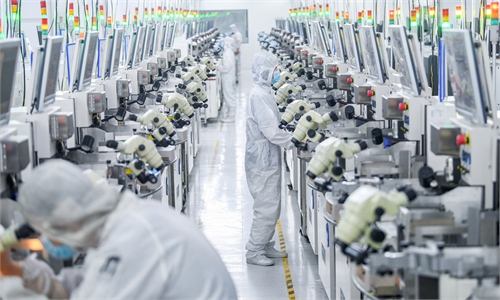
China's AI penetration rate of more than 80 percent in key industries offers a glimpse of how AI is becoming embedded in the wider economy. How has such adoption been achieved? It reflects a combination of factors, from the expansion of digital infrastructure and the development of industrial applications to the efforts of businesses to integrate AI into production processes. This is reflected, for example, in the expansion of intelligent factories across China. According to media reports, by 2025, China has built over 35,000 basic-level, more than 8,200 advanced-level, over 500 excellence-level and 15 flagship intelligent factories nationwide.
A more specific example comes from the dental industry. A company in Southwest China's Guizhou Province told local media that doctors previously had to wait at least a week for dental prostheses, whereas today digital data collected in the morning can be used to produce them by the afternoon. In some cases, patients can receive their prostheses the same day or the following day. Behind this improvement are digital manufacturing technologies, including intelligent 3D printing, which have helped shorten production cycles and improve the efficiency of traditional industries.
Looking beyond individual applications, the broader 3D printing sector and its role in global industrial supply chains offer a wider perspective. Data from the General Administration of Customs shows that from January to April, China exported 2.46 million 3D printers worth 6.106 billion yuan ($898 million), up 100.3 percent and 110.4 percent year-on-year, respectively. During the same period, domestic output of 3D printing equipment rose 50.9 percent from a year earlier, ranking among the fastest-growing segments of advanced manufacturing.
This raises an important question: to what extent can China's experience of integrating AI into traditional industries be adapted by other economies seeking to expand the use of AI in their own industries? The development of 3D printing offers a useful perspective from which to explore this question, particularly how exports of high-tech products can contribute to technological diffusion.
Some international narratives that focus narrowly on China's trade surplus or frame its exports as a "China shock 2.0" overlook a broader reality. High-tech exports can facilitate the diffusion of technologies, equipment and industrial capabilities across markets, creating opportunities for businesses and supporting industrial development.
China's AI penetration rate of more than 80 percent in key industries is a figure that merits attention. As economies around the world seek to expand AI adoption, there is room for further cooperation - including a more practical understanding of China's high-tech exports and the role they can play in supporting industrial development.
The author is a reporter with the Global Times. bizopinion@globaltimes.com.cn
RELATED ARTICLES