Lithium battery, radar pioneers win China's top science award
Xi calls for advancing Chinese modernization through sci-tech innovation


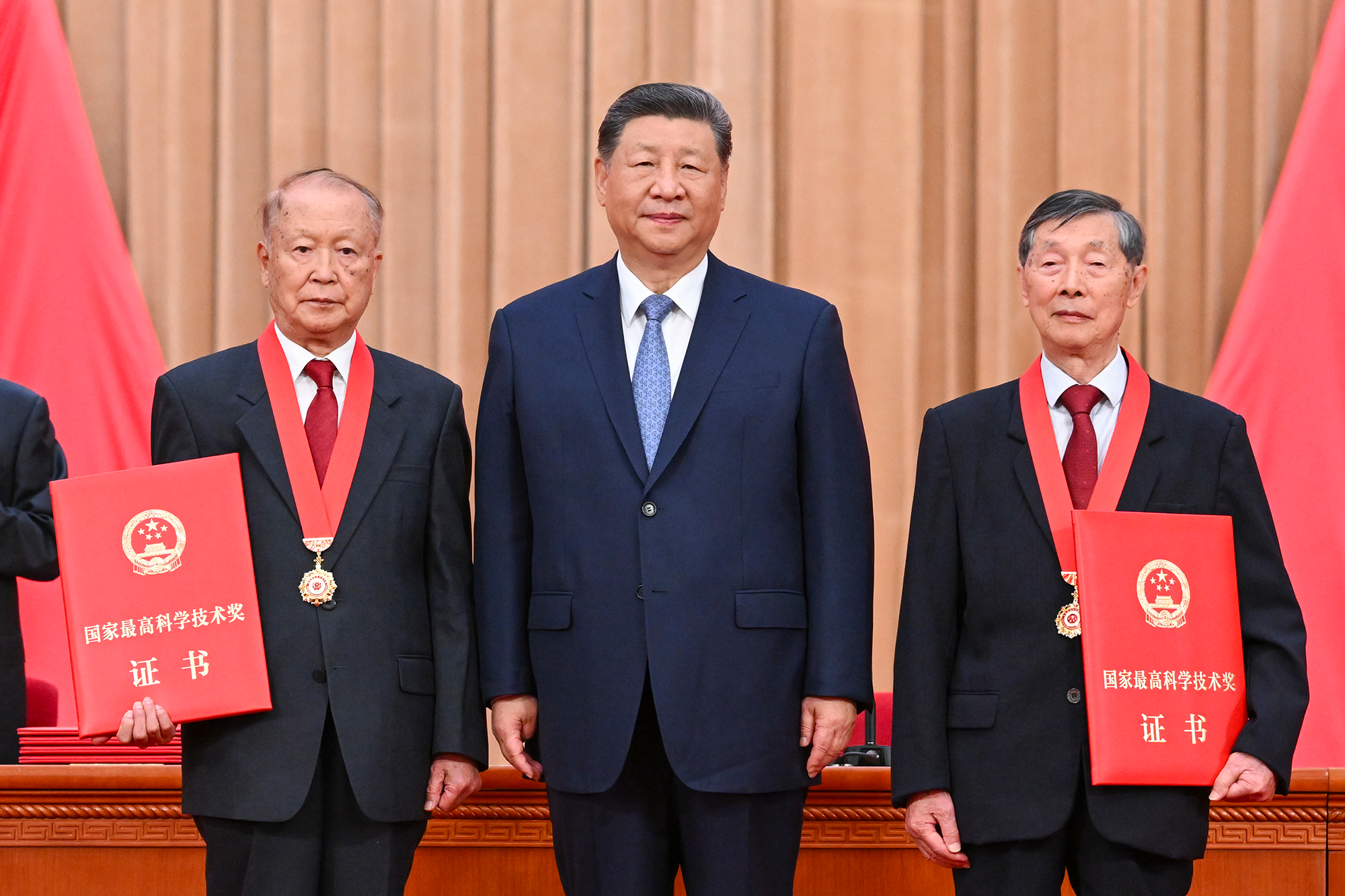
Chinese President Xi Jinping stands with radar technology expert Ben De (left) and founder of China's lithium battery sector Chen Liquan (right) as the two academicians are presented with China's top sci-tech award for the year 2025 in Beijing on July 8, 2026. Photo: Xinhua
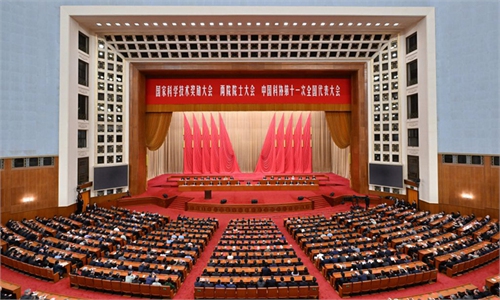
Chinese President Xi Jinping presented the country's top sci-tech award and delivered an important speech at a meeting in Beijing on Wednesday, the Xinhua News Agency reported.
The meeting brings together the national science and technology award conference, the general assemblies of the members of the Chinese Academy of Sciences and the Chinese Academy of Engineering, and the 11th national congress of the China Association for Science and Technology.
Wednesday's meeting honored 258 projects and 11 scientific and technological experts. Among them, 51 projects received the State Natural Science Award, 58 projects were awarded the State Technological Invention Award, and 149 projects received the State Scientific and Technological Progress Award.
Founder of China's lithium battery sector Chen Liquan and radar technology expert Ben De were presented with China's top sci-tech award for the year 2025 on Wednesday.
Besides presenting China's top sci-tech award to Chen and Ben and shaking hands with them, Xi, along with other Party and state leaders and two top-award winners, presented certificates to representatives of recipients of other awards.
Prior to the ceremony, Xi and other leaders met warmly with all representatives of winners of the State Scientific and Technological Progress Award and posed for group photos with them, per Xinhua.
Innovation drive
In his speech on Wednesday, Xi called for accelerated efforts to achieve high-level self-reliance and strength in science and technology, and leverage sci-tech innovation to underpin and drive Chinese modernization, Xinhua reported.
He said the 15th Five-Year Plan period (2026-30) is a critical phase for tackling tough challenges in building up the country's strength in science and technology.
"We must seize the historic opportunity, rise to the challenges of the times, accelerate efforts to achieve high-level self-reliance and strength in science and technology, and make steady progress toward the 2035 goal of becoming a leading country in science and technology," he said, per Xinhua.
"The achievements of the two academicians who received this year's top honor in science and technology represent core accomplishments in both safeguarding national security and advancing scientific innovation, while also driving China's green transition and strengthening its national defense capabilities," Chinese engineering expert Song Zhongping told the Global Times on Wednesday.
Their work serves as a benchmark for meeting the country's strategic needs and enhancing its capacity for independent innovation, Song said.
Chen, born in 1940, is a researcher at the Institute of Physics under the Chinese Academy of Sciences, and an academician of the Chinese Academy of Engineering (CAE). He is widely recognized as the founder, pioneer and leader of China's lithium battery sector.
Chen built China's first solid-state ionics laboratory from scratch. His team produced China's first lithium-ion battery and established the country's first pilot production line using entirely homegrown technology, equipment and raw materials, according to Xinhua.
He pioneered and realized the in-situ solidification battery technology approach, advancing sodium-ion batteries from fundamental research to commercial-scale deployment, and cementing China's strategic lead in next-generation battery technologies.
Ben, born in 1938, is a researcher at the China Electronics Technology Group Corporation and also a CAE academician. He is acclaimed as the founder of China's airborne pulse Doppler radar technology, a major pioneer of phased array radar technology, and a forerunner of space-based surveillance radar technology.
Ben successfully developed China's first airborne pulse Doppler fire-control radar and its first large-scale long-range phased array early-warning radar. The two fundamental modern radar technologies he pioneered, pulse Doppler and phased array, have guided the development of China's land, sea, air and space early-warning and detection systems.
Song noted that this year's list of awardees shows a clear emphasis on original homegrown innovation, particularly in technologies related to national security. As a result, the awards are no longer focused primarily on practical applications, as they were in the past, but place greater weight on breakthroughs in fundamental science.
In particular, priority has been given to overcoming key technological bottlenecks, such as semiconductors, chips, new materials, and other areas that remain among China's greatest technological challenges. Many of this year's award-winning achievements have filled critical domestic gaps and addressed long-standing weaknesses in strategically important industries, Song said.
"The great honor shines on every one who works in the battery industry," said Yang Quanhong, a professor at Tianjin University and an expert in battery technologies, who has worked closely with Academician Chen.
"In the late 1970s, starting from scratch and keeping pace with the world, Chen pioneered solid‑state ionics and secondary battery research in China with his keen scientific acumen. He then drove the birth and rapid growth of China's lithium battery industry through technological innovation - an industry that has now become the undisputed global leader," Yang told the Global Times.
"Today, the all‑encompassing supporting role of lithium batteries and new battery technologies for future industries in China is becoming ever more critical… As peers in the field, we are truly inspired," Yang noted.
Promoting humankind progress
In addition to the two recipients of the top award, nine experts were conferred the China International Science and Technology Cooperation Award on Wednesday.
China is accelerating its transformation from a participant and contributor to a pioneer and leader in global science and technology, making it one of the fastest-rising economies in innovation, Xi said, per Xinhua.
He called on Chinese scientists to be deeply involved in the global governance in science and technology, offer Chinese wisdom, and make greater efforts to promote the building of a community with a shared future for humanity.
As early as 2018, at China's top sci-tech gathering, the Chinese leader has put forward similar propositions. He called on Chinese scientists to offer Chinese wisdom and make greater efforts to promote the building of a community with a shared future for humanity. "While achieving its own development, China will bring benefits to more countries and their peoples and promote balanced development around the globe," he said in 2018, per Xinhua.
So far, China has shared the BeiDou Navigation Satellite System, the anti-malarial drug artemisinin and hybrid rice with the world to address common challenges. China has also opened 10 major pieces of scientific research infrastructure, including the FAST telescope and the deep-sea manned submersible Fendouzhe, to global scientists and engineers.
Wang Yiwei, a professor at the Renmin University of China, told the Global Times that this year's award-winning projects cover not only disciplines serving major national strategic priorities, including physics, chemistry, biology, advanced materials and mineral exploration, but also key fields such as food security, disaster prevention and mitigation, low-carbon development, and landmark national sci-tech initiatives represented by FAST.
"These achievements demonstrate that China's scientific and technological agenda is not only focused on meeting its own development needs but is also aimed at contributing to global progress," Wang said, "The benefits extend beyond China to other countries and, ultimately, to humanity as a whole, underscoring the broader significance of science and technology for the common good and international cooperation."
Therefore, these awards recognize not only scientific and technological excellence itself, but also contributions that advance the progress of humankind, Wang said.
RELATED ARTICLES