China rolls out labor plan to cap urban jobless rate at 5.5% or lower in coming five years
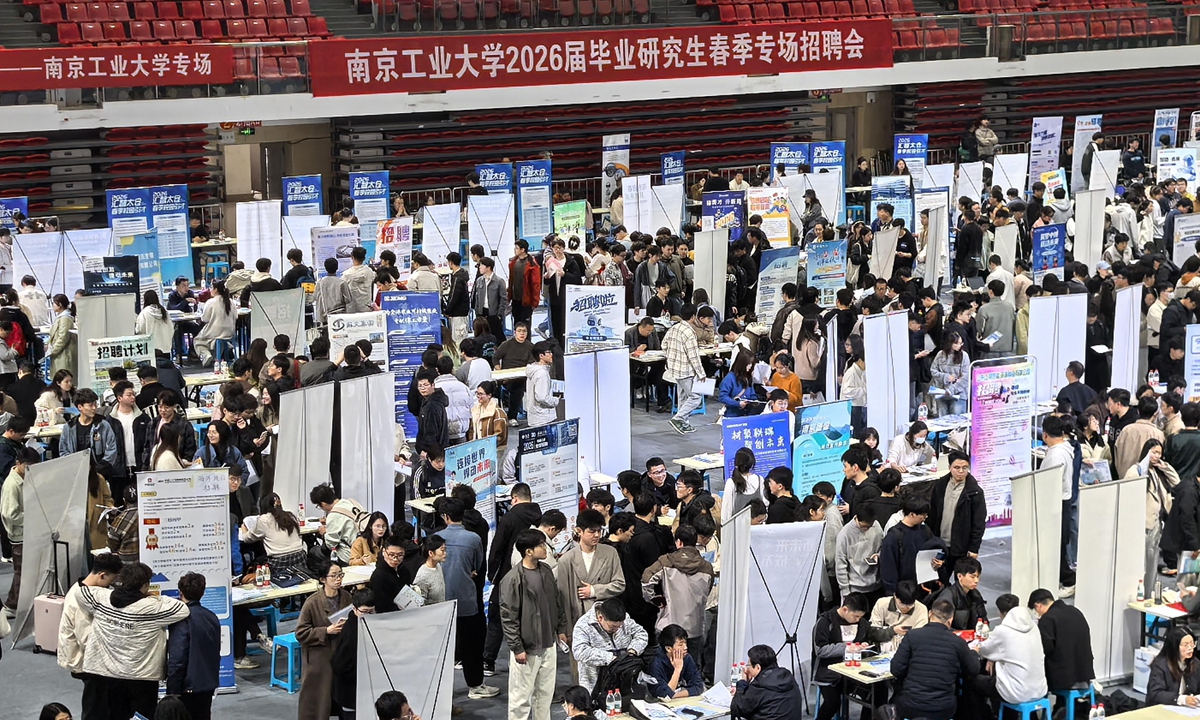
Graduating students attend a job fair at Nanjing Tech University in Nanjing, East China's Jiangsu Province, on March 25, 2026. The university held the special spring job fair to boost high-quality employment for its 2026 graduates. More than 220 enterprises provided over 1,000 job vacancies, drawing a large number of postgraduate students. Photo: VCG
China's Ministry of Human Resources and Social Security released a development plan on Thursday for human resources development during the 15th Five-Year Plan period (2026-30), setting seven major goals and 18 quantitative indicators, including a target that the number of newly created urban jobs should reach a considerable size during the period.
On targets for reemployment, the plan sets a target of helping 25 million unemployed urban workers find new jobs and keeping the urban surveyed unemployment rate within 5.5 percent over the next five years.
And, urban social security coverage rate should expand, with the plan calling for the gross participation rate of the basic retirement insurance to stay above 95 percent.
The number of people covered by unemployment insurance and work-related injury insurance should reach 255 million and 345 million, respectively, while the size of enterprises' annuity funds should exceed 9 trillion yuan ($1.32 trillion) in total. Meanwhile, the coverage rate of the population holding electronic social security cards is targeted to reach 90 percent by the end of 2030.
The plan projects that 14 million people will obtain professional and technical qualification certificates during the coming five years, with 35,000 postdoctoral researchers to be recruited annually in the country.
Regarding labor relations, targets set for the end of the period, or 2030, include a 65-percent success rate for labor and personnel dispute mediation, a 93-percent case closure rate for labor and personnel dispute arbitration, and a 97-percent closure rate for labor security supervision complaints.
Beyond the quantitative targets, the plan lays out major tasks in eight fields, including promoting high-quality employment, carrying out large-scale vocational skills training, improving the social security system, optimizing talent development mechanism, refining the wage and income distribution system, building harmonious labor relations, and comprehensively enhancing public services.
Global Times
RELATED ARTICLES