Namibian president's China visit highlights industrial, green co-op
By Published: Jul 09, 2026 11:04 PM

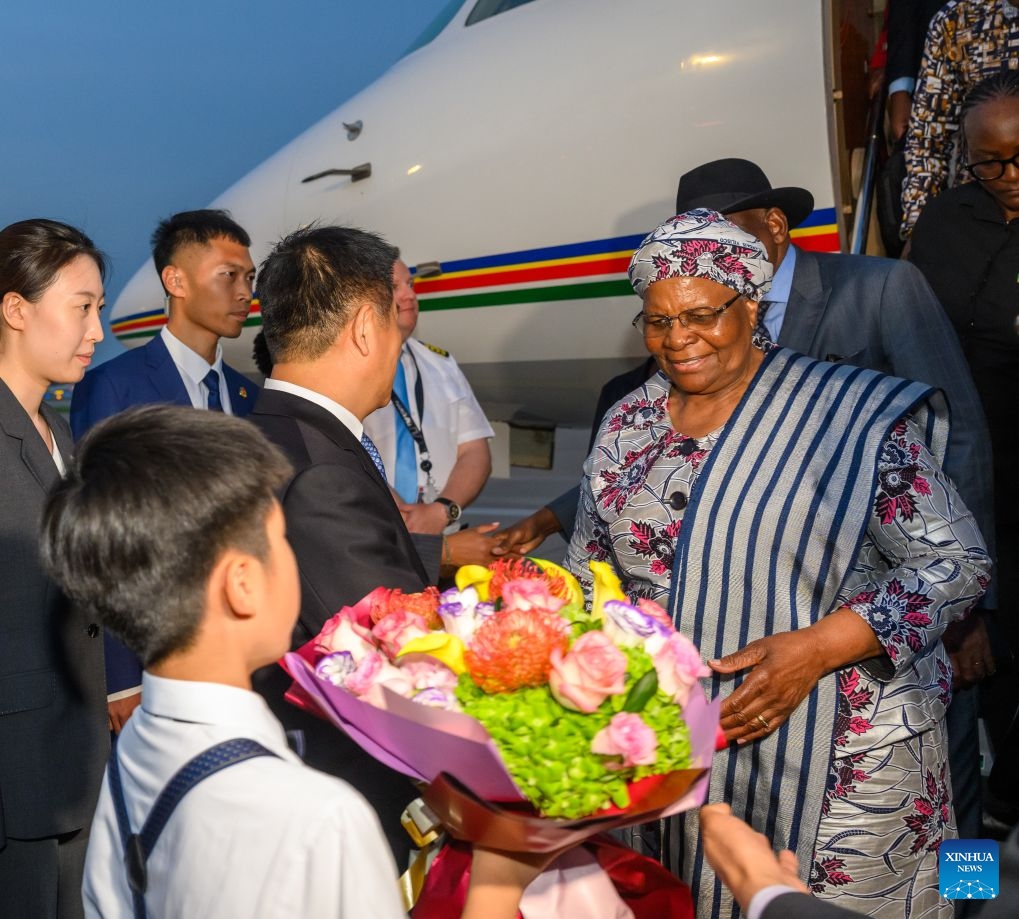
President Netumbo Nandi-Ndaitwah of the Republic of Namibia arrives in Beijing, capital of China, July 8, 2026. Namibian President Netumbo Nandi-Ndaitwah arrived here on Wednesday during a state visit to China from July 5 to 11. (Xinhua/Jin Liangkuai)
Following a packed schedule of visits in South China's Guangdong Province and Southwest China's Sichuan Province, Namibian President Netumbo Nandi-Ndaitwah arrived in Beijing on Wednesday to continue a state visit to China, the Xinhua News Agency reported.
Some experts on China-Africa relations said on Thursday that the visits demonstrate that China-Namibia cooperation, and even China-Africa cooperation more broadly, has moved beyond the traditional one-way model centered on resources and markets. It is now expanding into a wider range of areas, including industrialization, green development, and the improvement of people's livelihoods, they noted.
Nandi-Ndaitwah visited Chengdu in Sichuan on Wednesday. Impressed by the city's modern agricultural achievements, she said that she would return and that Namibia plans to purchase seeds and equipment, according to a video by Sichuan Daily.
In Sichuan, she also met local officials and representatives from Chinese companies including Sichuan Investment Group, China National Chemical Engineering, and Sichuan Development Holding Co, aiming to deepen cooperation between the two sides, according to Namibian Presidency, the official Facebook account of Presidency of the Republic of Namibia.
This is Nandi-Ndaitwah's first trip to China since assuming office, according to the website of the government of Guangzhou, where she started her week-long state visit in China on Sunday.
Reflecting on the strong comprehensive strategic cooperative partnership between the two nations, the visit highlights a shared commitment to mutual respect, solidarity and sustainable development, which is set to deepen economic cooperation and advance joint initiatives that bring practical advantages to people in both countries, according to Namibian Presidency on Monday.
In Sichuan, the Namibian president also visited the Sichuan Academy of Agricultural Sciences, learning more from agricultural-related technologies, according to the official statement.
Driven by the benefits of the zero-tariff initiative and the complementary market demand on both sides, China-Namibia agricultural cooperation has continued to expand, opening broader access to international markets for Namibian agricultural products. At the same time, China has continued to support Namibia in improving its agricultural productivity, the Xinhua News Agency reported on Saturday.
In Guangdong, the Namibian president visited the China General Nuclear (CGN) Power Cooperation and Chinese tech company Huawei where she also watched a welcome dance performed by robots, according to videos and releases on Namibian Presidency.
From the itinerary, the visit of the Namibian president is a highly pragmatic one with a clearly defined agenda for industrial cooperation, some Chinese experts said.
"From lithium battery manufacturing and skills transfer in Guangdong, to seed and agricultural machinery procurement in Sichuan, each stop featured concrete industrial cooperation objectives. The visit underscored Namibia's development-oriented approach and sent a strong diplomatic signal of solidarity among Global South countries in pursuing shared development and greater self-reliance," Liu Qinghai, research fellow at the Institute of African Studies, Zhejiang Normal University, told the Global Times on Thursday.
According to GDToday, choosing Guangdong as the first stop for Nandi-Ndaitwah's visit in China is no coincidence: the province stands as China's most economically dynamic region and a vital gateway for China-African engagement. Guangdong has forged increasingly close ties with Namibia in recent years through robust trade, high-level policy dialogue, and practical projects that deliver water, jobs, food, and hope.
"Under the framework of the Belt and Road Initiative and the Forum on China-Africa Cooperation (FOCAC), Guangdong will strengthen the alignment of its development strategies with those of Namibia, make full use of policy dividends such as China's zero-tariff treatment for Namibia, and leverage Guangdong's comparative strengths to expand cooperation in mineral resource development, the integrated utilization of new energy, infrastructure construction, and agricultural product processing, Huang Kunming, secretary of the CPC Guangdong Provincial Committee, told the Namibian president on Monday, according to Shenzhen Daily.
Guangdong will also support the entry of high-quality and competitive products from both sides into each other's markets, encourage more Guangdong enterprises to invest and do business in Namibia, promote the upgrading of bilateral economic and trade cooperation, and better support Namibia's poverty reduction efforts as well as its national prosperity and stability, Huang said.
Against the backdrop of the successful 2024 Beijing Summit of the FOCAC, Namibia's visit demonstrated a pathway for deepening bilateral relations under the FOCAC framework: moving from political mutual trust to industrial chain collaboration, and from resource trade to cooperation in value-added processing and manufacturing, Liu said.
Namibia possesses abundant strategic mineral resources, but its exports are still largely dominated by raw minerals or primary products, leaving only limited added value within the country. In the future, China and Namibia could expand cooperation in areas such as mineral processing, smelting, primary material processing, and the testing and certification of critical minerals, thereby enhancing Namibia's mineral processing capacity, Song Wei, a professor at the School of International Relations and Diplomacy at Beijing Foreign Studies University, told the Global Times on Thursday.
"Namibia is endowed with abundant high-quality renewable energy resources, including solar and wind power. Cooperation between China and Namibia in these areas has the potential to become an important driver of Namibia's development," Song said.
Whether in mineral development or green hydrogen projects, success depends on supporting infrastructure such as electricity, water resources, and ports. China-Namibia cooperation in the mining sector will provide important support for enhancing Namibia's industrial resilience, she added.
RELATED ARTICLES