Xiaomi unveils second SUV as rapid product iteration highlights China’s EV industry edge: experts
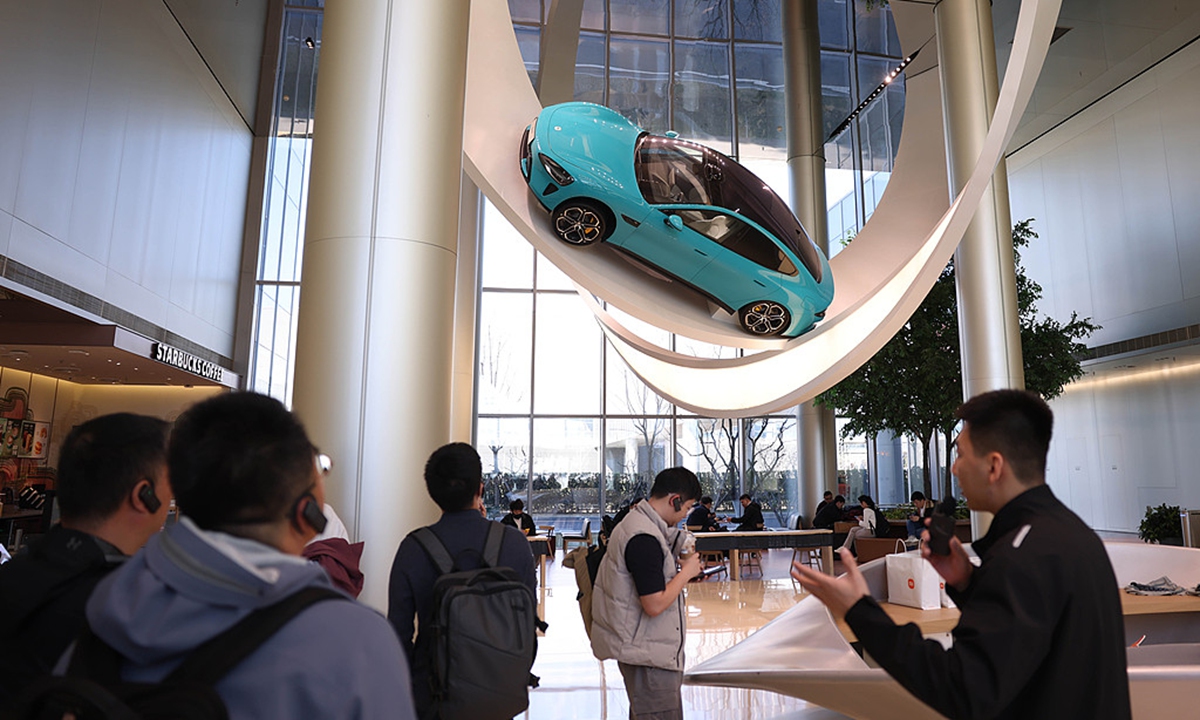
Tourists visit Xiaomi's auto factory in Beijing on March 24, 2025. Photo: VCG
Chinese tech giant Xiaomi officially unveiled its second SUV product line, the SkyNomad, on Thursday. This marks the brand's third major expansion of its automotive portfolio in merely two years, after it rolled out the SU7 sedan and YU7 SUV.
Industry analysts told the Global Times that the company's rapid product rollout is a vivid reflection of the fast iteration speed and systematic innovation capabilities that underpin the global competitiveness of Chinese electric vehicles (EVs).
The lineup features smart, versatile and spacious SUVs tailored to consumers' demand for more flexible interior space, Xiaomi founder Lei Jun posted on Sina Weibo, adding that the new model will be released soon.
Xiaomi debuted its SU7 sedan in March 2024, with customer deliveries rolling out shortly after the official launch event. The brand then unveiled its YU7 SUV in June 2025, marking its second major vehicle release within just over a year.
Zhang Xiang, secretary-general of the International Intelligent Vehicle Engineering Association, told the Global Times that Xiaomi's impressive speed in new vehicle development is not an isolated achievement, but a direct embodiment of the core strengths of China's domestic automotive industrial ecosystem.
Thanks to the highly mature and complete domestic industrial chain, Chinese component suppliers can conduct in-depth collaborative R&D with vehicle manufacturers. The integrated industrial system enables seamless progress across component design, prototype trial production, assembly verification and large-scale mass delivery, drastically compressing the overall lead time for new vehicle projects, Zhang noted.
Cui Dongshu, secretary-general of the China Passenger Car Association, told the Global Times on Thursday that Xiaomi launching two product lines in just two years is typical for China's new-energy vehicle (NEV) manufacturers.
"It takes overseas automakers four to six years to develop a brand-new vehicle platform, while Chinese firms only need 1.5 to two years," Cui noted.
Xiaomi's new offering arrives amid a broader transformation in China's NEV sector, which is entering a deeper phase of intelligent innovation.
On Wednesday, Chinese automaker BYD reached another milestone as its 17 millionth NEV rolled off the production line, making it the world's first automaker to achieve that figure, China Media Group reported.
The brand also launched China's first 4-nanometer smart driving chip in May and pledged over 100 billion yuan ($14.72 billion) in R&D to advance safe intelligent mobility, according to a press release on its official website.
In April, Huawei released its ADS 5.0 smart driving system with advanced cloud-based world models that slash collision risks by half, according to Xinhua.
"The industry has hit a clear turning point. Gone are the days when competition revolved around electric batteries. Today's race hinges on self-developed chips and full-stack intelligent driving systems," Cui said.
Cui noted that domestic automakers are now phasing out imported chips for in-house alternatives, shifting focus from adding more radar sensors and hardware to end-to-end large-model autonomous driving, and competing via full industrial chain ecosystems rather than standalone vehicle models.
Official data from the China Association of Automobile Manufacturers further underscored the industry's robust growth.
In the first half of 2026, China produced and sold over 7.4 million NEVs, with pure battery electric vehicles accounting for 67 percent of sales. In June, China produced 1.598 million NEVs and sold 1.643 million units, with both production and sales jumping over 20 percent year-on-year. The share of NEVs in total new vehicle sales rose further to 58.5 percent.
RELATED ARTICLES