Illustration: Liu Xiangya/GT
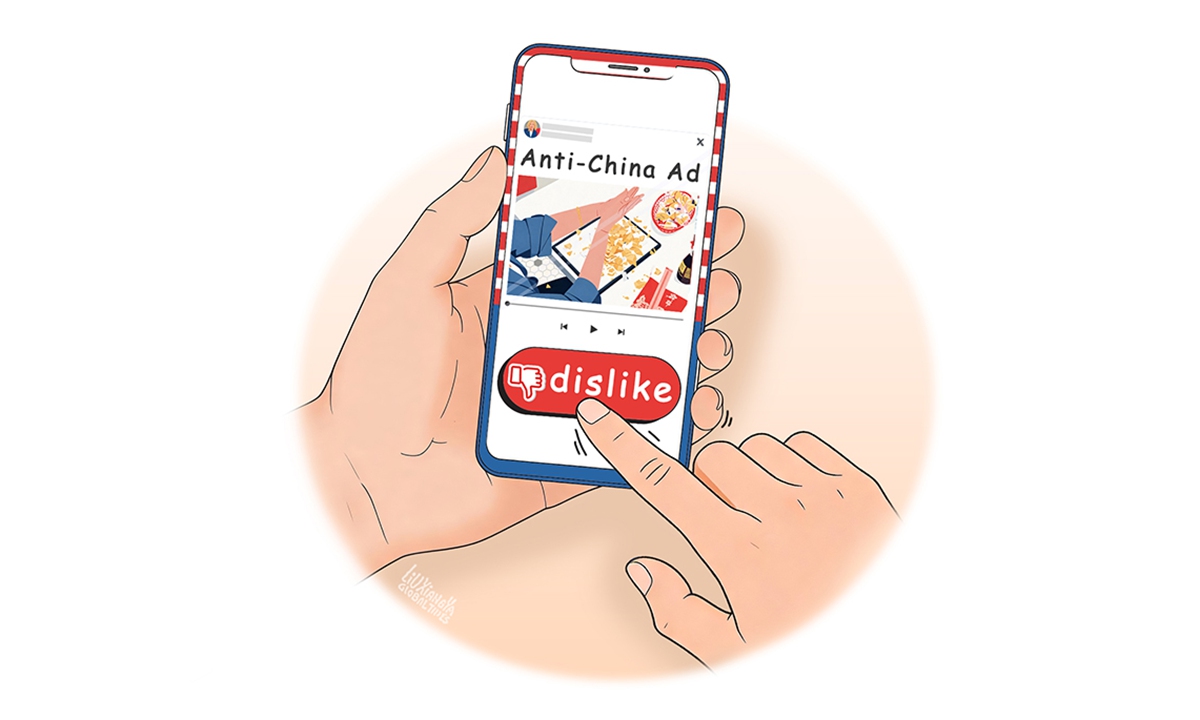
Recently, US Senator Marsha Blackburn's attempt to win over voters in her bid for governor of Tennessee with an anti-China campaign ad backfired remarkably.
In the ad, the Tennessee senator sits in what appears to be a Chinese restaurant, declares that she will "stop Communist China and protect Tennessee land," and dramatically crushes fortune cookies to project a tough-on-China image. But instead of winning applause from voters, the carefully choreographed anti-China political theater triggered a wave of ridicule among American netizens across social media.
Some dismissed it as a "stunt" produced by "ignorant, fear-mongering politicians," while others criticized the senator for failing to improve people's lives and for ignoring pressing state issues such as immigration. Beyond these sharp comments, a crucial question emerges: Why is the "China threat" playbook, once considered by US politicians as "reliable," no longer winning over voters the way it used to?
The most fundamental reason is that the alleged "threat" China poses to Tennessee, as portrayed by the senator and her likes, is simply not grounded in reality. According to reports, in Tennessee, "many residents are struggling to make ends meet" and "too many households are falling behind as the cost of living continues to skyrocket." As many have pointed out, China has virtually no direct causal connection to these problems. If there is any cause to be identified, it lies in the state's own policy choices, local governance, and the structural challenges associated with its post-manufacturing economic transition.
This ad is not merely another failed campaign stunt. It offers a revealing snapshot of the current US political landscape, reflecting how the political logic long embraced by some elite US politicians is increasingly losing its effectiveness. A scholar who has long observed US politics told the Global Times on Wednesday that "this reflects a typical political tactic of externalizing domestic problems and evading responsibility." The senator and the US elite group she represents have no intention of solving real problems, but are accustomed to stirring up hostility and shifting the blame onto China to divert attention.
These ideological threat narratives fabricated by these US political elites ultimately crumbles when confronted with the real concerns of ordinary Americans. Clearly, what the American people truly care about are education, healthcare, employment and social security. They are becoming increasingly desensitized to hollow ideological slogans and are far less willing to buy into them. One netizen captured this growing sentiment in a blunt comment: "Don't you have anything positive to inspire American with other than divert their attention from your incompetencies by harnessing hate?"
This also serves as a warning to those American politicians who have long peddled the "China threat theory." In recent days, more and more Americans are coming to understand that the real China is far from the "threat" portrayed by politicians through opinion polls, social media and direct exchanges. More importantly, through China as a mirror, they are increasingly seeing clearly the institutional shortcomings and governance weaknesses in the US: Why are there so few homeless people on China's streets? Why has China achieved such remarkable results in grassroots poverty alleviation? Why are Chinese people able to enjoy affordable and efficient healthcare services?
What Americans increasingly see are US politicians whose competence is being questioned, and the reality that Washington's political system has become increasingly sluggish amid partisan infighting and increasingly incapable of responding to the real demands of the public. When rational US voters no longer believe the narrative of an imaginary "external enemy" and instead begin asking "who is really solving our problems," this shoddy political theater begins to fall apart.
More importantly, the "anti-China" gimmick peddled by some US politicians for narrow political gain not only fails to solve America's own problems, but also risks undermining a growing cooperation consensus based on shared interests. More Americans are increasingly recognizing that China-US cooperation benefits both sides. Tennessee illustrates this reality: As early as 2007, Tennessee already opened a trade office in Beijing to facilitate increased trade and investment. Tennessee ranks as the fourth-largest US state for total trade with China, with its goods and services exports to China supporting around 20,000 jobs as of recent years.
By continuing to indulge in cheap anti-China political manipulation, these politicians will only cause American states to miss valuable opportunities for cooperation and squander local development dividends.
Compared with the cheap political theater of smashing fortune cookies, the real challenge is how to deliver tangible benefits to American voters through practical cooperation with China - a question that some US politicians seem unwilling or unable to answer.
RELATED ARTICLES