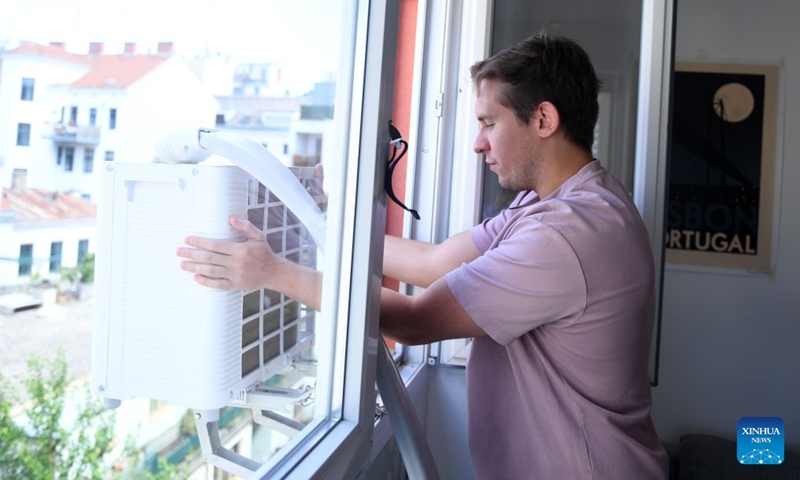
Denis Yurchak shows how to install a Midea Portasplit mobile split air conditioner at his apartment in Vienna, Austria, July 4, 2026. For Austrian resident Denis Yurchak, the search for an air conditioner to survive this year's scorching summer felt like embarking on an adventure.
On Friday, Singaporean media Lianhe Zaobao published a feature titled "European heatwave triggers air-conditioning revolution: How China's 'cooling power' sweeps across Europe." The term "cooling power" is particularly thought-provoking. On the surface, it refers to the strong sales of Chinese air conditioners in Europe, but in reality, it reveals a new form of China's power today.
This summer, countries across Europe - including France, Germany, Spain, and the UK - have experienced persistently rising temperatures, with many areas exceeding 40°C. Hospitals, nursing homes, residential buildings, and urban infrastructure are all under immense pressure. At such times, the most practical issue is not abstract discussions about climate concepts or environmental ideals, but how to cool down, how to save lives, and how to ensure people can sleep soundly, work with peace of mind, and live safely.
It is precisely at this moment that Chinese air conditioners have seen surging sales across Europe. According to reports, Midea air conditioners saw sales in the Western European market grow by more than 70 percent in the first half of this year. Portable split air conditioners have even sold out in multiple European countries. In France, such air conditioners are nearly impossible to find; consumers in Germany and Austria are hunting everywhere for available stock; and search volumes for portable air conditioners in the UK have surged.
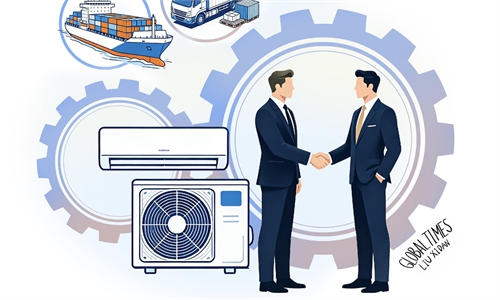
The reason Chinese companies have been able to open up the European market is not simply because their products offer good quality at affordable prices. Rather, they have provided a complete set of systematic solutions that precisely and conveniently meet European consumers' urgent need for cooling. China's "cooling power" is not merely about selling air conditioners to Europe; it represents the comprehensive export of industrial strength, technological prowess, regulatory adaptability, and problem-solving ability, ultimately earning genuine recognition from European distributors, consumers, and markets.
At its core, China's "cooling power" rests on the hard power of Chinese manufacturing. It is only through long-term R&D accumulation that products can be developed to fit European regulations and usage scenarios. It is only with a complete parts and components ecosystem that costs can be controlled while maintaining performance. And it is only through efficient cross-departmental collaboration that R&D, manufacturing, legal affairs, certification, logistics, distribution, and after-sales service can be seamlessly connected. The strong sales of Chinese air conditioners in Europe are, in effect, a concentrated demonstration overseas of China's technological strength of Chinese manufacturing, industrial organization, and supply chain system.
This is not limited to air conditioners. Chinese new energy vehicles are also gaining strong momentum in Europe, accounting for approximately 9 percent of overall vehicle sales and over 15 percent of electric vehicle sales. Heat pumps, power batteries, intelligent cockpits, advanced driver assistance systems, complete vehicle electrical and electronic architectures, and vertically integrated supply chains - these are all hallmarks of "high-end green intelligent manufacturing." The strong sales of both Chinese air conditioners and automobiles in Europe demonstrate that Chinese manufacturing is moving beyond its old model of contract manufacturing and low-end supply, and entering a new stage defined by high technology, high energy efficiency, strong scenario adaptability, and high system integration.
China's "cooling power" also has a soft side. Without a deep understanding of European regulations, research into local consumer habits, adaptation to distribution networks and retail systems, and the gradual building of brand credibility, even the most capable Chinese manufacturers might not be able to break in. Today, European consumers are willing to open their wallets not only because Chinese companies "can make it," but also because they "make it right," "deliver it," "make it work well," and "earn trust."
"Cooling power" is not a new term positioned between hard power and soft power. It is a genuine competitive edge that cuts through the global market when the two are combined.
So what kind of power is China's "cooling power"? It is precisely the comprehensive embodiment of China's hard power and soft power - the ability to turn hard power into products, soft power into trust, and then combine the two into global solutions. It relies on products, performance, delivery, adaptation, and user experience to reinforce the new position of Chinese manufacturing in the most concrete living and industrial scenarios around the world.
The phenomenon of China's "cooling power" sweeping across Europe illustrates at least three things.
First, market laws outweigh geopolitical games. When real problems arise, protectionism and emotional narratives cannot solve them. Consumers ultimately recognize only performance, price, and availability. When a heatwave hits, those calling for "decoupling" will honestly reach for a Chinese air conditioner first.
Second, global manufacturing power is being redistributed. In the past, the West held the dominant position in high-end manufacturing, and Chinese manufacturing was often labeled as "low-end" and "cheap." But today, from air conditioners to automobiles, and even breakthroughs in cutting-edge technologies such as reusable rocket recovery, it is clear that China is achieving systematic leadership in multiple high-end, green, and highly complex manufacturing fields.
Third, the underlying nature of China-Europe industrial relations remains complementary and symbiotic. In many sectors, European manufacturing faces problems of insufficient production capacity, high costs, and slow transformation. To a certain extent, Chinese manufacturing is filling Europe's supply gaps, supporting its green transition, alleviating its industrial anxieties, and even helping it preserve jobs and industrial capabilities.
The European heatwave has unexpectedly become a showcase for China's "cooling power." It allows the world to see more clearly that today's China can not only produce goods, but also provide solutions; that it can not only participate in markets, but also reshape them; and that it is not only meeting the standards of the old industrial era, but is beginning to define the standards of the new industrial era.
"Cooling power" is not cold at all. Behind it is a modern China that is reshaping the global industrial landscape through green development, high-end manufacturing, and systemic capabilities.
RELATED ARTICLES