Typhoon Bavi lands on China's east coast amid safety precautions; widespread rainfalls cause wide flight, railway cancellations in Yangtze River Delta

City workers clear trees toppled by Typhoon Bavi in the urban area of Xianju county, Taizhou, East China's Zhejiang Province on July 12, 2026. Photo: VCG
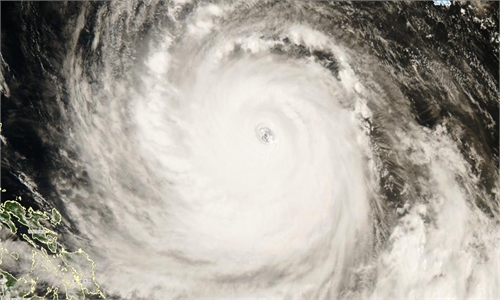
Typhoon Bavi, previously a "super typhoon," weakened into a typhoon before making landfall in the coast of Yuhuan, East China's Zhejiang Province at around 11:20 pm Saturday, yet it is still the strongest typhoon to make landfall in China so far this year, according to official information.
To cope with Typhoon Bavi and the extreme weather it may bring, multiple regions have rolled out response measures, including suspending classes, work and outdoor activities when necessary, adjusting or canceling flights and railway services, and reminding residents to stay safe when traveling under severe weather conditions.
China's national commission for disaster prevention, reduction and relief, together with the Ministry of Emergency Management and the National Food and Strategic Reserves Administration, has allocated 70,000 pieces of central disaster relief supplies to support Zhejiang, Tianjin, Anhui and other regions in their disaster relief efforts following Typhoon Bavi, the Xinhua News Agency reported on Sunday, citing the Ministry of Emergency Management.
According to Weather China, a website run by the China Meteorological Administration, after making landfall, Bavi will continue to bring strong winds and heavy rainfall to Zhejiang and Fujian provinces before moving inland. Due to its large size, the typhoon's heavy rainfall is expected to affect more than 10 provincial-level regions, including Jiangxi, Anhui, Hubei, Henan, and Beijing-Tianjin-Hebei.
According to China's National Meteorological Center (NMC)'s tropical cyclone classification system, Bavi was previously classified as a super typhoon, the highest category, before weakening into a typhoon, the third-highest category. It has continued weakening after going inland. According to updates from Zhejiang, Bavi has further weakened to a severe tropical storm, a level below typhoon.
Sun Qianqian, a meteorological analyst at Weather China, said that landing does not mean the danger is over. Bavi is still large in size and remains powerful, with its impacts expected to last for a long period and affect a wide area, causing extreme weather to some areas, according to Weather China.
Ma Jun, director of the Beijing-based Institute of Public and Environmental Affairs, told the Global Times on Sunday that typhoon landfall draws significant attention because the landfall location is usually where the storm delivers its most direct impact, affecting both the landfall area and surrounding regions. During landfall, a typhoon can bring powerful winds, high waves and storm surges, which may worsen coastal flooding risks.
To cope with Typhoon Bavi, the China Meteorological Administration has upgraded its emergency response for major meteorological disasters to Level II. Several airports in Zhejiang and Shanghai reduced or canceled flights over the weekend, with airlines in Hangzhou planned to cancel 198 inbound and outbound flights. Railway services in the Yangtze River Delta were also adjusted or suspended for safety reasons, according to Weather China.
According to travel analytics platform Umetrip, as of 8 pm on Saturday, Chinese airlines had planned to cancel more than 2,800 inbound and outbound flights scheduled for Sunday due to Bavi impacts.
The Shanghai Municipal Meteorological Service upgraded the typhoon alert from blue to yellow on Saturday afternoon, while the city's flood control and typhoon prevention headquarters simultaneously raised the emergency response level from Level IV to Level III. Jinshan district alone in Shanghai has relocated more than 5,000 people in total and activated 78 shelters to provide safe accommodation, where residents have access to food, drinking water and other emergency supplies, China Central Television (CCTV) News reported on Sunday.
A red alert for mountain flood risks was issued for Hangzhou in Zhejiang and provincial meteorological observatory continued to maintain a typhoon emergency warning.
A resident in Hangzhou told the Global Times on Sunday that she had been closely following reminders issued by local government WeChat accounts ahead of the typhoon's arrival. Some local residents had also stocked up on daily necessities in advance.
Residential communities across the city actively took precautionary measures, including issuing notices on vehicle parking arrangements, pedestrian safety during extreme weather, possible flooding risks in underground parking garages, and urging residents to stay indoors. She also saw many city workers reinforcing roadside trees to prepare for the typhoon.
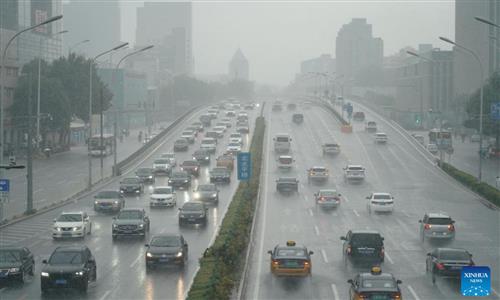
The resident said that Hangzhou was affected by the typhoon to some extent, but the impact was so far not severe overall. There was heavy rainfall and high humidity. Some trees in her residential community had been blown down, but they were quickly cleared away, she observed.
Ma said that after moving inland, a typhoon usually weakens as it loses the energy supply from the ocean and may eventually develop into a low-pressure system. However, its residual circulation and abundant moisture can still bring heavy rainfall, strong winds and severe convective weather along its path.
According to the latest update from Zhejiang provincial authorities, the center of Typhoon Bavi has moved out of Zhejiang Province and was located in Ningguo, Anhui Province, at 11 am on Sunday. Further weakening to a severe tropical storm, a level below typhoon, Bavi is moving toward northwest.
The typhoon's main circulation and long-distance moisture transport will bring heavy rainfalls to East China, North China and Northeast China in the coming two days, while strong winds will continue to affect the southeastern coast, Weather China reported.
From Sunday night to Monday, heavy to torrential rainfall is expected in parts of Zhejiang, Fujian, Jiangxi, Beijing, Tianjin, Hebei, Liaoning, Jilin, Sichuan Basin and Taiwan island, with some areas likely to experience extreme rainfall.
After moving inland, Bavi will continue to bring heavy rainfall to Jiangxi, Anhui and Jiangsu. Its residual circulation will move northward from Monday to Tuesday, bringing further rainfall to the Huanghuai region and North China, Weather China reported.
RELATED ARTICLES