H1 sales of Japan’s top three automakers slump in China, falling behind local EV boom
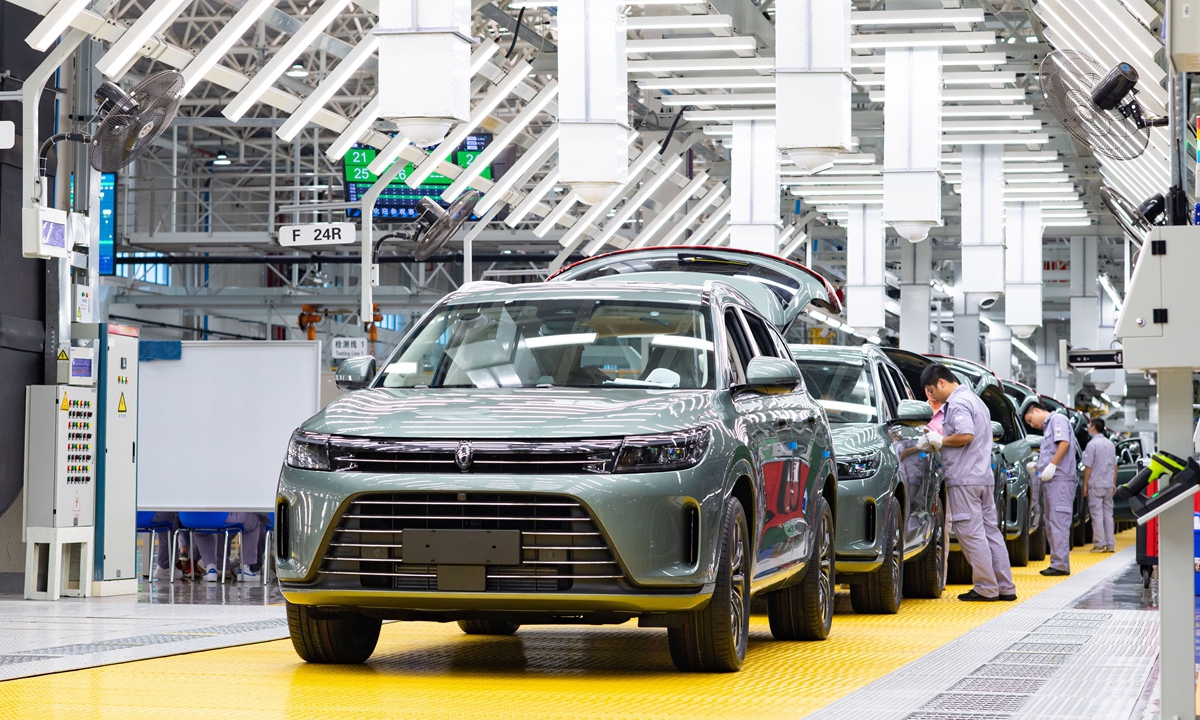
An NEV manufacturing line in Southwest China's Chongqing Municipality Photo: VCG
Japan's three leading automakers have reported sharp year-on-year declines in their China sales for the first half of 2026, Kyodo News reported.
From January to June, Toyota sold 694,700 vehicles, a 17.1 percent drop from a year earlier. Nissan recorded sales of 237,000 units, down 15 percent. Honda suffered the steepest fall, with sales of just 205,800 vehicles, a 34.7 percent decline, hurt by slow new model rollouts, according to the report.
In June alone, all three automakers saw weaker sales, and Honda has now posted 29 straight months of falling sales, according to the report.
The report partly attributed the downturn to higher fuel prices caused by Middle East tensions, which have dampened demand for gasoline-powered cars.
Cui Dongshu, secretary-general of the China Passenger Car Association, told the Global Times on Sunday that the prolonged sales slump of Japanese automakers in China stems from their insufficient innovation and sluggish transformation to electric vehicles (EVs).
Japanese automakers have over-relied on regular hybrids, missing demand for plug-in hybrids and pure EVs. Slow model development, poor local adaptation and outdated smart systems have left them unable to attract young buyers.
As electrification is sweeping China's car market, affordable Chinese plug-in hybrids and EVs dominate mainstream family car sales, eroding the traditional fuel-saving advantage of Japanese hybrid and gasoline vehicles, the expert noted.
China's new-energy vehicle (NEV) sector continued to grow in the first half of 2026, with output and sales both exceeding 7 million units, industry data showed on Thursday.
NEV output reached 7.438 million units, while sales stood at 7.446 million units, according to data released by the China Association of Automobile Manufacturers.
Pure EVs accounted for 67 percent of total NEV sales during the period, the data showed.
EVs have low acceptance in Japan, partly because domestic automakers have few pure electric models with inferior technology, along with high electricity prices, leading to weak overall competitiveness and a very low market share, Zhang Xiang, secretary-general of the International Intelligent Vehicle Engineering Association, told the Global Times on Sunday.
"While other nations are embracing electrification, EVs are yet to truly take off in Japan," according to a Roland Berger report in 2025.
A decline in EV sales and limited growth in its charging market saw Japan rank 32nd of 33 nations in an EV Charging Index 2025 compiled by Roland Berger.
"A full recovery is unlikely," Cui said. "With domestic Chinese brands firmly entrenched in the electric and intelligent vehicle market, Japanese automakers are unlikely to return to their previous position."
RELATED ARTICLES