China rejects joint hype over 'SCS Arbitration Award' 10 years on; Have those countries supporting 'award' voluntarily waived maritime rights, FM asks
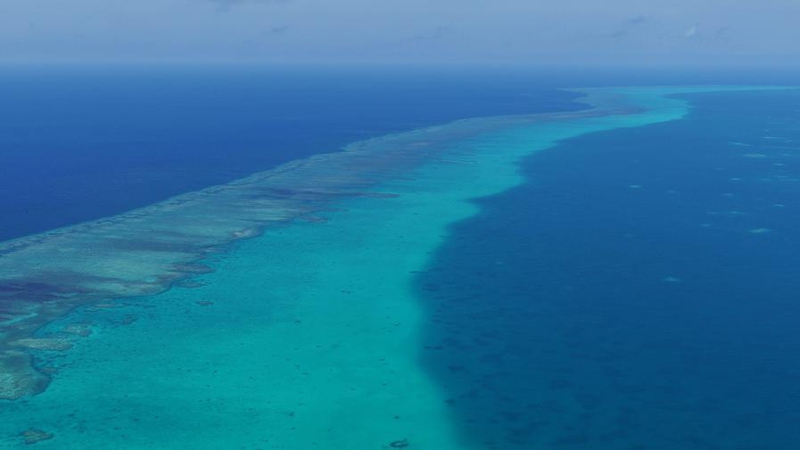
An aerial drone photo taken on May 2, 2026 shows reefs in the territorial waters of China's Huangyan Dao in the South China Sea. (Xinhua/Chen Bin)
China's Foreign Ministry on Sunday issued a statement in response to certain countries' playing up of the "South China Sea Arbitration Award" 10 years after its issuance. Chinese Foreign Ministry reiterated that China does not accept or recognize the "award," and China's territorial sovereignty and maritime rights and interests in the South China Sea shall not be affected by the "award" under any circumstances.According to the Associated Press, the joint statement was issued by 14 countries, including the US, Australia, the UK, Japan, the Philippines, New Zealand, Canada, Estonia, Germany, Italy, Latvia, Lithuania, Romania and Slovenia. The statement claimed that they rejected "destabilizing" actions in the disputed waters that threaten regional stability, and claimed they reaffirm the arbitral tribunal's so-called decision that there is "no legal basis" for China's maritime claims in the South China Sea, including those based on historic rights.
In its Sunday statement, China's Foreign Ministry made clear that China has sovereignty over Nanhai Zhudao (the South China Sea Islands), consisting of Dongsha Qundao (the Dongsha Islands), Xisha Qundao (the Xisha Islands), Zhongsha Qundao (the Zhongsha Islands) and Nansha Qundao (the Nansha Islands); China has internal waters, territorial sea, contiguous zone, exclusive economic zone and continental shelf, based on Nanhai Zhudao; China has historic rights in the South China Sea. China's sovereignty over Nanhai Zhudao and the relevant rights and interests in the South China Sea have been established in the long course of history.
In response to certain countries' infringements and provocations in the South China Sea, China has taken resolute measures to defend its rights and interests—measures that are reasonable, legitimate, professional and restrained. The US and other external countries have been persistently reinforcing military presence in the South China Sea, throwing their weight around and fanning the flames. These acts of militarization and coercion constitute the primary challenge to the current situation in the South China Sea, the statement said.
China does not accept any imposed solution with respect to territorial issues and maritime delimitation disputes, and China will continue to uphold the fundamental principles of international law and basic norms of international relations as affirmed by the United Nations Charter, including respect for state sovereignty and territorial integrity and the principle of peaceful settlement of disputes, the statement said.
Yang Xiao, a research professor at the Institute of Peaceful Development under the Chinese Academy of Social Sciences, told the Global Times on Sunday that the joint statement issued by certain countries itself shows the so-called arbitration award does not enjoy broad support from the international community.
There are 193 member states in the United Nations, yet only 14 countries, mostly US allies, joined the statement, Yang said. In Asia, only Japan and the Philippines are among the signatories, which shows that their support for the so-called award is not driven by respect for international law, but by political manipulation, he said.
A statement about the South China Sea was not initiated by relevant Asian countries, nor was it supported by ASEAN countries, but was instead dominated by US allies and some European countries, Yang noted. This exposes the real intention of certain countries from outside the region to interfere in the South China Sea, stir up trouble and undermine regional peace and stability, he said.
The US-led statement expressed so-called "strong opposition" to "destabilizing or unilateral actions including by force or coercion" that threaten peace and stability in the region. It also claimed opposition to the use of coast guard, military and maritime militia forces to "harass, obstruct, intimidate lawful operations by other states at sea or in the air."
China's Foreign Ministry said in the statement that the South China Sea is one of the safest sea lanes in the world. The freedom of navigation and overflight in the South China Sea has never been a problem. China firmly upholds its territorial sovereignty and maritime rights and interests in the South China Sea, and remains steadfast in maintaining peace and stability in the South China Sea.
The reasoning behind this arbitration award is riddled with blatant double standards and utterly inconsistent.
"If the 'award' were to be taken as a standard, many countries' islands and reefs would be denied the basis for claiming maritime rights and interests. May we ask, have those countries supporting the "award" voluntarily waived the maritime rights and interests deriving from their relevant islands and reefs?" according to the statement.
Also, Chinese Foreign Ministry spokesperson responded on Sunday after Japan's Foreign Minister Toshimitsu Motegi made a statement ten years after the "2016 Arbitral Award on the South China Sea." The spokesperson said that by turning a blind eye to the glaring flaws in the "award" while openly endorsing it, Japan has laid bare its double standards and hypocrisy.
According to the "award," Taiping Dao in the Nansha Qundao, an area that spans 500,000 square meters and has fresh water, vegetables, fruits and poultry to sustain human habitation, is not even considered an island and therefore cannot generate entitlement to exclusive economic zone (EEZ) and continental shelf.
If that could stand, how could Okinotori - nothing more than two tiny rocks of less than 10 square meters in the Pacific - possibly justify a claim to EEZ and continental shelf of hundreds of thousands of square kilometers? By that "standard," many of Japan's islands and reefs would likewise have no basis for claiming maritime rights and interests. Since Japan has publicly endorsed the "award," China has every reason to believe that Japan has accepted the same "standard" and voluntarily renounced the corresponding maritime claims, the spokesperson said.
An official in charge of the Department of Asian Affairs of the Chinese Foreign Ministry on Sunday summoned the Chief Minister of the Embassy of Japan in China over Japanese Foreign Minister's hype of so-called "Arbitral Award on the South China Sea" 10 years after its issuance and Japan's joint statement issued in collusion with certain other countries, lodging stern representations and expressing strong dissatisfaction and protest, adding that China will resolutely and forcefully counter Japan's provocations and firmly safeguard its territorial sovereignty and maritime rights and interests.
The Chinese side said that Japan bears historical crimes relating to the South China Sea and has never been clearly settled, leaving it with no ground whatsoever to make unwarranted remarks on the issue, according to the Chinese Foreign Ministry.
RELATED ARTICLES