China braces for Typhoon Bavi landing with precautions
Authorities allocate relief supplies and funds to support recovery
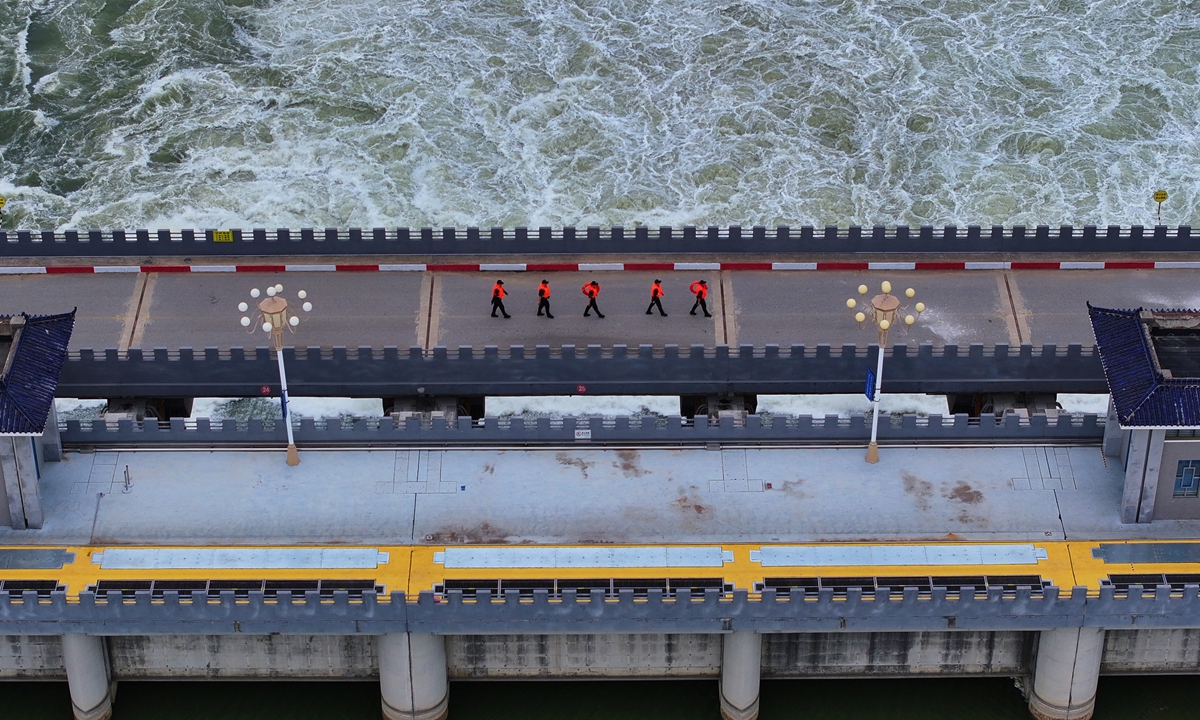
Patrol officers from Hubin New District Branch of Suqian Public Security Bureau inspect Zhangshan Bridge to safeguard flood discharge operations in Suqian, East China's Jiangsu Province on July 12, 2026. Photo: VCG
Typhoon Bavi, the ninth typhoon of the year, made landfall on the coast of East China's Zhejiang Province at around 11:20 pm on Saturday, the Xinhua News Agency reported on Sunday, citing Zhejiang provincial meteorological observatory. While Bavi struck a wide area along China's eastern coast, bringing with it torrential downpours and high winds, affected regions rolled out emergency preparations days in advance, as Chinese authorities distributed daily necessities and arranged funds to support post-typhoon recovery efforts.
The typhoon, with the maximum wind force at its center reaching 40 meters per second at landfall, first churned ashore at Yuhuan, a county-level city administered by the city of Taizhou, before making a second landfall in Yueqing under the city of Wenzhou at around midnight, per Xinhua.
At 2 pm on Sunday, the center of Bavi was in Wuhu, East China's Anhui Province, with maximum winds of Force 10 or 25 meters per second, according to Anhui provincial meteorological observatory.
According to Weather China, a website run by the China Meteorological Administration, Bavi will continue to bring strong winds and heavy rainfall to Zhejiang and Fujian provinces before moving inland. Due to its large size, the typhoon's heavy rainfall is expected to affect more than 10 provincial-level regions, including Jiangxi, Anhui, Hubei, Henan and the Beijing-Tianjin-Hebei region.
Expected to be the strongest typhoon to make landfall in China this year, Typhoon Bavi prompted China's National Meteorological Center to issue yellow alerts for typhoon and severe convection alongside an orange rainstorm alert at 10 am Sunday. It will move northwest while gradually weakening, before shifting northeast across eastern Anhui Province on Monday.
Ahead of Typhoon Bavi's landfall, regions rolled out emergency preparations, including mass evacuations of local residents and suspensions of flights, classes and workplace operations. In the wake of the storm, China has also ramped up funding allocations to support post-typhoon recovery efforts.
Preparedness underway
China's national commission for disaster prevention, reduction and relief activated a Level IV national emergency response for disaster relief on Sunday in response to severe damage caused to Zhejiang by Typhoon Bavi. A special working group has been dispatched to the affected areas to guide local authorities in relocating residents and guaranteeing their basic living supplies, Xinhua reported.
China's National Development and Reform Commission urgently allocated 100 million yuan ($14.7 million) from the central government's budgetary investment to support Zhejiang Province in post-typhoon emergency recovery efforts. The funds will primarily go toward the emergency restoration of damaged infrastructure, including roads and water conservancy facilities, as well as public service facilities such as schools and hospitals in disaster-hit areas, the commission said on Sunday.
The Chinese government on Sunday also allocated 70,000 items of central disaster relief supplies to support Zhejiang, Tianjin, Anhui and other regions in their disaster relief efforts following Typhoon Bavi, Xinhua reported on Sunday, citing the Ministry of Emergency Management.
Multiple regions in Zhejiang affected by the typhoon suspended classes and work in past two days, and several airports in Zhejiang and Shanghai reduced or canceled flights over the weekend, with airlines in Hangzhou planning to cancel 198 inbound and outbound flights. Railway services in the Yangtze River Delta area were also adjusted or suspended for safety reasons, according to Weather China.
Before Bavi made landfall, a total of 1.716 million residents across Zhejiang had been evacuated. As of 8 am on Saturday, all 12,154 schools and kindergartens suspended classes, construction and industrial sites halted work, a total of 444 A-level scenic spots closed, and ferry, train and flight services were suspended, according to Xinhua.
Shanghai, one of the affected regions, had evacuated over 299,000 residents and opened 905 flood control shelters as of 9 pm on Saturday, according to local newspaper the Xinmin Evening News. Evacuations mainly covered coastal districts including Pudong, Fengxian and Jinshan, as well as other high-risk zones.
A temporary resettlement site for relocated workers in Wenzhou, Zhejiang is equipped with not only hot water and instant food, but also medical support and movie screenings to help evacuees safely get through the typhoon period, Dushi Kuaibao, a newspaper under Hangzhou Daily, reported.
A resident in Hangzhou told the Global Times on Sunday that she had been closely following reminders issued by local government WeChat accounts ahead of the typhoon's arrival. Some local residents had also stocked up on daily necessities in advance.
Residential communities across the city actively took precautionary measures, including issuing notices on vehicle parking arrangements and pedestrian safety during extreme weather, possible flooding risks in underground parking garages, and urged residents to stay indoors. She also saw many city workers reinforcing roadside trees to prepare for the typhoon.
The resident said that Hangzhou was affected by the typhoon to some extent, but the impact was so far not severe overall. There was heavy rainfall and high humidity. Some trees in her residential community had been blown down, but they were quickly cleared away, she observed.
Large and powerful
Typhoon Bavi formed on July 2 and rapidly intensified in recent days. It strengthened into a super typhoon on July 4 and maintained that strength for an unusual 138 hours. Satellite imagery shows it boasts an enormous circulation stretching over 1,500 kilometers across, making it a massive typhoon in every sense.
At the same time, landfall does not mean the danger is over. Sun Qianqian, a meteorologist with China Weather, said that Typhoon Bavi is large in size and powerful, bringing prolonged, wide-ranging impacts with extreme weather in some areas, according to China Weather.
Ma Jun, director of the Beijing-based Institute of Public and Environmental Affairs, told the Global Times on Sunday that after moving inland, a typhoon usually weakens as it loses its energy supply from the ocean and may eventually develop into a low-pressure system. However, its residual circulation and abundant moisture can still bring heavy rainfall, strong winds and severe convective weather along its path.
The flood season has arrived earlier this year accompanied by above-normal rainfall across the country, Ma said, adding that soil moisture levels in many regions have remained high. The impact of the current heavy rainfall will compound existing conditions, raising flood risks. It will also extend the disaster chain, as flash floods can easily trigger secondary geological disasters such as landslides and mudslides.
Observations show that rainfall patterns across China, especially in northern areas, follow a roughly 20-year cyclical pattern. This constitutes another factor behind the more frequent heavy rainfall events recently, Ma said.
Against the broader backdrop of global warming, this year's El Nino has developed faster than expected, which will likely lead to more frequent and intense heavy rainfall and extreme storm events, Ma added.
RELATED ARTICLES