China completes first field trial of transporting methanol through existing fuel pipelines
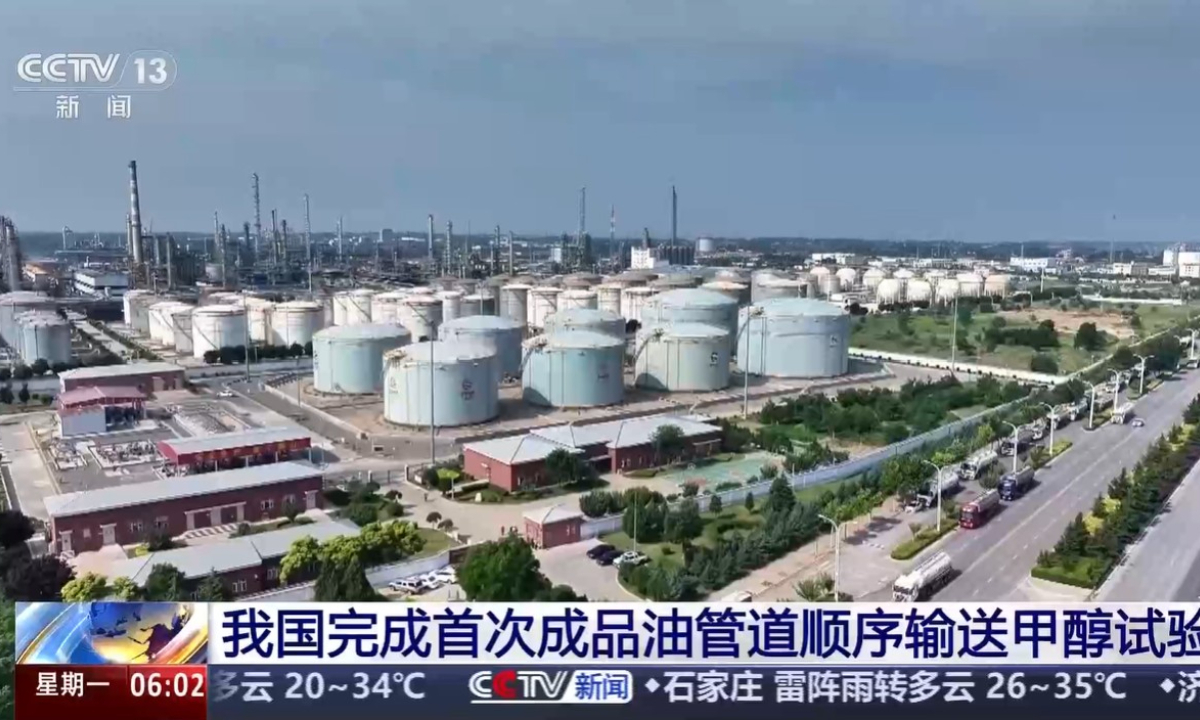
China completes a field trial for the sequential transport of methanol through a long-distance refined oil pipeline in Northwest China's Gansu and Shaanxi provinces. Photo: screenshot from CCTV News
China has completed its first field trial of transporting fuel methanol through an existing long-distance refined oil pipeline, marking a key step from theoretical research to engineering application in the large-scale transport of methanol through fuel pipeline networks, CCTV News reported.
The results provide a complete technical solution and practical experience for future large-scale, cross-regional transport of fuel methanol, CCTV News reported on Monday.
The trial was carried out in Northwest China's Gansu and Shaanxi provinces. After a comprehensive assessment of pipeline compatibility and safety upgrades at two stations, 1,000 cubic meters of fuel methanol were transported in two batches through an operating refined oil pipeline from Gansu to an oil depot in Shaanxi, with the entire process conducted in a sealed and controllable manner.
The trial used a sequential transport method, in which methanol and gasoline were transported through the same pipeline in batches, Wang Yubin, a senior engineer at the Research Institute of PipeChina, was quoted as saying by the report.
"The total length of the mixed section between methanol and gasoline was kept within one kilometer, showing that the system is capable of supporting large-scale methanol transport," Wang said. At the oil depot, the two materials were successfully separated and stored in different tanks, completing the full industrial verification process, he added.
Lin Boqiang, chair professor and dean of the China Institute for Studies in Energy Policy of the School of Management at Xiamen University, told the Global Times on Monday that as methanol pipeline transport involves relatively complex technologies, the successful test provides a foundation for future large-scale and long-distance methanol transportation.
During the trial, two sets of tests were conducted under different operating conditions, covering high and low flow rates as well as pipeline start-up and shutdown scenarios. The tests verified the adaptability of the technology under various operating modes and complex terrain conditions, according to the CCTV News report.
In refined oil pipelines, methanol has good compatibility with gasoline. When the two substances are transported consecutively, the mixed section is relatively short and concentration changes occur gradually, making separation easier. By contrast, methanol has poorer compatibility with diesel. Under conditions such as low flow rates or uneven terrain, methanol and diesel can separate due to differences in density, resulting in longer mixed sections and greater difficulty in separation.
Therefore, the trial placed methanol between gasoline batches during transport, allowing methanol to "ride" existing refined oil pipelines and reach destinations safely and efficiently, the report said.
"Pipeline transport is generally the most economical option for bulk energy transportation over long distances," Lin said. "If the technology is further developed, it could provide an efficient transport channel for methanol while also improving the utilization efficiency of existing refined oil pipeline infrastructure." Using available pipeline capacity for methanol transport could help maximize the value of existing energy facilities, he added.
"From theoretical research and laboratory tests to pilot-scale pipeline experiments and now field engineering demonstrations, the successful completion of this trial has effectively verified the technical feasibility of transporting methanol through refined oil pipelines in terms of processes, pipeline materials and safety management," Zhang Duihong, president of the Research Institute of PipeChina, was quoted as saying in the CCTV News report.
Zhang said that the trial provides an engineering foundation for the regular and large-scale transport of methanol through refined oil pipelines, and lays the technical groundwork for the future development of a large-scale "west-to-east methanol transport" corridor.
The broader significance of expanding methanol use is also linked to China's efforts to diversify its energy sources and reduce reliance on imported oil, according to Lin. "The development of green methanol powered by renewable energy such as wind and solar could help cut carbon emissions across the industrial chain and contribute to the building of a more resilient and sustainable energy system," Lin said.
Global Times
RELATED ARTICLES