World Cup drives influencer economy as football stars bridge brands to global audiences
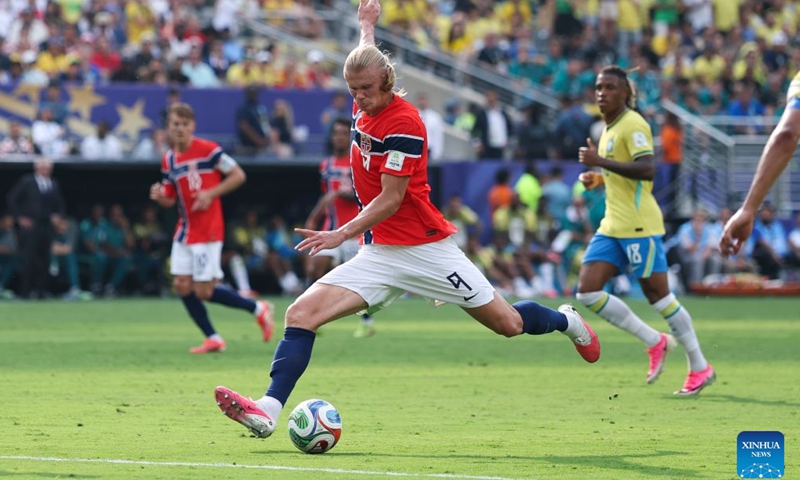
Erling Haaland of Norway scores with a shot during the round of 16 match between Brazil and Norway at the 2026 FIFA World Cup at the New York New Jersey Stadium, the US, July 5, 2026. Photo: Xinhua
The FIFA World Cup is not only a global sporting event, but also a power engine for influencer economy, as football stars with massive global followings increasingly serve as bridges connecting brands, consumers and markets.
Norwegian footballer Erling Haaland's growing popularity in China during the World Cup has demonstrated how the influence of sports icons can generate commercial opportunities across borders, driving a broader industrial chain involving brand marketing, social media operations, consumer products and cultural exchanges.
During the tournament, Haaland's followers on two Chinese social media platforms surpassed 30 million, mor than five times of Norway's total population of under 6 million, according to the People's Daily.
Data from the Chinese social media platform Xiaohongshu, or RedNote, shows that, during the World Cup, views of Haaland-related topics on that platform has surged by 220 million in a short period, with total views reaching as high as 960 million at one point.
Moreover, the footballer's popularity has translated into tangible market value. For example, Norwegian salmon exports to China reached 10,889 tons in June, up 31 percent year-on-year, while export value rose 21 percent to NOK840 million ($86 million), according to the latest data provided by the Norwegian Seafood Council (NSC) to the Global Times.
Behind Haaland's commercial appeal reflects a growing global ecosystem built around sports influencers. Chinese brands have also been active participants in this trend. Around the World Cup, advertisements featuring Haaland from Chinese brands including home appliance maker Midea and the Chinese natural plant drink maker WALOVI gained widespread attention on social media platforms.
In one commercial for a home appliance company, the Norwegian striker carries a washing machine and other appliances during a training session as a coach delivers a straight-faced commentary, creating a striking comedic contrast. In another campaign for a Chinese herbal tea brand, Haaland playfully "breathes fire" before cooling off with the drink, punctuated by his signature "ha ha ha" laugh throughout the advertisement.
WALOVI told the Global Times on Monday that this partnership goes beyond a typical brand endorsement. It reflects a proactive effort by a Chinese consumer brand to engage with global sports culture, align with worldwide health-conscious consumption trends, and establish meaningful dialogue with international young audiences, said the company.
"We firmly believe that events like the World Cup, football, and international sports icons are not just sources of traffic or exposure, but vital arenas for global cultural exchanges," said the company.
Over the past decade, its overseas market scale has grown 6.5 times, with an average annual compound growth rate exceeding 25 percent. The co-branded marketing of Haaland and the Chinese brand at the FIFA World Cup 2026 has further elevated the brand popularity, continuously fueling momentum in overseas markets, said the company.
The commercial value of sports influencers is no longer limited to short-term advertising exposure. Instead, it involves a complete value chain covering athlete IP development, brand strategy, digital marketing, content production, fan communities and overseas market expansion, Hu Qimu, a professor at the Maritime Silk Road Institute of Huaqiao University, told the Global Times on Monday.
"For brands, cooperation with internationally recognized athletes provides access to highly engaged audiences. For athletes, social media platforms and commercial partnerships offer new ways to expand personal influence beyond the field," Hu said, noting that meanwhile, for countries, globally recognized sports figures can become informal ambassadors that help introduce national culture, products and industries to foreign consumers.
Norwegian Ambassador to China Vebjørn Dysvik told the Global Times that Haaland and the Norwegian national team "open a door for communicating about our country, maybe to people who are difficult to reach through regular diplomats."
The Haaland phenomenon shows how the boundary between sports, entertainment, commerce and cultural communication is becoming increasingly combined. As global sporting events continue to attract billions of viewers, the influencer economy surrounding athletes is expected to create more opportunities for brands seeking to enter new markets, said Hu.
RELATED ARTICLES