IN-DEPTH / IN-DEPTH
How China's high-speed rail goes from manufacturing to intelligent creation, and why it now leads the globe
From Tangshan to the world
By and Xu Jiatong Published: Jul 13, 2026 11:35 PM

Stepping into the factory of CRRC Tangshan Co., Ltd., a major Chinese high-speed train manufacturer, also a key designer and manufacturer of China's Fuxing bullet trains, one encounters a scene quite different from the noisy, sparks-flying workshop that comes to mind. Automated robotic arms move with precision, while orange overhead cranes traverse the top of the workshop, slowly shuttling back and forth under the control of a digital system. Under highly intelligent operations, workers are not densely present on the production line. Dressed in clean and neat uniforms, they focus primarily on machine operation, precision tasks and quality monitoring, as if entering a technology-driven factory of the future.
In a survey involving young people from 20 Belt and Road partner countries, participants selected the "New Four Great Inventions of China," and high-speed rail ranks first. It can be said that rail transit is the "golden calling card" of China's high-end equipment manufacturing, and CRRC Tangshan is the main force in building this brand.
As a company with a 145-year history, it has produced China's first steam locomotive, and the country's first brand new 350 km/h high-speed freight electric multiple units (EMU) train, independently developed by China.
Recently, Global Times reporters visited the intelligent manufacturing production lines for high-speed EMU car bodies, assembly lines and the data center at CRRC Tangshan, to learn how the company pushed the performance and manufacturing standards of its core rail transit business to the global forefront and expanded overseas, and how it has made innovative explorations in digital industrialization.
'Ten years later, German guests were astonished when they returned'
Zhang Xuesong, a deputy to the 14th National People's Congress and CRRC's chief skills expert, established the Zhang Xuesong Studio, dedicated to digital production research and personnel training for the company.
When the reporters met Zhang, he showed them a photograph taken in 2015: several German engineers from Siemens were carefully inspecting rows of fully debugged high-speed train cars at the CRRC factory. They leaned forward, trying to get closer and see more clearly. Zhang said with pride, "Ten years later, when the German guests returned, they were all astonished. They said that a smart production line of such a large scale had always been their dream. Unfortunately, constrained by factors such as cost, production cycle and market size, this dream was difficult to realize."
Zhang has witnessed China's high-speed rail journey from its first shaky steps to leading the world. He recalled, "In 2004, I visited Volkswagen's production line in Wolfsburg, Germany. Their fully automated stamping workshop was extremely advanced and left a deep impression on me. But when I visit German factories now, the difference between our production lines is no longer significant. In fact, many of our technologies are more advanced."
In 2005, CRRC Tangshan introduced a 350 km/h EMU production project from Germany for the first time. "Prior to that, we could only produce 160 km/h trains. Such a huge leap left us with almost no confidence, so we made up our minds to first 'rigidly copy' the foreign technology exactly as it was, and then gradually understand, absorb and innovate independently," Zhang recalled.
The prototype development phase was the most challenging. At the time, Zhang and his colleagues lived and ate in the factory for a whole month to overcome the "tough nut" of aluminum alloy car body manufacturing. Previously, passenger cars mainly used carbon steel bodies - building a frame first and then attaching the skin. Aluminum alloy bodies, however, involved directly welding large profiles into a cylindrical structure, completely overturning the previous process logic. With no drawings, no reference materials and no experience to draw upon, the sole goal was to build one car first, "so that the other side would be willing to sit down and talk with us."
Inside the workshop, the reporter ran a hand over a finished side wall window panel of the car body that had been welded and polished - its surface perfectly smooth, completely free of burrs. "My mentor had extremely high requirements for precision. He was never satisfied with just 'qualified.' Some precision components had to reach an accuracy of ±0.02 millimeters," said 27-year-old Li Ziyu, Zhang's apprentice and an operator at CRRC Tangshan's machining center.
Li's job is to operate automated equipment to grind the side wall weld seams. According to him, one car body side wall is welded from five side panels, after which the four nearly 100-meter-long weld seams in the middle must be ground. The grinding precision directly affects the structural strength and stability of the car body.
Li pointed to the grinding tool housing at the front of the automated equipment and said, "With this, the machine has 'hands,' but we also needed to give it 'eyes' and a 'brain.' The biggest challenge at the time was developing the vision system to allow the equipment to simulate the human eye in locating weld seams." At first, they tried point lasers, scanning one point at a time, which was painfully slow. Later, they switched to line lasers, but still had to scan before grinding, and efficiency remained low. Finally, Zhang and his colleagues consulted materials, sought advice from peers and held technical meetings, finding a third path: using mechanical scanners to achieve real-time identification and real-time operation.
'Chinese high-speed rail can meet the needs of almost any country'
If the production workshops demonstrate the "hard power" of Chinese high-speed rail manufacturing, then CRRC Tangshan's engineering research center reveals the "soft power" behind China's leadership in high-speed rail. While ensuring operational safety and pursuing higher speeds, Chinese high-speed rail also strives to provide passengers with a comfortable riding experience. Staff of CRRC Tangshan told the Global Times that whether it is freezing cold or scorching hot outside, the interior is maintained at a comfortable 26 C. No matter how sandy or windy it is outside, interior noise is controlled between 65 and 68 decibels.
Zhang introduced that "China has a vast territory, which not only provides us with a broad application market but also exposes us to diverse natural environments from east to west and north to south - strong sandstorms in the west, severe cold in the north, intense heat in the south, and humid, corrosive conditions along the eastern coast." Facing these climatic conditions, they have continuously identified problems and accumulated experience through the actual operation of thousands of high-speed trains, gradually forming the unique application advantages of Chinese high-speed rail.
"Today, we have the confidence to say that Chinese high-speed rail can meet the product needs of almost any country, because China's application scenarios cover virtually all types of environments around the world," said Zhang.
In the whole-vehicle environment laboratory, reporters saw simulation equipment capable of covering all kinds of extreme climates. The system can simulate complex weather conditions such as snowfall, icing, sandstorms and heavy rain, with a temperature range from -50 C to 60 C. In the semi-anechoic chamber, white and blue conical sound-absorbing bodies cover the entire walls and ceiling. The auditory contrast is almost instantaneous - the high-ceilinged workshop has obvious echoing machine noise, but the moment you step into the semi-anechoic chamber, all industrial sounds are instantly absorbed, and even one's breathing becomes clearly audible.
Entering the assembly division workshop, reporters boarded the Fuxing CR400BF-AS EMU under assembly. Inside, the lighting is even and bright, the seats are comfortable and form-fitting, the interior wall panels feature smooth, flowing lines with fine texture and the onboard screens not only display real-time station information but also clearly show the crowding levels in each car. These human-centered designs add a touch of warmth to China's high-end manufacturing icon.
Full-lifecycle smart solutions
In the past, the core competitiveness of rail transit equipment manufacturers lay in manufacturing craftsmanship, production speed and product quality. Today, CRRC Tangshan has moved beyond the traditional manufacturing mindset of "simply building and selling trains." Through more than a decade of deep digital transformation, it has built an intelligent platform covering the full lifecycle of trains - from research and development to production, operation and maintenance.
Outside the workshops, the digital control center serves as the "intelligent brain" of the entire factory. A massive high-definition screen covers nearly an entire wall, displaying all dynamic data of the company's production and operations in real time - including the startup status of each production line, progress and process timing - making everything clear at a glance.
More importantly, digitalization has fundamentally transformed the train design process, making it fully transparent and verifiable from the outset. In the past, the rationality and functionality of vehicle designs could not be verified in advance. Now, an intelligent simulation and verification system allows all design issues to be eliminated before production begins - essentially giving each train a comprehensive "health check" before it rolls off the line.
Wu Hongwen, general manager of Hebei CRRC Digital Intelligence Technology Co., Ltd., cited the light rail project exported to Kazakhstan as an example. Previously, the models mainly operated in temperate zones. Facing Astana's extreme cold of -40 C, the technical team not only developed vestibule heating systems but also solidified the solutions into the digital platform. Now, when receiving orders for high-cold environments, the system automatically matches historical experience and proactively alerts teams to potential risks, achieving experience sharing and real-time reuse. Thanks to this, the Astana project was delivered just 10 months after signing, setting a new record.
From exporting hardware products to providing digital services, the Chinese manufacturer is taking a mature set of digital solutions abroad, becoming a new calling card for China's rail transit intelligent manufacturing. Digital transformation not only improves production efficiency but also gives Chinese rail transit technology and services greater confidence in global competition.
In the Zhang Xuesong Studio, reporters witnessed a meaningful effort: veteran workers' skills are being preserved through short instructional videos. These capture decades of hard-earned expertise - from gluing techniques to subtle operational know-how - which are now systematically documented and uploaded into the company's digital knowledge base. The team plans to further organize this data to train large models, allowing intelligent systems to learn from master craftsmen and offer improved solutions.
As the Global Times reporters left the factory, CRRC Tangshan's Chairman Zhou Junnian's words echoed: "China's high-speed rail is already the fastest in the world - does that mean we should stop?"
Even at the forefront of speed, Chinese craftsmen refuse to rest. Stepping beyond train manufacturing, CRRC Tangshan is going global with standards, services and intelligent solutions - carrying the innovative spirit and confidence of China's high-end manufacturing to new heights.
In a survey involving young people from 20 Belt and Road partner countries, participants selected the "New Four Great Inventions of China," and high-speed rail ranks first. It can be said that rail transit is the "golden calling card" of China's high-end equipment manufacturing, and CRRC Tangshan is the main force in building this brand.
As a company with a 145-year history, it has produced China's first steam locomotive, and the country's first brand new 350 km/h high-speed freight electric multiple units (EMU) train, independently developed by China.
Recently, Global Times reporters visited the intelligent manufacturing production lines for high-speed EMU car bodies, assembly lines and the data center at CRRC Tangshan, to learn how the company pushed the performance and manufacturing standards of its core rail transit business to the global forefront and expanded overseas, and how it has made innovative explorations in digital industrialization.
A power-concentrated EMU train with a designed speed of 160 kilometers per hour, developed by CRRC Tangshan Co., Ltd., runs on a railway line. Photo: Courtesy of CRRC Tangshan Co., Ltd.
'Ten years later, German guests were astonished when they returned'
Zhang Xuesong, a deputy to the 14th National People's Congress and CRRC's chief skills expert, established the Zhang Xuesong Studio, dedicated to digital production research and personnel training for the company.
When the reporters met Zhang, he showed them a photograph taken in 2015: several German engineers from Siemens were carefully inspecting rows of fully debugged high-speed train cars at the CRRC factory. They leaned forward, trying to get closer and see more clearly. Zhang said with pride, "Ten years later, when the German guests returned, they were all astonished. They said that a smart production line of such a large scale had always been their dream. Unfortunately, constrained by factors such as cost, production cycle and market size, this dream was difficult to realize."
Zhang has witnessed China's high-speed rail journey from its first shaky steps to leading the world. He recalled, "In 2004, I visited Volkswagen's production line in Wolfsburg, Germany. Their fully automated stamping workshop was extremely advanced and left a deep impression on me. But when I visit German factories now, the difference between our production lines is no longer significant. In fact, many of our technologies are more advanced."
In 2005, CRRC Tangshan introduced a 350 km/h EMU production project from Germany for the first time. "Prior to that, we could only produce 160 km/h trains. Such a huge leap left us with almost no confidence, so we made up our minds to first 'rigidly copy' the foreign technology exactly as it was, and then gradually understand, absorb and innovate independently," Zhang recalled.
The prototype development phase was the most challenging. At the time, Zhang and his colleagues lived and ate in the factory for a whole month to overcome the "tough nut" of aluminum alloy car body manufacturing. Previously, passenger cars mainly used carbon steel bodies - building a frame first and then attaching the skin. Aluminum alloy bodies, however, involved directly welding large profiles into a cylindrical structure, completely overturning the previous process logic. With no drawings, no reference materials and no experience to draw upon, the sole goal was to build one car first, "so that the other side would be willing to sit down and talk with us."
Inside the workshop, the reporter ran a hand over a finished side wall window panel of the car body that had been welded and polished - its surface perfectly smooth, completely free of burrs. "My mentor had extremely high requirements for precision. He was never satisfied with just 'qualified.' Some precision components had to reach an accuracy of ±0.02 millimeters," said 27-year-old Li Ziyu, Zhang's apprentice and an operator at CRRC Tangshan's machining center.
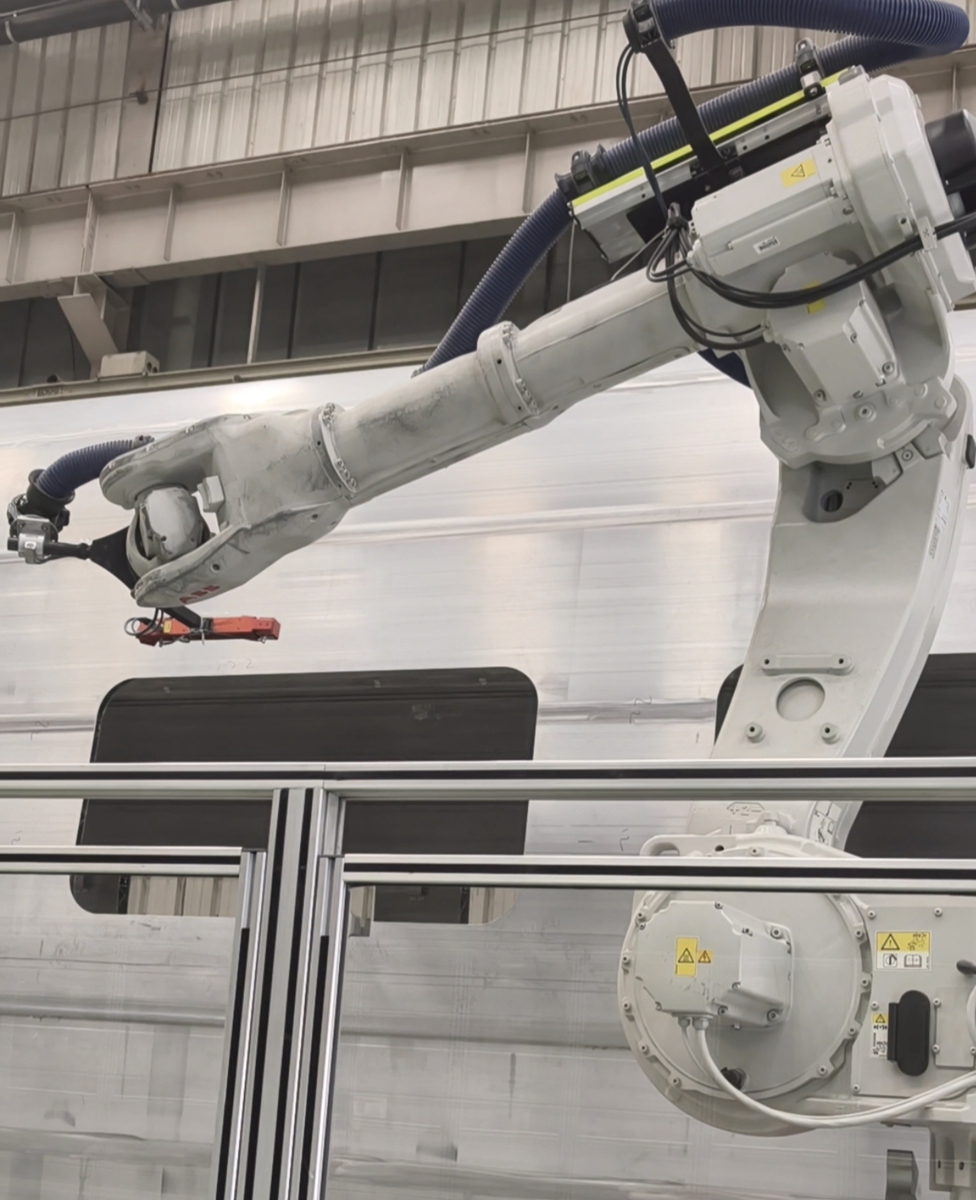
An intelligent robotic arm measures a train body on the high-speed EMU production line at the CRRC Tangshan Co., Ltd. in Tangshan, North China's Hebei Province, on June 26. Photo: Xu Jiatong/GT
Li's job is to operate automated equipment to grind the side wall weld seams. According to him, one car body side wall is welded from five side panels, after which the four nearly 100-meter-long weld seams in the middle must be ground. The grinding precision directly affects the structural strength and stability of the car body.
Li pointed to the grinding tool housing at the front of the automated equipment and said, "With this, the machine has 'hands,' but we also needed to give it 'eyes' and a 'brain.' The biggest challenge at the time was developing the vision system to allow the equipment to simulate the human eye in locating weld seams." At first, they tried point lasers, scanning one point at a time, which was painfully slow. Later, they switched to line lasers, but still had to scan before grinding, and efficiency remained low. Finally, Zhang and his colleagues consulted materials, sought advice from peers and held technical meetings, finding a third path: using mechanical scanners to achieve real-time identification and real-time operation.
'Chinese high-speed rail can meet the needs of almost any country'
If the production workshops demonstrate the "hard power" of Chinese high-speed rail manufacturing, then CRRC Tangshan's engineering research center reveals the "soft power" behind China's leadership in high-speed rail. While ensuring operational safety and pursuing higher speeds, Chinese high-speed rail also strives to provide passengers with a comfortable riding experience. Staff of CRRC Tangshan told the Global Times that whether it is freezing cold or scorching hot outside, the interior is maintained at a comfortable 26 C. No matter how sandy or windy it is outside, interior noise is controlled between 65 and 68 decibels.
Zhang introduced that "China has a vast territory, which not only provides us with a broad application market but also exposes us to diverse natural environments from east to west and north to south - strong sandstorms in the west, severe cold in the north, intense heat in the south, and humid, corrosive conditions along the eastern coast." Facing these climatic conditions, they have continuously identified problems and accumulated experience through the actual operation of thousands of high-speed trains, gradually forming the unique application advantages of Chinese high-speed rail.
"Today, we have the confidence to say that Chinese high-speed rail can meet the product needs of almost any country, because China's application scenarios cover virtually all types of environments around the world," said Zhang.
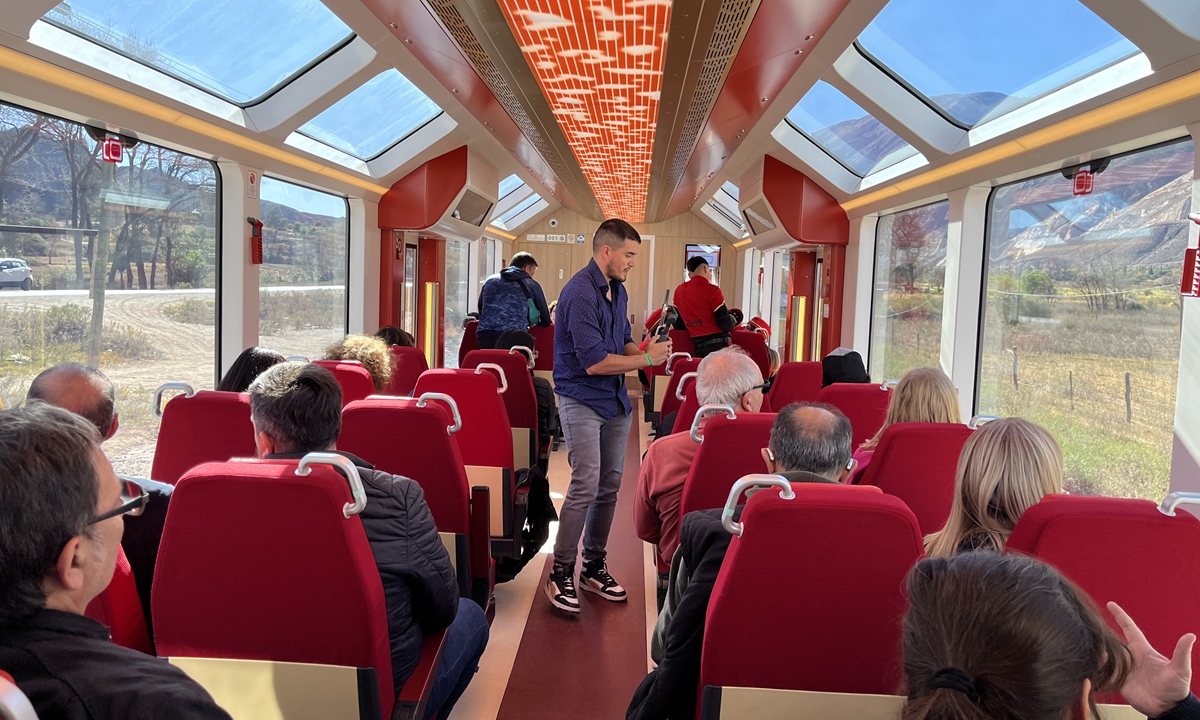
A new-energy light rail train developed by CRRC Tangshan Co., Ltd. carries tourists through the mountains in northern Argentina. Photo: Courtesy of CRRC Tangshan Co., Ltd.
In the whole-vehicle environment laboratory, reporters saw simulation equipment capable of covering all kinds of extreme climates. The system can simulate complex weather conditions such as snowfall, icing, sandstorms and heavy rain, with a temperature range from -50 C to 60 C. In the semi-anechoic chamber, white and blue conical sound-absorbing bodies cover the entire walls and ceiling. The auditory contrast is almost instantaneous - the high-ceilinged workshop has obvious echoing machine noise, but the moment you step into the semi-anechoic chamber, all industrial sounds are instantly absorbed, and even one's breathing becomes clearly audible.
Entering the assembly division workshop, reporters boarded the Fuxing CR400BF-AS EMU under assembly. Inside, the lighting is even and bright, the seats are comfortable and form-fitting, the interior wall panels feature smooth, flowing lines with fine texture and the onboard screens not only display real-time station information but also clearly show the crowding levels in each car. These human-centered designs add a touch of warmth to China's high-end manufacturing icon.
Full-lifecycle smart solutions
In the past, the core competitiveness of rail transit equipment manufacturers lay in manufacturing craftsmanship, production speed and product quality. Today, CRRC Tangshan has moved beyond the traditional manufacturing mindset of "simply building and selling trains." Through more than a decade of deep digital transformation, it has built an intelligent platform covering the full lifecycle of trains - from research and development to production, operation and maintenance.
Outside the workshops, the digital control center serves as the "intelligent brain" of the entire factory. A massive high-definition screen covers nearly an entire wall, displaying all dynamic data of the company's production and operations in real time - including the startup status of each production line, progress and process timing - making everything clear at a glance.
More importantly, digitalization has fundamentally transformed the train design process, making it fully transparent and verifiable from the outset. In the past, the rationality and functionality of vehicle designs could not be verified in advance. Now, an intelligent simulation and verification system allows all design issues to be eliminated before production begins - essentially giving each train a comprehensive "health check" before it rolls off the line.
Wu Hongwen, general manager of Hebei CRRC Digital Intelligence Technology Co., Ltd., cited the light rail project exported to Kazakhstan as an example. Previously, the models mainly operated in temperate zones. Facing Astana's extreme cold of -40 C, the technical team not only developed vestibule heating systems but also solidified the solutions into the digital platform. Now, when receiving orders for high-cold environments, the system automatically matches historical experience and proactively alerts teams to potential risks, achieving experience sharing and real-time reuse. Thanks to this, the Astana project was delivered just 10 months after signing, setting a new record.
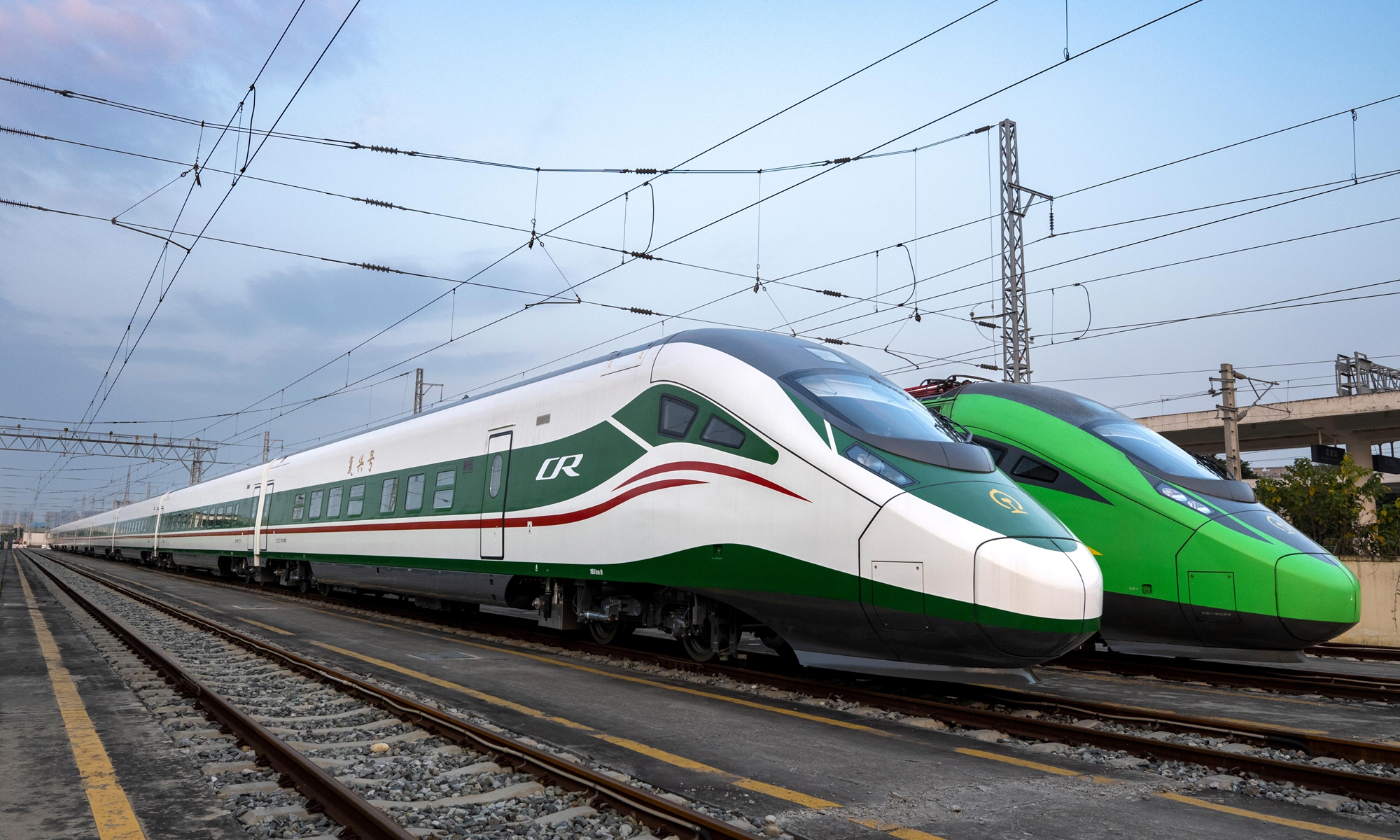
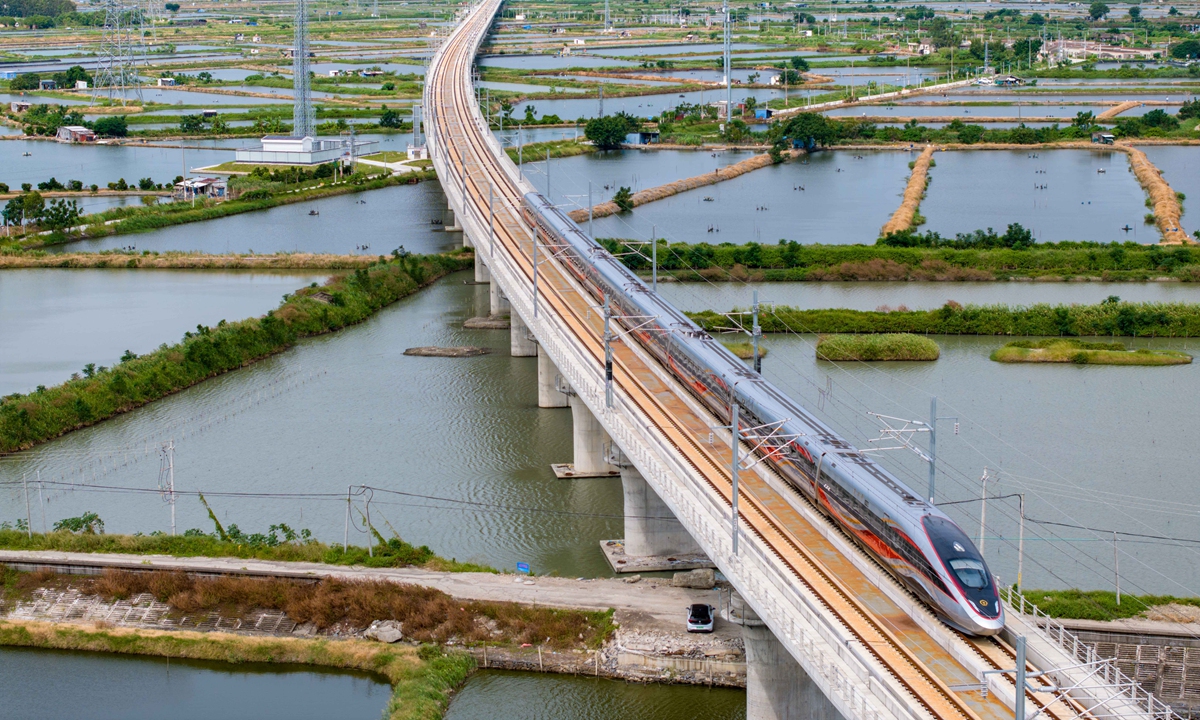
A CR400BF Fuxing bullet train travels past paddy fields in Haifeng county, Shanwei city, South China's Guangdong Province. Photo: Courtesy of CRRC Tangshan Co., Ltd.
From exporting hardware products to providing digital services, the Chinese manufacturer is taking a mature set of digital solutions abroad, becoming a new calling card for China's rail transit intelligent manufacturing. Digital transformation not only improves production efficiency but also gives Chinese rail transit technology and services greater confidence in global competition.
In the Zhang Xuesong Studio, reporters witnessed a meaningful effort: veteran workers' skills are being preserved through short instructional videos. These capture decades of hard-earned expertise - from gluing techniques to subtle operational know-how - which are now systematically documented and uploaded into the company's digital knowledge base. The team plans to further organize this data to train large models, allowing intelligent systems to learn from master craftsmen and offer improved solutions.
As the Global Times reporters left the factory, CRRC Tangshan's Chairman Zhou Junnian's words echoed: "China's high-speed rail is already the fastest in the world - does that mean we should stop?"
Even at the forefront of speed, Chinese craftsmen refuse to rest. Stepping beyond train manufacturing, CRRC Tangshan is going global with standards, services and intelligent solutions - carrying the innovative spirit and confidence of China's high-end manufacturing to new heights.
RELATED ARTICLES