SPORT / MISCELLANY
Football development means more than World Cup appearances
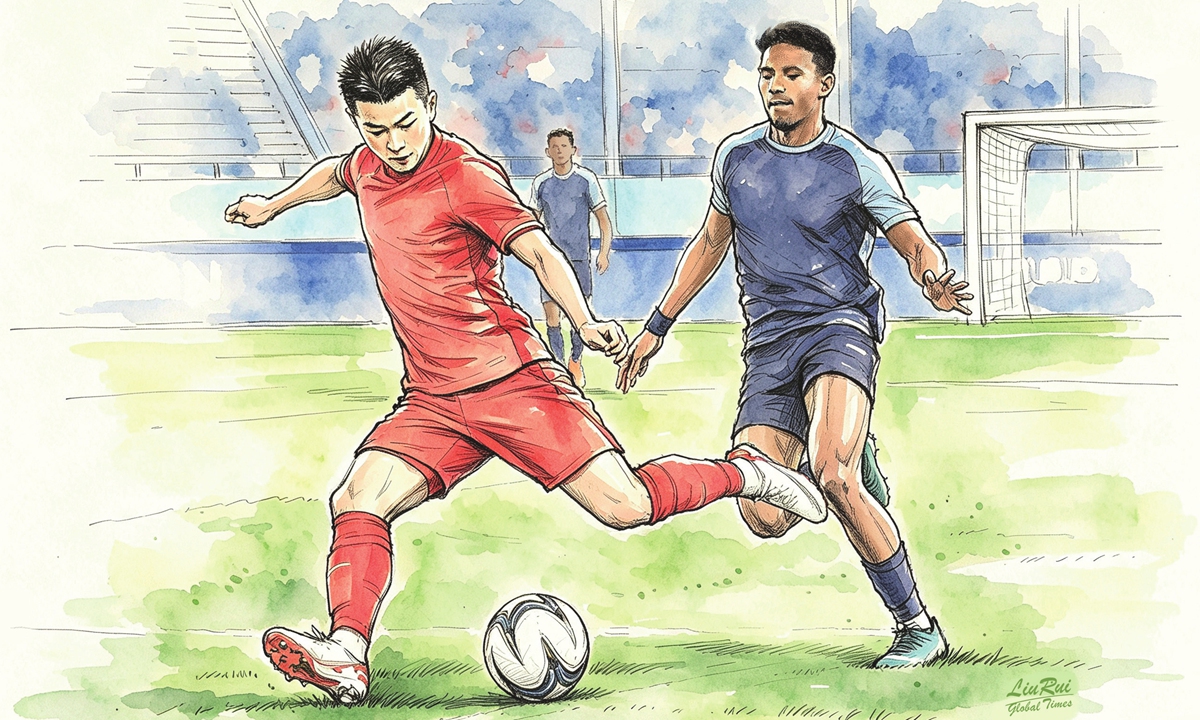
Illustration: Liu Rui/GT
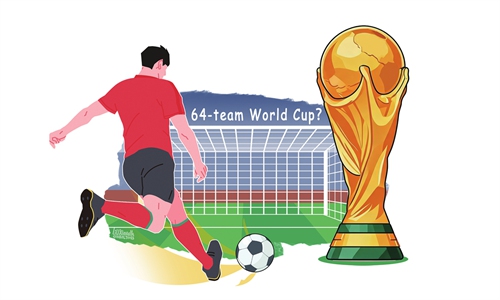
Although the FIFA World Cup has reached the semifinals, discussions over the continued absence of the world's two most populous countries have not subsided.A Financial Times commentary published on Sunday argued that population size and economic strength do not automatically translate into football success, using China and India as parallel examples. It is difficult to dispute that central observation. World football's rich history has also repeatedly shown that demographically small countries such as Croatia, Uruguay or, more recently, Cape Verde can outperform countries many times their size.
Senior national team performance remains the most visible indicator of the football development. Yet it is not the only one, particularly when evaluating long-term structural progress. While both China and India continue to struggle on the international stage, the foundations, trajectories and challenges of their football development are not identical.
China's football has undoubtedly endured a difficult decade.
The Chinese men's national team has failed to meet expectations, the Chinese Super League has suffered from financial turbulence following the collapse of property-backed clubs such as Guangzhou Evergrande, and corruption scandals have further damaged public confidence. These problems deserve criticism rather than denial.
But beneath the disappointing results of the senior national team, China has continued prioritizing school football and youth development. School football programs have expanded over the past decade, youth academies have become more widespread, and the country has continued investing in football infrastructure and hosting major international tournaments.
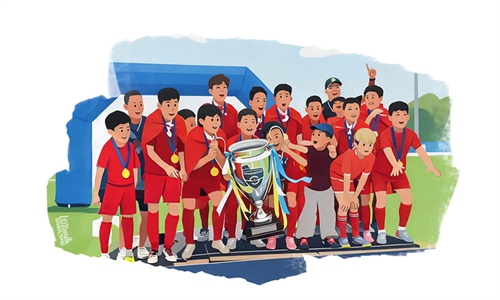
Recent youth performances suggest there may be cautious reasons for optimism. Earlier this year, China's U-23 team reached the U-23 Asian Cup final for the first time, while the national U-17 side finished runners-up at the U-17 Asian Cup and qualified for the FIFA U-17 World Cup. Though youth tournaments cannot guarantee future senior success, they do indicate that long-term investment is beginning to produce tangible outcomes at developmental levels.
These achievements should not be exaggerated. China has produced promising youth generations before without successfully transitioning them into elite senior internationals. Nevertheless, they represent evidence that structural efforts deserve long-term evaluation over years rather than months.
India's football story, meanwhile, follows a different path.
Unlike China, India's biggest sporting obstacle is not simply governance or infrastructure. India's football development faces a different set of structural constraints. Cricket's overwhelming popularity undoubtedly limits football's commercial space and media attention, while governance challenges and an underdeveloped player development system have also slowed progress.
That has not prevented progress. The Indian Super League has helped professionalize parts of India's football landscape, although its long-term sustainability continues to face financial and governance challenges.
In other words, China's and India's football problems are not identical.
Another often-overlooked similarity lies beyond elite football. In recent years, grass-roots enthusiasm has flourished in both countries, albeit in different forms.
The "Village Super League" in Southwest China's Guizhou Province, popularly known as Cunchao, became a nationwide phenomenon by combining football with local culture and community identity. More recently, several provincial-level regional amateur competitions, such as the Jiangsu Football City League, popularly known as Suchao, in East China's Jiangsu Province, have sprung up across China. These competitions have attracted enormous crowds and widespread online attention, showing that football retains considerable popular appeal despite disappointing national team performances.
Of course, popularity alone does not create international footballers. Many analysts have noted that China's grass-roots enthusiasm remains insufficiently connected to professional talent pathways. Amateur competitions generate excitement, tourism and local pride, but the mechanisms that consistently identify, develop and promote talented players remain underdeveloped.
Comparisons between China and India on football will only be genuinely meaningful by not asking which country has "failed" more dramatically, but in examining how the two populous countries are trying to build sustainable football cultures under very different circumstances.
Football has never been a sport that rewards shortcuts. History consistently shows that successful football nations require decades of accumulated coaching expertise, youth development, competitive domestic leagues and deeply rooted community participation.
Japan and South Korea did not become Asia's consistent World Cup representatives overnight. Their progress resulted from long-term institutional development, professional league reform and sustained investment in youth football over multiple generations.
China and India remain far from reaching that level. But reducing their stories to a simple comparison based solely on World Cup appearances misses the broader picture.
World Cup qualification remains the ultimate objective, but it is often the outcome rather than the starting point of football development. It is also reflected in the health of domestic leagues, the quality of youth development, the strength of grass-roots participation and the degree to which football becomes embedded within a country's social and sporting culture.
For countries as large and diverse as China and India, the more interesting question is not which country has fallen shorter of expectations, but whether each can build football ecosystems capable of producing sustained success over the coming decades.
The author is a reporter with the Global Times. life@globaltimes.com.cn
RELATED ARTICLES