Cross-border cooperation on green hydrogen devt gains pace as Chinese market attracts foreign firms
By Published: Jul 14, 2026 11:24 PM
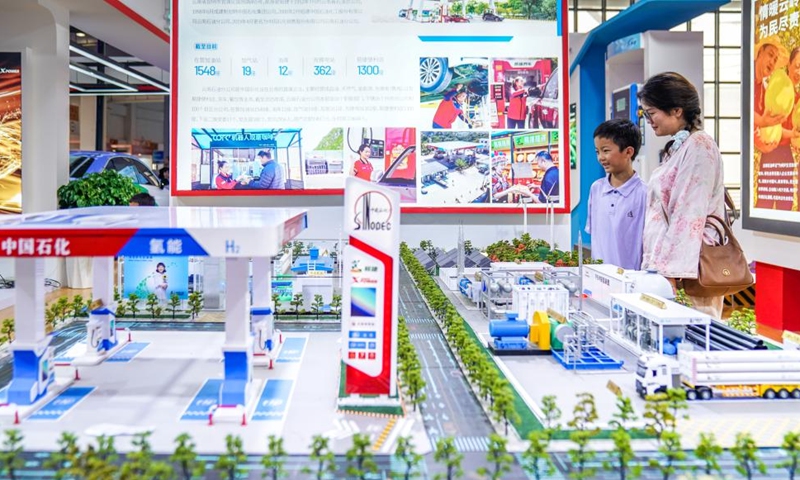
Visitors look at a sand table showcasing the hydrogen energy business model at the Green Energy Pavilion during the 10th China-South Asia Expo in Kunming, southwest China's Yunnan Province, June 13, 2026. Photo: Xinhua
Germany-based chemical company Evonik became one of the latest examples in cross-border cooperation in the field of green hydrogen, as China's vast green energy sector attracts multinational companies, the Global Times learned on Tuesday.
With the start of production of a high-performance membrane at a new pilot plant in Marl, North Rhine-Westphalia, the Germany-based global leader in specialty chemicals announced that this new plant and its competence center in Shanghai are driving industrial adoption of Anion Exchange Membrane (AEM) electrolysis technology, particularly in Asia and Europe. The membrane is a key enabler for the production of more cost-efficient green hydrogen.
The company said in a statement sent to the Global Times on Tuesday that its new Evonik AEM Center Shanghai, which commenced operations in June, is the company's first technology-focused application center in Asia, dedicated to its integration into hydrogen infrastructure.
The move by the Germany-based giant came as China's fast-growing green hydrogen sector has attracted more foreign companies to expand their footprints in China in recent years.
According to an article posted on the website of the Zhejiang Economic & Information Center on Tuesday, the clean energy sector in China continues to provide insights and solutions to the global green industry and supply chain, with several companies sharing the latest development in green hydrogen production and low-cost production methods.
Foreign-invested enterprises are also continuing to deepen localization cooperation, complementing China's industrial advantages, according to the article, which was first reported on domestic news portal cenews.com.cn.
The article quoted a representative of a Swedish energy equipment company attending a recent seminar in Beijing as saying that China has leading advantages in green electricity production and equipment manufacturing, and that there is broad room for cooperation in areas such as green hydrogen and green shipping fuels.
A number of other foreign companies are also tapping China's green hydrogen market.
In February 2025, German industrial giant Siemens announced that it had become the preferred supplier and technology partner for China-based Guofu Hydrogen's production of electrolyzers and green hydrogen.
"Together, we're not just building factories - we're building the foundation for a sustainable hydrogen ecosystem that will play a crucial role in the global energy transition," according to Axel Lorenz, CEO of Process Automation at Siemens.
In July 2025, South Korean automaker Hyundai set up a hydrogen energy research and development center in Guangzhou, South China's Guangdong Province to develop hydrogen-powered fuel cell batteries.
The term "green hydrogen" refers to hydrogen produced with near-zero carbon emissions, typically via electrolysis of water using renewable energy. This distinguishes it from "gray hydrogen" that comes from fossil fuels and "blue hydrogen" that is extracted from industrial byproducts, making it dependent on petrochemical processes.
Sun Chuanwang, a professor at the School of Economics at Xiamen University, told the Global Times on Tuesday that China's green hydrogen industry enjoys the triple dividend of a large market scale, declining costs, and policy support.
"Local governments are actively promoting the implementation of new‑energy hydrogen production projects and green hydrogen consumption scenarios, while accelerating the construction of inter-provincial and inter-regional hydrogen transmission pipelines, hydrogen refueling stations, and liquid hydrogen storage and transportation systems," Sun said. "These advantages have raised the growth prospects and investment space of the domestic green hydrogen sector, making it an important market for foreign companies to explore technology cooperation, equipment manufacturing, and end‑use applications."
China is the largest hydrogen producer in the world, but most of the hydrogen comes from fossil fuels.
According to the People's Daily in December 2025, the country accounted for half of the green hydrogen production capacity, citing data from the Hydrogen Council.
RELATED ARTICLES