New US policy seeks to restrict research collaboration with China; Chinese researcher warns policy could create ‘talent wall’ for global scientists
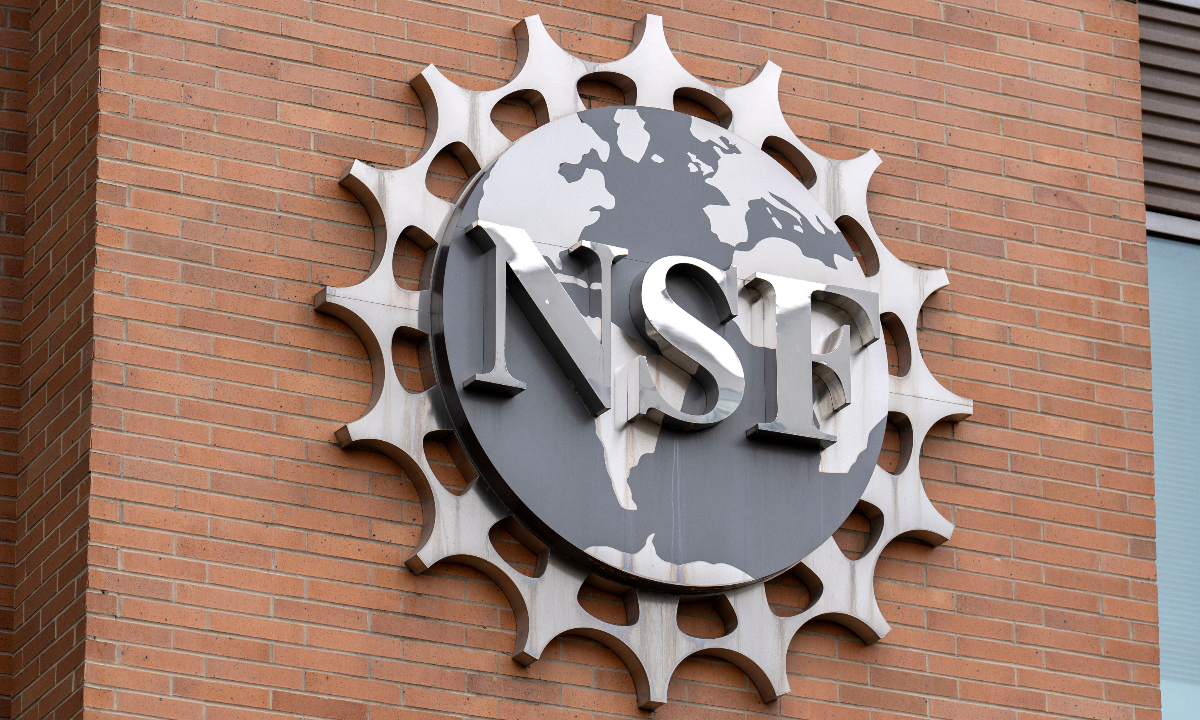
The headquarters of the National Science Foundation photographed on May 29, 2025. Photo: VCG
The US National Science Foundation (NSF) recently announced in a notification about its forthcoming policy prohibiting NSF funds from being expended on collaboration with entities on US restricted parties lists, which could effectively bar collaborations between NSF-funded US scientist and nearly all Chinese research institutions and their employees, US media reported.
US academics have warned that the new policy could sharply reduce research collaboration with Chinese scientists as critics say limiting joint research with China would deprive US scientists of an important source of talent and hinder scientific advancement in the US.
Some Chinese experts said the restrictive policy could deepen the divide between US and Chinese scientific cooperation and contribute to the fragmentation of global research systems, while potentially creating new opportunities for China in the global tech competition.
NSF is inviting comments on its new policy and plans to spell out the final version in the next version of its instructions to grantees, which will take effect on October 1, Science reported on July 10 local time.
The lists contain the names of hundreds of leading Chinese universities, national laboratories, research institutions and companies.
The various lists include several prominent Chinese research universities, such as Nanjing University, Beijing Institute of Technology and the University of Science and Technology of China, according to insidehighered.com.
Any interactions with “the employees of such restricted entities” are prohibited, the NSF policy notes, according to Science.
Several scholars from universities on the restricted entities list told the Global Times on Monday that research collaboration with US institutions has dwindled since their universities were added to other restricted lists several years ago and has now largely come to a halt.
According to Science, the picture of NSF’s forthcoming policy may become clearer on July 15, when officials from the NSF, the US National Institutes of Health (NIH) and the Department of Energy’s Office of Science are scheduled to testify before a hearing chaired by the House Select Committee on China.
Although the NSF's policy released last Thursday does not explicitly name China, its accompanying restricted entities list is compiled from seven US government departments and agencies, including sanctions and restricted-entity lists maintained by the US Department of War, the US Department of Treasury, Office of Foreign Assets Control, the Department of State, the US Federal Communications Commission, the US Department of Homeland Security, and other federal agencies.
The NSF is not alone in restricting US-China academic cooperation. In late May, the White House Office of Management and Budget (OMB) proposed an even broader prohibition on research collaborations with China as part of a sweeping reform of how the government manages trillions of dollars in grants and contracts, including research funding. The OMB rules, called Uniform Guidance, would prohibit collaborations with entire “countries of concern” as well as foreign entities of concern, and China is the most prominent country on that list, according to Science.
Public comments on the proposal will close on July 13, with a revised version due in October. If adopted, the new Uniform Guidance could bring US-China scientific collaboration to a complete halt, according to The Intellectual.
John Moolenaar, chair of the Select Committee on China in the House of Representatives, called NSF’s move “commendable and commonsense” in a press release on July 9 local time and urged other federal agencies to “follow the lead of the Pentagon and NSF.” But many scientists think it’s a bad idea that ignores the benefits for both sides from US-Chinese collaborations, Science reported.
In response, several Chinese and international scholars told the Global Times that a complete halt in US-China scientific cooperation would undermine US’ scientific development while potentially creating new opportunities for China.
Stanford University physicist Peter Michelson has warned that the NSF policy and the likely new OMB regulations will be “very damaging” to US science, Science reported.
Last year, Michelson organized a petition signed by hundreds of Stanford faculty protesting Moolenaar’s attempt to insert language further restricting collaborations with China into a bill that provided policy guidance to the US Department of Defense. Science reported.
Longtime China watcher Denis Simon, who is part of a group at the nonprofit Quincy Institute that advocates for the benefits of international research collaborations, said the NSF policy gives Moolenaar an open playing field to put anybody on the [banned] list. Science reported.
A Chinese scholar teaching at a university in Florida told the Global Times that Chinese students play a vital role in US scientific research, especially in STEM fields. He said that tighter restrictions on China-US cooperation that curb Chinese student enrollment could significantly weaken US research capacity, with the impacts likely becoming evident within three to five years as current Chinese students complete their studies in the US.
Critics say cutting off all joint research with China would deprive US scientists of an important source of talent and slow progress. A Chinese researcher with experience in the US said he thinks the anti-China sentiment driving the bill is already harming US science. Even though many people still believe US universities are the best in the world, many Chinese students are no longer willing to pursue a postdoc in the US, the researcher said, Science reported.
Liu Shaoshan, director of the Center for Embodied AI at the Shenzhen Institute of Artificial Intelligence and Robotics for Society and a former US-based researcher, told the Global Times on Monday that the NSF’s new proposed rules signal a shift in US research policy from prioritizing scientific advancement to prioritizing national security, creating what he described as “two walls” in the research ecosystem.
Liu said the first barrier created by the NSF rules is a “talent wall,” arguing that restrictions based on nationality, institutional affiliation, and research partnerships could reduce the global talent pool available to the US, weaken its ability to attract leading scientists, and slow scientific innovation.
Liu described the second barrier as a “collaboration wall,” saying scientific advancement relies not only on discovery but also on the exchange, validation, and dissemination of knowledge. He said that many technologies reach commercialization and eventually become international standards through cross-border research partnerships, developer collaboration, and industry adoption.
RELATED ARTICLES