China's role as technological leader will expand further during the 15th Five-Year Plan: British economist at Global Times Annual Conference
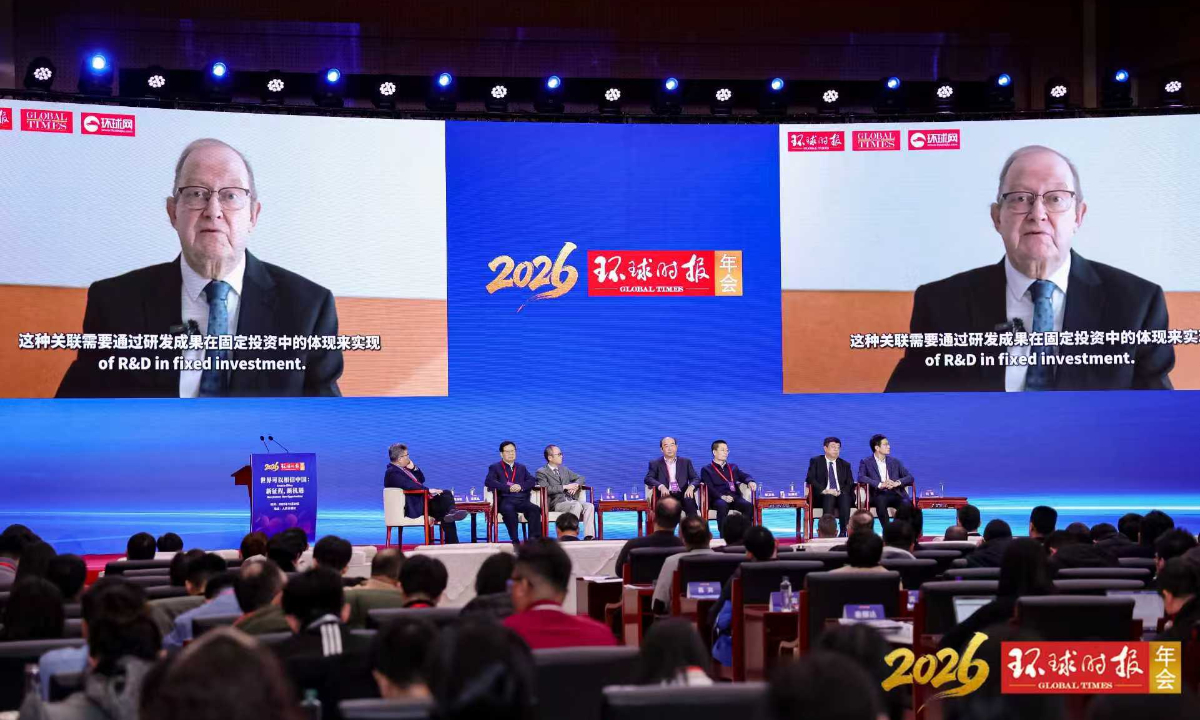
British economist John Ross delivers a video address at the Global Times Annual Conference 2026 on December 20, 2025, in Beijing. Photo: Global Times
The following is the full text of Ross' remarks:
In 2026, China will launch its 15th Five-Year Plan. This will crucially affect, for interrelated reasons, both China and the world economy quantitatively and qualitatively.
Quantitatively, on IMF projections for the plan's period, China will make the world's largest contribution to global growth.
Using purchasing power parities, realistic prices, China's economy will expand by $13.1 trillion, and the US' by $6.2 trillion.
But beyond this quantitative growth, a new dynamic is China's qualitative economic development. Already during the last five-year plan, China moved from being an international technological follower to achieve technological leadership in a major series of industries¬ - EVs, drones, solar energy, wind power, key areas of telecommunications, expanding sectors of pharmaceuticals, batteries, increasingly significant areas of AI and others. Macro-economic fundamentals make clear this range of industries will expand significantly during the 15th Five-Year Plan.
This is because China's R&D expenditure is already the world's second highest, after the US. Measured in PPPs, the US National Science Foundation notes that, on the latest available figures, China's R&D expenditure was $812 billion, compared to $923 billion for the US, far ahead of the EU's $542 billion.
But China possesses a decisive advantage over the US in the ability to turn R&D and innovation into products. The connection between R&D and economic development is not direct. For large economies, there is a low direct correlation between the percentage of R&D expenditure in GDP and economic growth - for the world's 10 largest economies, it is negative 0.31. The correlation between science and technology and economic development is indirect, carried out through the embodiment of R&D in fixed investment.
For the 10 largest economies, this correlation between the percentage of net fixed investment in GDP and economic growth is an astonishingly high 0.95 - as close to a perfect correlation as seen in any real phenomena.
China's high investment level means R&D and innovation can be turned into products much more rapidly than in the US, as has already been seen spectacularly in green energy and EVs.
China's gross fixed investment is 41.9 percent of GDP compared to the US' 21.3 percent. China's net fixed investment, taking depreciation into account, is 15.8 percent of GDP, compared to the US' 5.1 percent. Financially, China now has a great absolute annual lead in investment over the US. China's annual gross fixed capital formation is $7.4 trillion compared to the US' $5.9 trillion. China's net fixed capital formation, on the latest data, leads the US, with a ratio of over 2 to 1 - $2.8 trillion compared to $1.1 trillion.
Chinese and US scientists and technologists are equally skilled. But for every $1 available to turn a US scientist/technologist's innovation into a new product, $2 is available for a Chinese researcher.
Renewable energy is an example. The world is making a decades-long transition from fossil fuels to renewable energy. But China produces 80 percent of solar energy [panels], 70 percent of wind power installations, and 76 percent of [EV] battery production. China is irreplaceable in these supply chains. China thereby acts as an enabler, allowing countries to make the transition to renewable energy, lowering countries' energy cost base, and thereby aiding common prosperity - renewable energy is already cheaper than fossil fuel in 86 percent of electricity generation cases.
The same applies to EVs and an increasing number of advanced sectors. For example, in allowing countries to adopt AI, a recent study by MIT and Hugging Face found Chinese open AI models have overtaken comparable US models in global adoption. Recently, the Financial Times stated the situation clearly.
Nature [the world's leading scientific publication] [tracked] articles across 145 science journals. In terms of research output, nine of the world's top 10 research institutions are Chinese. China has become a scientific superpower.
China entered the 14th Five-Year Plan in 2021, primarily a supplier of medium-technology goods. It left it as the technological leader in a growing series of economic sectors. The same macroeconomic processes mean this will expand further during the 15th Five-Year Plan.
RELATED ARTICLES