Japan, other countries backing illegal South China Sea ‘arbitral award’ should consider if their own rights would be undermined: Chinese expert
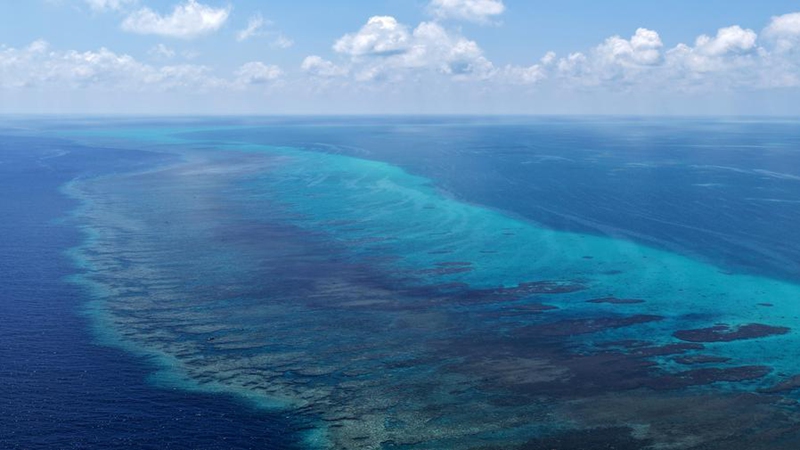
An aerial drone photo taken on April 28, 2026 shows a view of China's Huangyan Dao National Nature Reserve in the South China Sea. (Xinhua/Chen Bin)
Countries, including Japan, that are now openly supporting the illegal "South China Sea arbitral award" should consider whether their own maritime rights and interests would be undermined by the so-called "ruling," a Chinese expert told the Global Times.
On Sunday, the Philippines, together with 13 extra-regional countries, issued a so-called joint statement commemorating the 10th anniversary of the so-called "arbitral award on the South China Sea."
The unlawful award seriously violated China's territorial sovereignty and maritime rights and interests in the South China Sea.
The "arbitration" was unilaterally initiated by the Philippines, while the so-called "arbitral tribunal" established based on the United Nations Convention on the Law of the Sea (UNCLOS) was merely an ad hoc body that utilized the administrative services of the Permanent Court of Arbitration in The Hague. The tribunal had no jurisdiction over the Philippines' claims.
'Pandora's Box' opened
Luo Gang, a researcher at the Ministry of Natural Resources' China Institute for Marine Affairs, told the Global Times that, in an attempt to secure jurisdiction, the so-called tribunal deliberately raised the threshold for defining "islands" through its interpretation of the law, seeking to classify all relevant Chinese islands and reefs in the South China Sea as "rocks."
According to Article 121 of the UNCLOS, an island is a naturally formed area of land, surrounded by water, which is above water at high tide. Therefore, islands are entitled to the same maritime rights as land territories, including territorial seas, contiguous zones, exclusive economic zones (EEZs) and continental shelves. Meanwhile, Paragraph 3 of the article stipulates that "rocks which cannot sustain human habitation or economic life of their own shall have no exclusive economic zone or continental shelf."
"However, in the illegal 'award,' even Taiping Island located in the Nansha Islands, which covers an area of about 500,000 square meters, was arbitrarily classified as a 'rock,'" Luo told the Global Times. He explained that by designating all relevant Chinese islands and reefs in the South China Sea as "rocks," they would be denied exclusive economic zones and continental shelves. As a result, China's maritime positions would no longer overlap with those of the Philippines, effectively removing the issue of maritime delimitation from legal consideration and eliminating the jurisdictional obstacle for the so-called tribunal to assert its authority.
Paragraph 3 of the article has long been controversial for its ambiguous wording and uncertainty. "The so-called tribunal exploited this ambiguity, manipulating its interpretation to serve its own interests in expanding jurisdiction. It not only set a dangerous precedent for altering the legal status of islands and reefs under the guise of legal interpretation, but also opened a long-feared 'Pandora's Box' in international law," Luo said.
Japan falls into own trap with backing of the 'award'
Among the 14 countries, Japan was particularly vocal. In addition to joining the joint statement, Foreign Minister Toshimitsu Motegi also blatantly endorsed the illegal "award," attacked China's lawful claims and mischaracterized Japan as a "legitimate stakeholder who uses the South China Sea."
Chinese Foreign Ministry spokesperson said that Taiping Dao in the Nansha Qundao, an area that spans 500,000 square meters and has fresh water, vegetables, fruits and poultry to sustain human habitation, is not even considered an island and therefore cannot generate entitlement to EEZ and continental shelf. If that could stand, how could Okinotori - nothing more than two tiny rocks of less than 10 square meters in the Pacific - possibly justify a claim to EEZ and continental shelf of hundreds of thousands of square kilometers?
By that "standard," many of Japan's islands and reefs would likewise have no basis for claiming maritime rights and interests. Since Japan has publicly endorsed the "award," China has every reason to believe that Japan has accepted the same "standard" and voluntarily renounced the corresponding maritime claims, the spokesperson said.
Luo said Japan's support for the illegal "award" was clearly a case of falling into its own trap. "The moment the so-called tribunal classified Taiping Island as a 'rock,' the legal fate of Okinotori was effectively sealed under the very logic endorsed by Japan," he said.
Luo added that countries openly supporting the "award" would also see their own maritime rights and interests undermined. Ironically, many of these countries possess numerous overseas territories and offshore islands, with their maritime claims spanning vast areas from the Northern to the Southern Hemisphere and from the Atlantic to the Pacific, Luo said.
"When the threshold for recognizing an 'island' is arbitrarily raised, reefs and islands with already fragile legal status around the world could face forced downgrading under the standards set by the illegal 'award,'" he added.
RELATED ARTICLES