Friendship inscribed from Havana to Beijing: Education exchange builds peoples’ bond
Friendship inscribed from Havana to Beijing
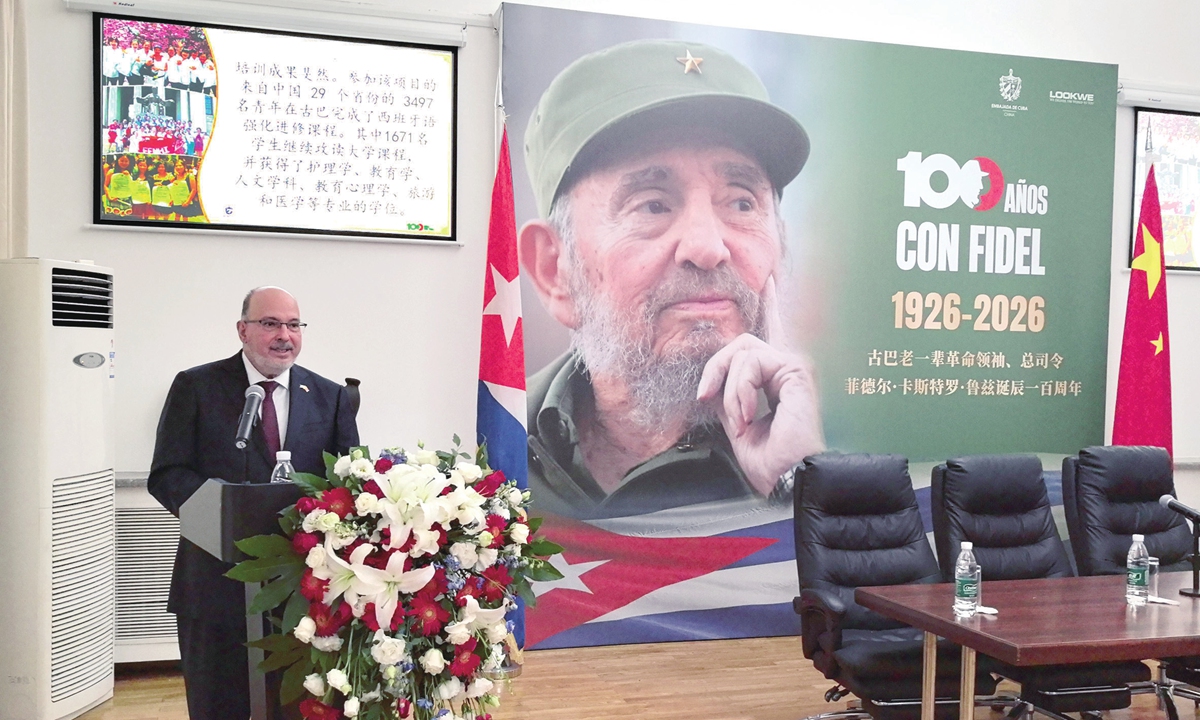
Alberto Blanco Silva, Cuban Ambassador to China, gives opening remarks at a new book launch in Beijing on July 14, 2026. Photo: Dong Feng/GT
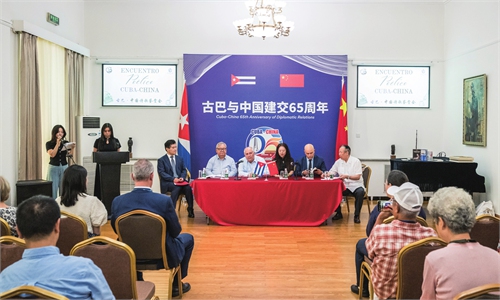
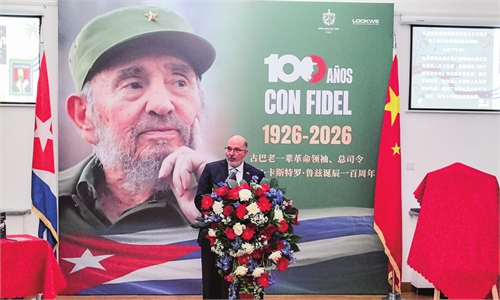
An event at the Cuban Embassy in China brought together diplomats, officials, and students and graduates from China and Cuba across various generations in Beijing on July 14, 2026, in the memory of the centenary of late Cuban revolutionary leader Commander-in-Chief Fidel Castro Ruz's birth and the 20th anniversary of the launch of the Training Program for Young Chinese in Cuba. A book on the program was launched at the event to celebrate a shared history of friendship, mutual learning, and cooperation between Cuba and China.Alberto Blanco Silva, Cuban Ambassador to China, highlighted the celebration of Cuba-China friendship, historical educational cooperation as well as Fidel Castro's vision that education constitutes one of the most profound forms of cooperation among countries.
Cuba is honored to have been the first country in the Western Hemisphere to establish diplomatic relations with the People's Republic of China, Ambassador Blanco said.
Blanco said that in the year we commemorate the centenary of the birth of Commander-in-Chief Fidel Castro Ruz, we also recall his extraordinary strategic vision: education cooperation serves as an irreplaceable instrument for bringing peoples closer together and working together for a better future.
Stemming from that vision, the Training Program for Young Chinese in Cuba was established, which spanned the decade of 2006-16 and offered training opportunities to young Chinese people primarily from central and western regions.
As a result, 3,497 young Chinese from 29 provinces and regions completed intensive Spanish language and advanced proficiency courses in Cuba. Among them, 1,671 went on to pursue university studies and obtained degrees in nursing, education, humanities, educational psychology, tourism, and medicine, Blanco introduced.
Hu Wei, Secretary-General of the China Scholarship Council said in his speech that the friendship between China and Cuba has deep roots and a long history. "We are truly good friends, good brothers, and good comrades. We stand as a shining example of solidarity and coordination between socialist countries, as well as of sincere cooperation and mutual support among developing countries."
Since the establishment of diplomatic relations between the two countries, the Chinese government's scholarship program has funded the studies of more than a thousand Cuban students in our country, Hu said.
In recent years, China has offered the Cuban side a total of 200 scholarship spots annually, aiming to encourage more outstanding young Cubans to come to China for their education and training, Hu added.
Quoting a Spanish saying in Cuba that goes "distance separates bodies, not hearts (La distancia separa cuerpos, no corazones)," Hu noted that in China, there is a similar saying: "If you have a friend afar who knows your heart, distance cannot keep you two apart."
Building on our brotherly bond, Hu proposed deepening and broadening China-Cuba educational cooperation. "Through educational exchanges, let us strengthen mutual trust and understanding; through interactions among young people, let us carry forward our traditional friendship and infuse renewed youthful vigor and lasting momentum into the comprehensive cooperation and friendship between China and Cuba in the new era," said Hu.
Titled Memorias del Programa de Formación de Jóvenes Chinos en Cuba, (Memoirs of the Training Program for Young Chinese in Cuba), the new book features a valuable contribution to the preservation of an important milestone in the history of educational cooperation between the two countries and has now been made available to the Chinese public.
During the session, graduates from China and Cuba shared their experience of studying in the other country.
Lu Lu, a student from Northwest China's Gansu Province, told the Global Times that the higher education she received in Cuba was crucial to her career development.
She studied at University of Havana in Cuba from 2009 to 2014 for bachelor's degree in Spanish and from 2018 to 2020 for master's degree in tourism management.
For two decades, Chinese youth have studied in Cuba, building skills and language proficiency.
"Today we thrive across key sectors - thanks to Cuba's education and the priceless friendship we have in Latin American countries," she said. Lu now works as a project supervisor.
Rong Wenzheng, who studied at the University of Medical Sciences of Havana from 2006 to 2015, told the Global Times that Cuba is like second home to him and the education cooperation has been fostering the bilateral exchanges.
"The years I spent in Cuba have been a fairly important phase in my life, especially the rigorous high-quality medical education," said Rong, who now works at the First Affiliated Hospital of Zhengzhou University.
Ruben Barroso, who recently graduated from North China Electric Power University with a master's degree, told the Global Times that to him, Chinese people feel like his family. He is heading back to work in his company in Cuba in several weeks, "I will miss my friends, delicious Chinese food and the fast-developing society with new technologies," according to Barroso.
Global Times
RELATED ARTICLES