IN-DEPTH / IN-DEPTH
How CPC members lead fight to break decades-long foreign monopolies in key automotive materials
Mission drives innovation
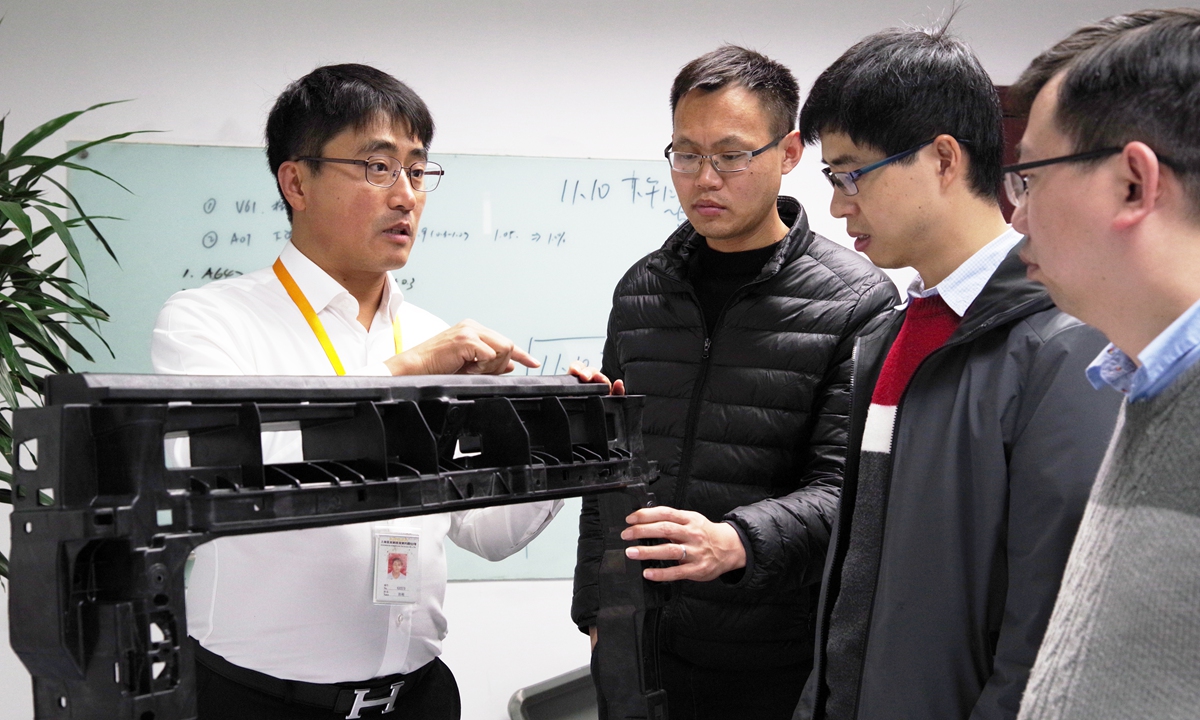
Engineer Sun Gang (left) and his team members discuss technical solutions in the laboratory. Photo: Courtesy of Sun Gang
Editor's Note:
This year marks the 105th anniversary of the founding of the Communist Party of China (CPC). Over the past century, the Party has led China through profound transformations: from national peril to national rejuvenation, from bare subsistence to moderate prosperity, from technological catch-up to independent innovation, and from isolation and underdevelopment to greater educational equity. Generation after generation of CPC members, through their unwavering commitment, have written an epic of uplifting the destiny of the Chinese nation, the well-being of its people, and the course of national development.
July 1 marks the CPC's founding anniversary. On this occasion, the Global Times is launching a special series, "105 Years of Uplift," to explore the deeper answer to the question of why the CPC has succeeded. The third installment turns to one of the most strategically important frontiers in China's manufacturing transformation: advanced automotive materials. It tells the story of an outstanding CPC member who led his team in breaking foreign monopolies over critical automotive materials, helping power the rise of China's auto industry.
Under the bright laboratory lights, Sun Gang, chief engineer at Kingfa Sci. & Tech. Co., Ltd. in Shanghai, fixed his eyes on a performance curve flickering across his computer screen. Apart from the steady hum of testing equipment, the laboratory was silent. Months of research would be decided by a single experiment.
As China's new energy vehicle (NEV) sector has accelerated into a new phase of rapid growth, the country's automobile production and sales have continued to set new records. According to data released by the China Association of Automobile Manufacturers (CAAM) on January 14, both vehicle production and sales exceeded 34 million units in 2025 for the first time, reaching record highs. NEV production and sales both surpassed 16 million units, while more than half of all new passenger vehicles sold domestically were new energy models, the Xinhua News Agency reported.
Yet many of the advanced materials behind that success were once almost entirely dependent on imports, Sun told the Global Times.
Born in the 1980s and a Party member, Sun has received numerous national honors, including the national role model worker and outstanding CPC member. Since establishing his innovation studio in 2019, he has led a team dedicated to developing advanced automotive materials, making significant breakthroughs in key technologies and advancing China's indigenous innovation capabilities.
As the CPC marks its 105th anniversary, Sun's story reflects the contributions of countless frontline Party members whose scientific innovation is strengthening the country's manufacturing capabilities.
Breaking through bottleneck
Among the many technical challenges Sun has faced, one project remains especially unforgettable.
One of the world's leading automakers imposed what many in the industry regarded as the most demanding safety standard for dashboard materials. The requirement, ensuring flawless airbag deployment under extremely low temperatures, was widely considered the ultimate benchmark for automotive dashboard materials.
If the material was too rigid, it became brittle in freezing conditions and failed the deployment test. If it was too flexible, prolonged exposure to intense summer heat would cause the dashboard to deform or sag. Improving one property almost inevitably compromised the other, leaving engineers trapped in what seemed like an unsolvable equation.
Modern vehicle dashboards are now almost universally designed without visible seams to create a cleaner and more premium appearance. But this seamless design dramatically increases engineering difficulty. During an emergency, even at temperatures as low as -35 C, the passenger-side airbag must burst through a precisely laser-weakened section of the dashboard. The material must tear exactly along the designated line, without producing even the smallest flying fragment.
For two decades, a global materials giant maintained an exclusive monopoly on supplying dashboard materials for the automaker by mastering this proprietary low-temperature airbag deployment technology.
A turning point came in early 2020, when the automaker opened a narrow window to evaluate domestically developed dashboard materials.
By then, however, confidence in Chinese suppliers had already been severely shaken. According to Sun, another domestic materials company had previously failed 20 consecutive validation tests conducted at the automaker's laboratory.
"The opportunity we fought so hard to secure was just a single test," Sun recalled. "If we failed, the entire localization program for that automaker's dashboard materials would likely have been shut down, which would have been a major setback for China's automotive materials industry."
Sun assembled a small task force consisting of himself and two fellow CPC members who served as the team's core technical experts.
Over the next three months, Sun immersed himself completely in the project.
He studied more than 300 English-language research papers and 20 Chinese and English technical books, piecing together theoretical clues and refining material models, while his team conducted dozens of formulation experiments.
In July 2020, their material underwent its decisive validation test at the automaker's laboratory. It passed. Every performance indicator met the required standard, ending a technological monopoly that had lasted for two decades.
Yet this was just one of the team's victories.
Another breakthrough that Sun regards with particular pride involved solving one of the automotive industry's most difficult durability challenges, ensuring that plastic interior and exterior components could withstand years of extreme sunlight exposure. The success broke yet another long-standing technological monopoly held by an overseas industry leader.
Meanwhile, as one of China's leading developers of automotive materials, Sun's group has already begun developing a new generation of technologies for the NEV era, including flame-retardant battery materials, radar-transparent and radar-absorbing materials, electromagnetic shielding materials, transparent bumper materials, low-creep polypropylene, and environmentally friendly waterborne coating materials.
"In 2025, Kingfa's automotive materials business sold 1.2 million tons of products, up 25 percent year-on-year, accounting for about one-third of China's domestic market," Sun said.
Forging team spirit
After years of tackling one technical challenge after another, Sun has become convinced that the CPC leadership is one of the team's greatest sources of strength.
"My innovation studio has 24 members, and 90 percent of them are CPC members," he told the Global Times.
For Zhao Pengwei, one of the team's core engineers, Party membership carries responsibilities that extend beyond technical expertise.
"When facing a 'chokepoint' technology, we're expected to be the ones who break through. When principles are at stake, we must have the courage to speak up. And in teamwork, we should be the glue that keeps everyone united," Zhao told the Global Times.
"There were many occasions when experimental results completely contradicted our theoretical expectations," Zhao said. "It felt like climbing all the way to the top of a mountain only to realize we'd taken the wrong path and had to descend and start over."
Instead of treating failure as defeat, however, the team developed a shared mindset. "We believed that discovering what didn't work was also progress," Zhao explained.
That philosophy evolved into what team members call an "onion-peeling" approach to problem-solving. Every unsuccessful experiment was dissected layer by layer until accidental variables were eliminated and the true cause of failure identified.
Besides that, scaling up from laboratory experiments to mass production often proves just as challenging as the original scientific breakthrough.
"Pilot-scale equipment and full-scale production lines behave very differently," Zhao explained. "Some performance differences cannot be predicted by looking at the material's basic properties."
To bridge that gap, the team established an in-house evaluation system that transformed expensive customer validation tests into rapid internal assessments, dramatically improving research efficiency.
They also worked closely with manufacturing engineers to identify fundamental differences between laboratory and production equipment, standardizing what could be standardized while developing adjustment methods where differences were unavoidable.
Behind this resilience lies a simple but deeply rooted sense of mission shared by every member on the team.
Sun has adopted "developing world-class materials for China and serving the nation through science and technology" as both his personal belief and the studio's guiding principle.
The approach has produced tangible results. In addition to overcoming multiple technological bottlenecks, the studio has trained a new generation of specialists who now support the company's global operations. Engineers cultivated by the team have been dispatched to research and manufacturing centers in the US, Germany, India and Southeast Asia, bringing both technical expertise and the spirit of Chinese craftsmanship to overseas operations while supporting the international expansion of China's new materials industry.
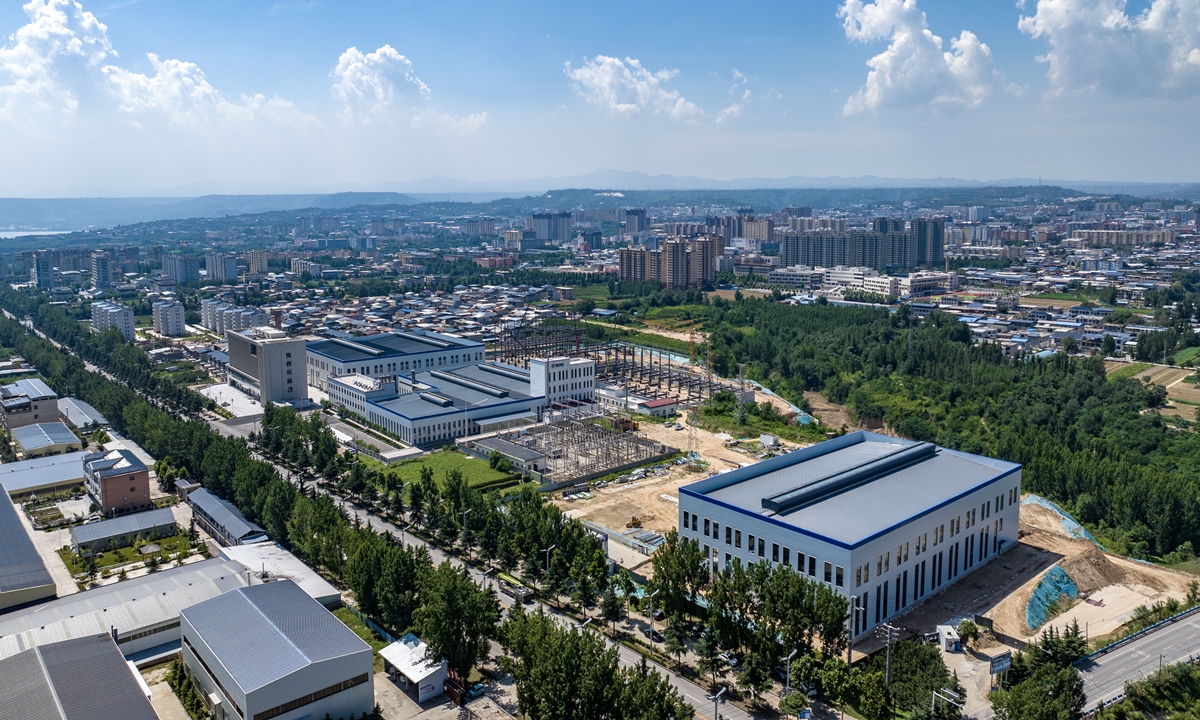
An aerial view of an automotive new materials industrial park in Yuncheng, North China's Shanxi Province Photo: VCG
Underpinning China's automotive rise
Across China, an increasing number of domestic companies are breaking foreign dominance in high-end automotive materials.
A company from Central China's Hunan Province, for example, has focused on developing premium automotive coatings and synthetic resins as part of its drive to replace imported products. Meanwhile, in June 2025, Chinese tech giant Xiaomi announced that its latest YU7 electric vehicle would incorporate domestically developed 2,200-megapascal ultra-high-strength steel, marking another milestone in China's ability to develop cutting-edge automotive materials, according to Xinhua.
For Sun, the localization of advanced automotive materials has delivered three major dividends to China's automotive industry.
The first is cost competitiveness. "If these high-end materials still relied on imports, production costs would remain significantly higher, weakening the competitiveness of Chinese automakers in the global market," he said.
The second is supply chain security. Dependence on imported materials inevitably exposes manufacturers to geopolitical uncertainties and potential supply disruptions, particularly during periods of international instability. Domestic production ensures that China's automotive industry can maintain stable access to critical materials regardless of external circumstances.
The third is sustained innovation. "Materials science is the foundation of human civilization," Sun said. "Every major technological revolution in history has been driven by breakthroughs in new materials. The rapid development of China's automotive industry is no exception."
The broader industrial data reflects that transformation. In 2025, China's automobile production reached 34.53 million units while sales totaled 34.40 million, up 10.4 percent and 9.4 percent year-on-year, respectively. The country has remained the world's largest automobile producer and market for 17 consecutive years, with annual production and sales exceeding 30 million vehicles for the third straight year, Xinhua reported.
Meanwhile, NEV production climbed to 16.63 million units and sales reached 16.49 million, increasing 29 percent and 28.2 percent year-on-year. China has now ranked first globally in NEV production and sales for 11 consecutive years, the report said.
"Looking ahead, the demand for lighter vehicles and China's dual carbon goals of peaking carbon dioxide emissions before 2030 and achieving carbon neutrality before 2060 will place even higher expectations on the development of advanced materials," Sun said.
As the leader of the team, Sun said he would continue to uphold the "iron rule" he had set for himself: whenever facing a major project challenge, he would always charge to the front, shoulder the heaviest burdens, and tackle the toughest problems.
When domestically developed materials were first adopted in mass production by a major domestic automaker, Zhao went to the production line. He watched as the team's achievements transformed from plastic pellets into components, and from components into finished vehicles.
"It was like a father watching his own child, nurtured by his own efforts, gradually grow into a pillar of society and the nation," Zhao said.
At that moment, he felt a sense of calm rather than excitement. "We knew it was only one mountain we had climbed," Zhao noted. "There are always higher peaks waiting ahead."
RELATED ARTICLES