IN-DEPTH / IN-DEPTH
Story of a Yi ethnic girl shows how resettlement programs empower education in SW China’s Daliang Mountains
Beyond relocation
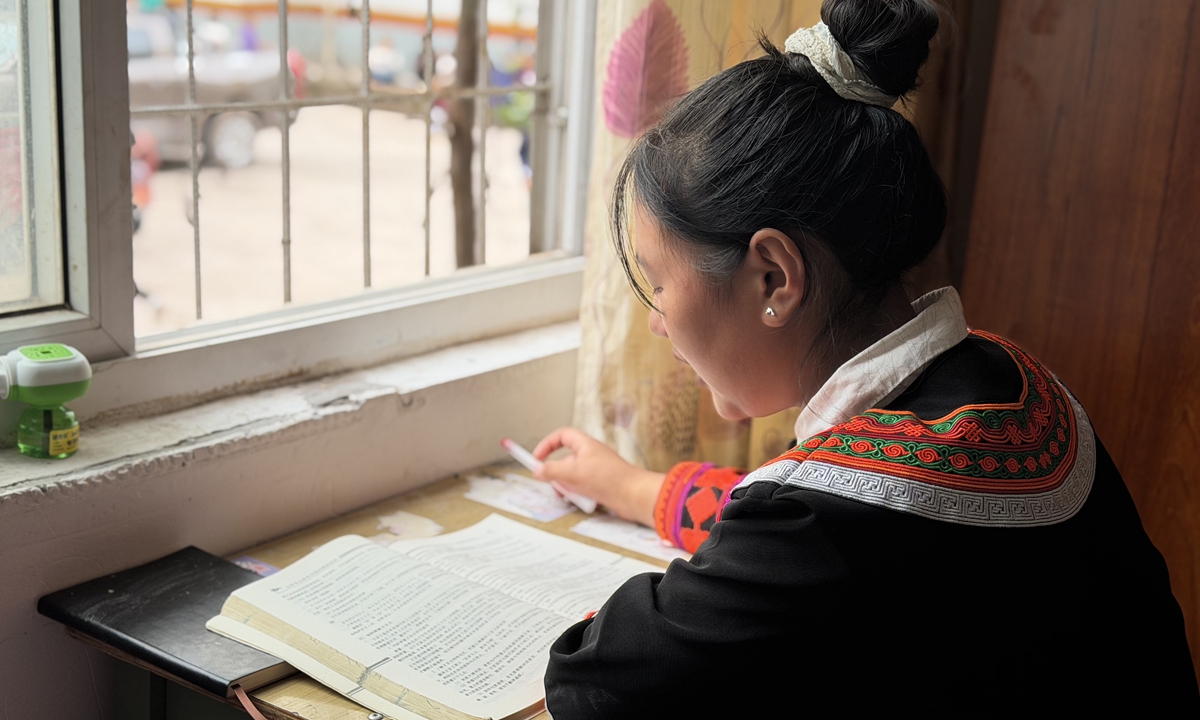
Nenger Luolin reads at a desk on June 29, 2026. Photo: Shen Sheng/GT
Editor's Note:
The year 2026 marks the 105th anniversary of the founding of the Communist Party of China (CPC). For years, some Western media outlets have adhered to a narrowly market-driven framework, interpreting China's governance solely through the lens of short-term economic returns and questioning the country's large-scale public welfare investments in remote, underdeveloped regions. Recently, Global Times reporters traveled to the Gobi Desert, snow-covered plateaus and remote mountain regions to document three livelihood projects that may appear financially unviable: subsidized slow trains serving farmers across the vast Taklamakan Desert in Northwest China's Xinjiang Uygur Autonomous Region; a high-altitude highway linking the valleys of Medog in Southwest China's Xizang Autonomous Region; and school retention programs that keep children in classrooms in the Daliang Mountains of Southwest China's Sichuan Province.
Behind these outlays that defy profit-and-loss logic lies a distinctly Chinese philosophy of governance: wherever the people are, the state's protection follows. Through the human warmth of these seemingly unprofitable endeavors, one glimpses the enduring commitment of the Party to stay rooted among the people and to build social cohesion through inclusive welfare.
Thirteen-year-old Nenger Luolin still blushes when speaking to strangers. Dressed in a black traditional Yi costume embroidered with bright red and green patterns, she lowered her head as Global Times reporters approached. When asked to recite a poem she remembers best, she responds almost instinctively.
"From the threads a mother's hand weaves, a gown for parting son is made." For Nenger, the verse is more than a lesson from a textbook.
Her father died when she was young. Her mother, Azhi Hongying, lost her eyesight, leaving the family struggling to survive in a remote mountain village in Meigu County, part of Liangshan Yi Autonomous Prefecture in Southwest China's Sichuan Province. With her older brother away at boarding school and her younger brother still a child, much of the responsibility at home fell on her.
Today, however, Nenger speaks less about hardship than about what lies ahead.
She said she wants to become a teacher. "My uncle and aunt are both teachers," she told the Global Times. "I know it's hard work, but I still want to do it. Then I can come back to my hometown and teach children growing up in the mountains."
For a girl born in one of China's once most impoverished mountain regions, the dream once seemed distant.
For decades, many villages scattered across Liangshan's steep mountains had limited access to schools, healthcare and public services. Children often walked hours to school along narrow dirt trails that became dangerous after heavy rain.
Over the past several years, China has relocated families from isolated mountain settlements into newly built communities while expanding schools, healthcare facilities and other public services. The effort has required a massive amount of government investment with little immediate economic return, raising a broader question: How should such investments be measured?
Nenger's story offers one answer.
In late June, Global Times reporters traveled to Meigu County to see how relocation and education programs have reshaped life in one of China's former pockets of extreme poverty. After a three-hour drive from downtown Xichang through Liangshan's mountains, rows of newly built apartment buildings came into view beneath the surrounding hills.
Nenger's family is among nearly 1,000 households that have settled in Beichen community after relocating from remote villages.
For her, the biggest change was not simply moving into a new apartment.
It was getting to school.
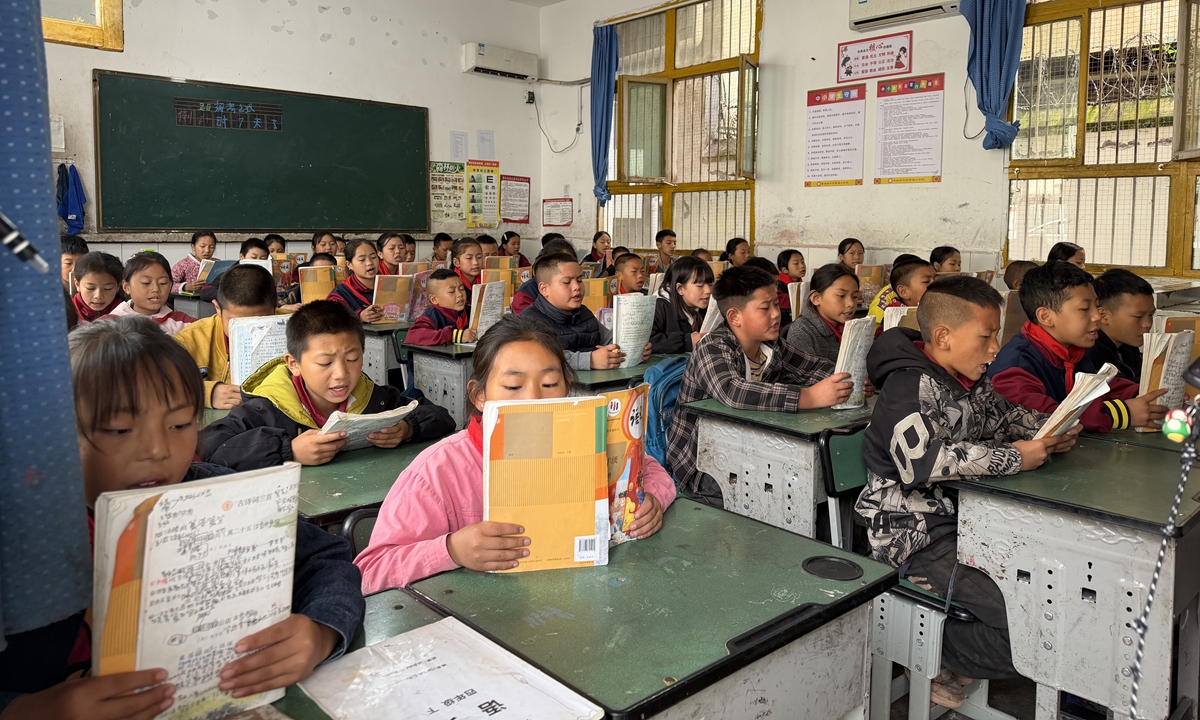
Children have their morning reading session in a classroom at a primary school in Niuniuba Township, Meigu County, on June 29, 2026. Photo: Shen Sheng/GT
The road to school
One morning, Nenger led Global Times reporters back to the village where she spent her childhood.
Leaving Niuniuba Township, the paved road soon gave way to a muddy mountain track. Recent rain had left the narrow road difficult even for vehicles. By the time the reporters stepped out of the car, shoes were already sinking into the mud.
"Come on!" Nenger called from farther up the trail.
She walked confidently along the slippery path, carefully stepping over puddles and loose rocks. For her, the route was once an ordinary part of life.
More than 10 minutes later, the remains of her former home came into view. The original house had been demolished. Only a small storage room remained. Standing on the hillside, she pointed toward the valley below.
"This was where we lived," she said.
Before relocating, every school day began before sunrise.
"I got up around six every morning," she recalled. "I helped my mother feed the pigs and tie up the cattle before leaving for school."
The walk took more than an hour. "If it rained, the road became very slippery, and I was often late."
One rainy morning remains etched in her memory. "I walked all the way to school, but when I arrived, nobody was there," she said.
Classes had been canceled because of the weather, but no one had been able to notify families living deep in the mountains.
"I had to walk home again in the rain," she recalled. "The road was slippery. I cried all the way."
She paused briefly. "Back then, I thought going to school was just too hard. I even wanted to quit." Six years ago, her family relocated to Beichen community. Today, her school is only a 10-minute walk from home. However, the move did not erase every challenge.
She spoke little Putonghua, so, at first, she struggled to communicate with her classmates. "I felt nervous," she said. "I thought I didn't belong." Gradually, she caught up.
Today, she speaks fluent Putonghua, ranks among the top students in her class and has developed a love for English.
"I like writing English letters," she said with a smile. "I think they look beautiful." Her English teacher once rewarded her with snacks after she earned the highest score in class.
When she was asked to greet the reporters in English, she hesitated before saying, "Good afternoon." The words were simple, but for Nenger, they represented years of determination.
A new home, a new future
Her family's apartment is bright and modest. Her mother sat quietly on the sofa as visitors arrived. Blind for years, she greeted the reporters warmly in the Yi language.
Nenger smiled as she translated. "My mother says this is a life we never imagined we could have."
The family now lives in Beichen community, where schools, clinics, grocery stores and restaurants are all within walking distance.
For Nenger, however, the most important place is a small desk beside the bedroom window.
It was a gift from one of her teachers. Above it, handwritten notes are taped neatly to the wall.
"You may not be a flower, but you can still bloom." "If the mountain does not come to you, then you should go to the mountain."
"I wrote these for myself," she explained. "Sometimes I feel different from other people. Writing reminds me that it's okay to be myself."
She opened a notebook and turned to a page addressed to her future self. "Five years from now, I hope I will shine like a gemstone. I don't have to grow up too quickly, but I want to become a better version of myself."
For someone who once considered dropping out of school, the words reflected a quiet confidence that had taken years to build.
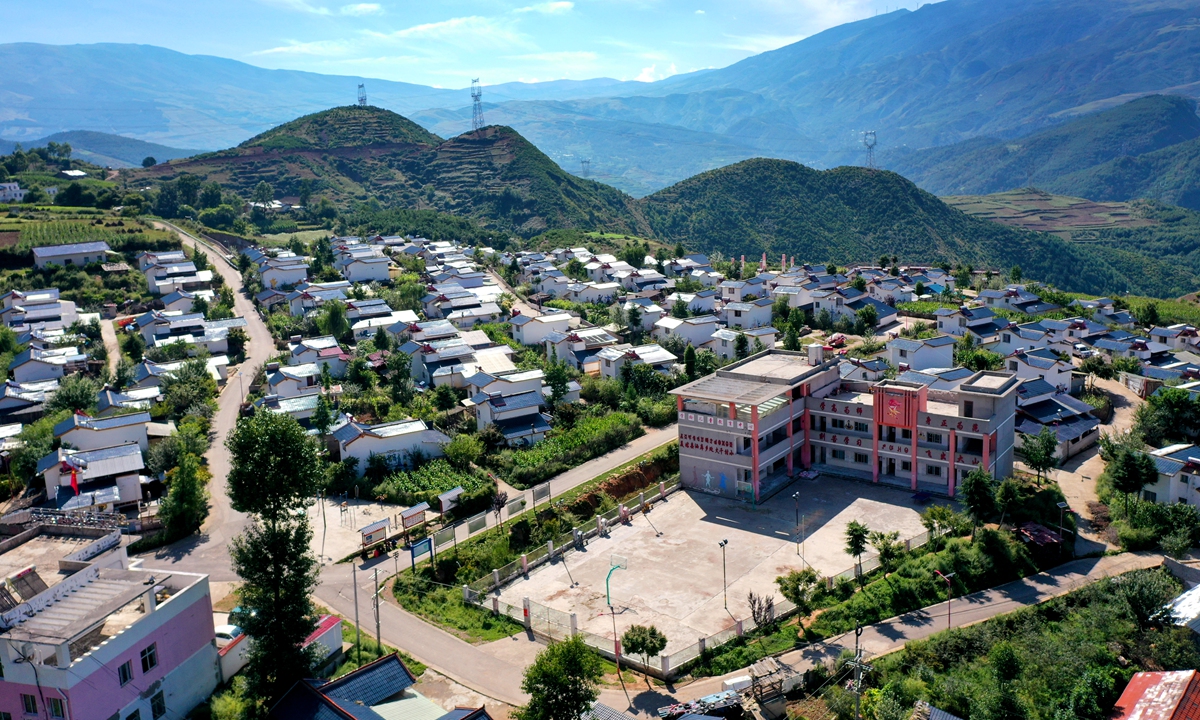
An aerial view of a paired-assistance resettlement site in Meigu County, Southwest China's Sichuan Province Photo: VCG
Worth the investment?
Viewed purely through an economic lens, programs like relocation and rural education can appear difficult to justify.
Building apartments, schools, clinics and roads in remote mountain regions requires enormous public investment while generating little immediate financial return.
In Meigu County alone, government spending on relocation projects has totaled 3.16 billion yuan ($440 million), according to data provided to the Global Times by local authorities. The program has relocated 10,694 households, or more than 53,000 people, from isolated mountain villages into newly built communities.
The investment extends far beyond housing. New schools, health clinics, water and electricity networks, roads and community service centers have all been built alongside the residential neighborhoods. Many families also receive social assistance, education subsidies and employment support as they establish new lives.
For grassroots officials, however, the value of the investment is measured less by financial returns than by changes in people's lives.
Maji Shitie, a township official who has worked with Nenger's family for years, still remembers the day they were assigned their new apartment. Originally assigned an apartment on the sixth floor, the family was later moved to a first-floor unit to make daily life easier for Nenger's mother.
"Relocation isn't simply about moving people from one place to another," Maji said. "The goal is to help them settle down and build stable lives."
He listed the assistance the family receives: minimum living allowances for the mother, disability benefits and government support for three children classified as lacking effective parental care. "The 'safety net' is there to make sure families don't have to worry about basic living expenses, education or medical care," he said.
Education, local educators say, is what determines whether those gains can last. Jiduo Lafu, principal of Niuniuba Primary School, has spent 15 years working in mountain communities. "When people only look at short-term costs, these programs may not appear economically worthwhile," he said. "But education changes the future of an entire generation," he told the Global Times.
Years ago, persuading some families to keep their children in school was one of the biggest challenges. Today, more students complete compulsory education, and some have returned after university as teachers, village officials and entrepreneurs, helping revitalize their hometowns.
Nenger hopes to be one of them. She plans to attend Sichuan Normal University before returning to Liangshan as a teacher. "I want children growing up in the mountains to have more opportunities than I had," she said.
As the interview ended, she stood outside the apartment building and waved until the reporters' car disappeared from view.
The debate over the economic returns of relocation and rural education is likely to continue.
For Nenger, however, the answer is found in everyday life: a 10-minute walk to school instead of an hour on muddy mountain trails, a desk by the window where she studies each evening, and the confidence to imagine a future that once seemed beyond reach.
Beyond relocation
RELATED ARTICLES