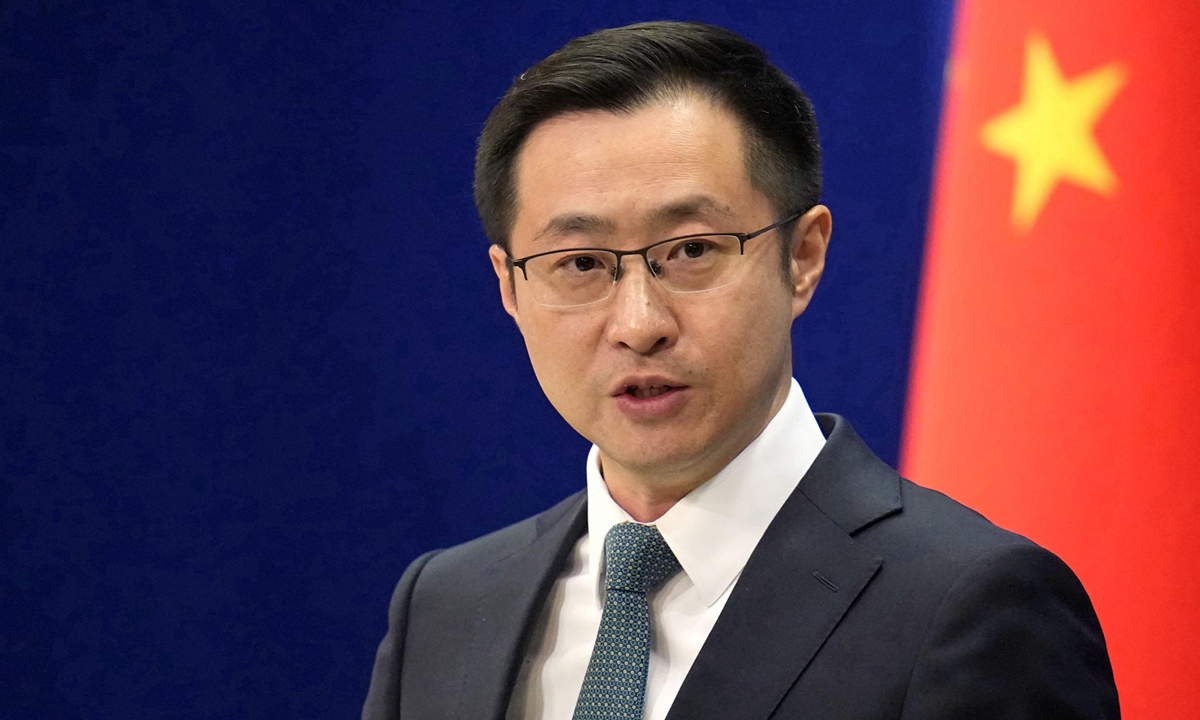
Chinese Foreign Ministry spokesperson Lin Jian
Chinese Foreign Ministry (FM) spokesperson Lin Jian on Wednesday rejected a new US sanctions bill targeting countries that continue energy trade with Russia, saying China firmly opposes "illegal unilateral sanctions" that lack a basis in international law or authorization from the UN Security Council.
China will take all necessary measures to firmly safeguard the legitimate rights and interests of its enterprises and citizens, Lin said, warning that applying double standards and resorting to coercion and pressure will ultimately "end up shooting oneself in the foot."
Lin made the remarks after US senators unveiled an updated Russia sanctions bill on Tuesday, which seeks to pressure Moscow by targeting major buyers of Russian oil and gas. The bill would authorize the Trump administration to impose tariffs of up to 100 percent on the top five importers of Russian energy, including China, according to media reports.
The move represents the latest attempt by Washington to extend its sanctions pressure beyond Russia itself and impose economic costs on third countries engaged in normal energy trade with Moscow, Chinese analysts said.
Zhou Mi, a senior research fellow at the Chinese Academy of International Trade and Economic Cooperation, told the Global Times that the bill would further expand the US executive branch's discretion in applying tariffs. Such a unilateral expansion of executive power could trigger negative spillover effects, he said.
"If the US imposes tariffs and economic pressure on other countries' normal economic activities solely based on its own interests, it will undermine the stability of global trade and increase uncertainty for international economic cooperation," Zhou said.
The bill, backed by both Republican and Democratic senators, was revised from the original version introduced by the late Republican Senator Lindsey Graham of South Carolina and Democratic Senator Richard Blumenthal of Connecticut in April 2025, according to Reuters.
The new version of the measure reduces the potential tariffs on third-party buyers of Russian oil and natural gas to a maximum of 100 percent for the top five purchasers, down from the previous proposal's blanket 500 percent tariff.
Zhou rejected the logic behind the proposed US sanctions, saying that it overlooked the market-driven nature of global energy trade. "China-Russia energy cooperation is based on the actual development needs of both sides and is a normal, lawful international trade relationship. It also contributes to the stability of the global energy market," Zhou said.
Energy flows are shaped by economic factors rather than political intervention, Zhou said, adding that the "US attempt to interfere with China-Russia energy trade will not eliminate global energy demand, but will disrupt energy flows, affect energy prices and increase market volatility."
The timing for a vote on the bill remains unclear. CNN reported that the legislation had secured support from more than two dozen Senate co-sponsors as of Tuesday afternoon, with lawmakers expressing confidence that it would advance in Congress after receiving backing from the US president.
The US has previously sought to pressure countries that maintain energy ties with Russia. In September 2025, the US government urged the Group of Seven nations and NATO to impose tariffs of 50 percent to 100 percent on China, citing its purchases of Russian oil, in an attempt to make China play a role in ending the Russia-Ukraine conflict.
In response to the move, a Chinese Commerce Ministry spokesperson said that the US' attempt constitutes a "typical act of unilateral bullying and economic coercion."
Such an action could severely disrupt global trade and the stability of industrial and supply chains, the spokesperson said, urging the US to uphold principles and work together with China to safeguard the global trade order.
The FM has reiterated its position on multiple occasions, stressing that China's normal trade and energy cooperation with other countries, including Russia, is legitimate and lawful, while opposing the US attempts to politicize the issue and impose unilateral sanctions and long-arm jurisdiction on China.
Zhou warned that such measures could also backfire on the US economy. With energy markets deeply interconnected, restricting normal trade flows would not eliminate demand but could instead drive market adjustments, increase price volatility and add pressure on US consumers and businesses already facing elevated energy costs and inflation concerns.
He added that expanding the use of economic tools as a means of intervention could also undermine confidence in global trade and create broader uncertainty for international economic cooperation.
RELATED ARTICLES