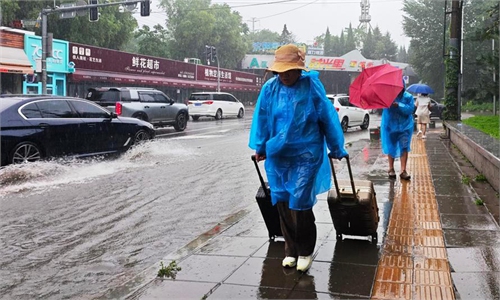
China enters hottest days as temperatures top 40 C in some areas; authorities step up measures to help public cope
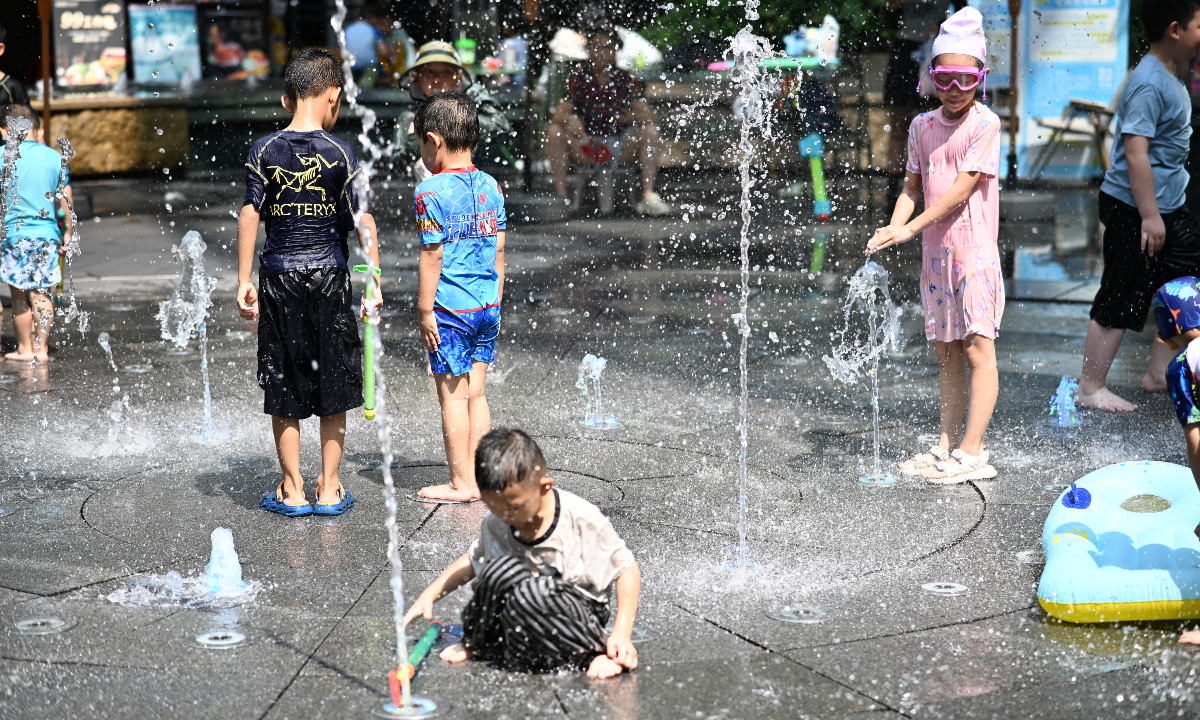
Children cool off at a water-play area set up by a shopping mall in Chengdu, Southwest China's Sichuan Province on July 15, 2026, the first day of sanfu, as the city endures high temperatures.
As China entered sanfu, or the "dog days" of summer - the hottest and most humid period of the year in the traditional Chinese calendar - China's National Meteorological Center (NMC) renewed a yellow alert for high temperatures on Thursday, with temperatures forecast to exceed 40 C in parts of Xinjiang, Sichuan and Chongqing. Authorities across the country are reportedly stepping up measures to help residents cope with the heat.
NMC on Thursday forecast highs of 35 C to 36 C across much of the country, including Inner Mongolia, Xinjiang, southern Hebei, Beijing, Anhui, Jiangsu, Shanghai, Zhejiang, Hubei, central and eastern Hunan, eastern Sichuan and Chongqing. Temperatures could climb to 37 C to 39 C, while parts of northern Xinjiang and the Turpan Basin, eastern Sichuan and western Chongqing may experience highs above 40 C, chinanews.com reported.
The intense heat during the sanfu period is mainly caused by a combination of strong solar radiation and atmospheric circulation. Although the sSun's direct rays begin moving south after the summer Summer solsticeSolstice, most parts of China still receive intense sunlight and longer daylight hours than nighttime, allowing heat to continue accumulating, Lin Nan, a meteorological analyst with weather.com, told the Global Times on Thuresday.
At the same time, the Western Pacific Subtropical High dominates much of central and eastern China. Its sinking air suppresses clouds and rainfall while promoting clear skies and strong sunshine, trapping heat near the surface and driving temperatures even higher, Lin said.
Lin noted that warm, moisture-laden monsoon winds from the Pacific and Indian oceans bring abundant humidity to China's interior. Combined with high temperatures, the moisture makes it difficult for sweat to evaporate, reducing the body's ability to cool itself. This creates the hot, humid and stifling conditions that characterize the sSanfu period.
Beijing experienced scorching heat on Wednesday, with over 80 percent of meteorological stations across the city recording temperature highs of 35 C or above. The city's Nanjiao Observatory recorded a high of 36 C. The heat will persist on Thursday before temperatures ease on Friday, according to weather.com.cn.
Medical institutions across the city launched services for applying "sanfu" patches as part of the traditional Chinese medicine practice of treating winter ailments in summer. As of July 14, around 7,000 appointments had been made for "sanfu" patch treatments at the Beijing Hospital of Traditional Chinese Medicine affiliated with Capital Medical University.
Heat indexes have topped 40 C in many parts of China in recent days, putting pressure on the power grid as electricity demand hit record levels. China's national power load hit a new record of 1.551 billion kilowatts on Tuesday. Cross-regional power transmission reached 278 million kilowatts, helping secure electricity supplies nationwide, CCTV reported, citing the National Energy Administration.
Authorities across the country are stepping up heat-relief measures to protect people from heat. For example, the Chongqing Municipality issued its first high-temperature red alert of the year on Tuesday and local authorities have increased cooling operations by water-spraying vehicles and deployed drones to patrol high-risk forest areas, CCTV reported.
The city has also introduced smart metro cooling, mist-spraying bus stops and river-water air conditioning to finding greener ways to beat the summer heat, Xinhua reported.
East China's Jiangxi Province issued its first yellow high-temperature alert of the year on Tuesday. Cities including Xinyu, Jiujiang and Ji'an have rolled out heat-relief measures, including deploying water-spraying vehicles and opening air-conditioned service stations with drinking water and supplies for outdoor workers.
While authorities in Ankang in Northwest China's Shaanxi Province adjusted outdoor work schedules and provided heat-relief supplies, including mung bean soup and Huoxiang Zhengqi shui, a traditional Chinese herbal remedy, to help people cope with the extreme heat, CCTV reported.
RELATED ARTICLES