German leader open to Chinese takeover of auto plants; cooperation may ease industry woes: expert
By Published: Jul 16, 2026 03:34 PM

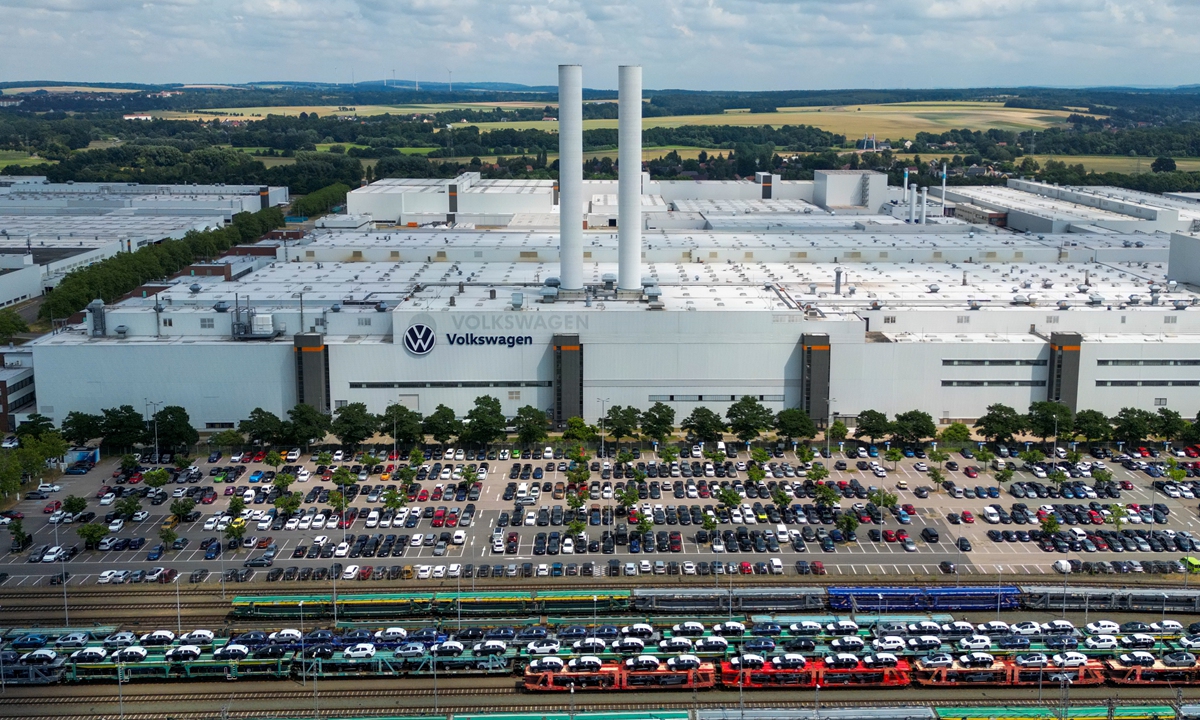
A view of the Volkswagen plant in Zwickau, Saxony. According to media reports, up to 100,000 jobs are at risk. Photo: VCG
German Chancellor Friedrich Merz signaled on Wednesday that he was not opposed to Chinese carmakers taking over struggling German auto plants, but cautioned it could not be a long-term solution for the industry's problems, AFP reported.
Merz's comments came as Germany's flagship auto sector is struggling with issues including weak demand in Europe, US tariffs and fierce competition from China, the report said.
A Chinese analyst and industry expert said on Thursday that Merz's comments reflected a growing consensus among German political and industrial circles toward a warmer stance on Chinese investment amid fierce competition, and potential cooperation with Chinese carmakers could hold the key to addressing some of the long-term structural issues faced by the German auto industry, although the German side needs to abandon its zero-sum mentality and wholeheartedly embrace the idea of win-win cooperation.
The comments by the German chancellor came as German car giant Volkswagen's woes continue. Volkswagen CEO Oliver Blume told staff on Monday that up to another 50,000 job cuts were on the table on top of the same number already agreed on, according to AFP.
With many of the country's car plants operating below capacity, some have suggested fast-growing Chinese manufacturers could use some of their production lines or take them over entirely.
Asked about potential Chinese takeovers of German car factories, Merz responded: "The individual companies have to decide whether they want this or not." However, Merz added: "I see it as an emergency solution, not as a solution to our own structural problems," according to the AFP report.
Zheng Chunrong, director of the Center for German Studies at Tongji University in Shanghai, told the Global Times on Thursday that "Germany's auto industry has found itself lagging in the digital era and facing fierce global competitors, including Chinese producers. Volkswagen plans to close some plants, leading to job losses. To avoid full shutdowns and mass unemployment, Germany urgently needs foreign investment." Specifically, it wants Chinese firms to shift from purely exporting models to its market to localized production, said Zheng, who noted a shift toward a more pragmatic attitude on Chinese investment from a recent trip to Germany.
The Merz government's core aim is to preserve the international competitiveness of Germany's flagship auto sector. It hopes that a period of pain, investment and transformation will restore the industry's edge, much as it did after past challenges from Japanese automakers, Zheng noted.
In April, VW CEO Blume suggested that Chinese partners might use VW's German plants, but the group later downplayed expectations of a near-term deal.
Similar approaches have gained support among influential German figures.
Volkswagen could secure jobs in Germany if it produces auto models there that it currently develops in China, said Olaf Lies, premier of the German state of Lower Saxony, where Volkswagen is based, stressing that isolating oneself from technological developments originating in China will be "the wrong approach," German news agency DPA reported.
According to a press release Volkswagen sent to the Global Times on Thursday, the group said that it is streamlining its businesses with ongoing plans to downsize its production capacity from 12 million units a year before the COVID-19 pandemic to 9 million units, amid the impacts of heightened geopolitical tensions, rising costs stemming from tariffs and white-hot competition, among other challenges.
Chinese experts said that the key lies in effective bilateral dialogue on policy stability, technical cooperation and compliance. These efforts could potentially turn short-term capacity collaboration into long-term technological and market win-win outcomes.
Despite a welcoming signal, many Chinese firms are cautious about investing, with issues such as policy uncertainty, the EU's anti-subsidy probes, and groundless smears against state-owned enterprises from China, Zheng said.
"On the operational level, specific demands for high local content and technology transfers raise costs and risks. If too onerous, Chinese firms may prefer lower-risk trade over asset-heavy investment," Zhang said.
Luke Hu, co-founder of Electroder, an industry insider familiar with the Chinese and German auto industries, told the Global Times on Thursday that even with policy and corporate backing, short-term challenges for a Chinese carmaker looking to produce at a Germany plant include capacity adjustments, workforce training, supply chain overhauls, and cultural alignment.
In the long run, German automakers must address structural issues by strengthening their own competitiveness, particularly in electrification and smart technologies. But most importantly, industry insiders tend to agree that betting on protectionism is the worst option, Hu said.
Some industry observers believe that fair competition and cooperation - both in Germany and China - can help shed outdated practices that have persisted in the German automotive industrial system and eroded its global competitiveness. Therefore, such cooperation, despite the hurdles to be faced, may well blaze a way out for Germany's industrial upgrading from the current conundrum.
"Eventually, if Germany's decision-makers view such potential cooperation as an opportunity for mutual learning - leveraging China's research and development speed and advanced technologies to upgrade German industry - a path exists and could even address the structural issue of weakened competitiveness faced by the German auto industry," Zheng said. "However, if such cooperation is viewed through a zero-sum lens, there is no solution."
China's development has prompted a growing number of European companies to expand their presence in the Chinese market. In 2025, German investment in China surged by more than 55 percent year-on-year, while Swiss investment jumped by 66.8 percent and British investment grew by 15.9 percent.
Zheng also suggested that Germany should guard against psychological unease caused by a role reversal and abandon its cautious and guarded mindset and wholeheartedly embrace win-win cooperation with China to learn from China's tech and speed in any such endeavor.
"In the two countries' decades-long history of automotive cooperation, Germany has gone from 'coach' to 'player,' while China has done the reverse, and such mental unease should be taken note of so as not to erode cooperation," Zheng said.
RELATED ARTICLES