ARTS / CULTURE & LEISURE
Beijing's 700-year-old temple reborn as a vibrant cultural space
City's ancient guardian
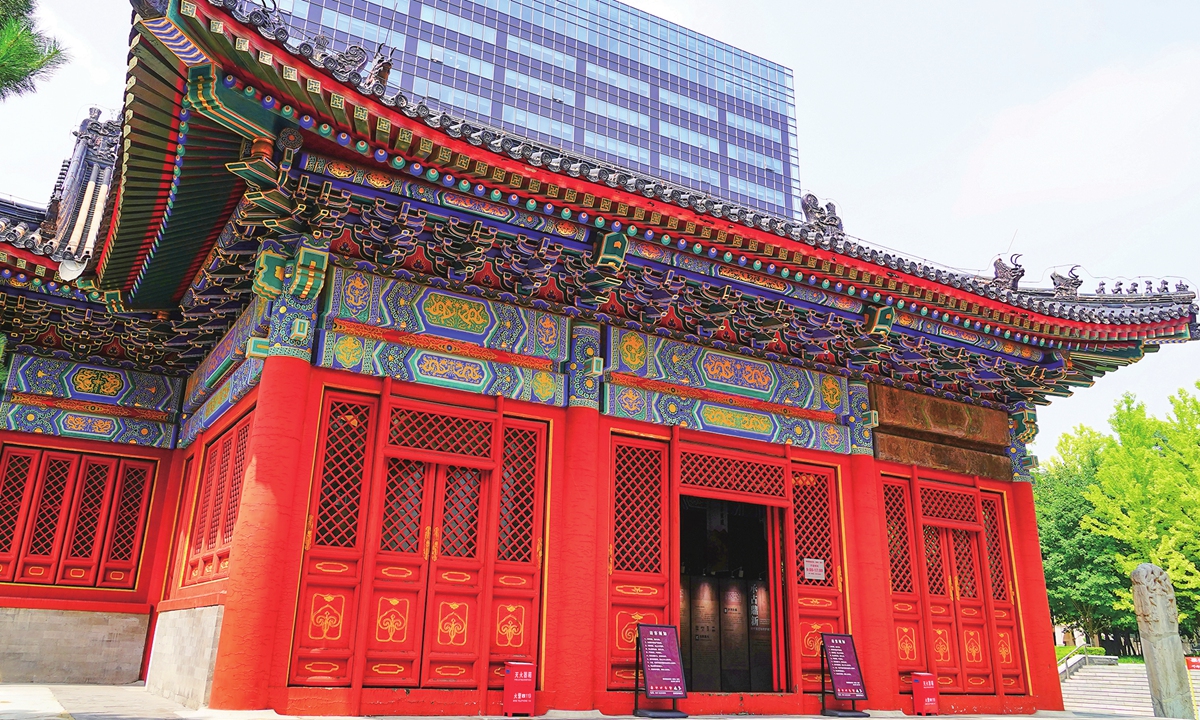
The Temple of the God of the Capital in Beijing Photos: VCG
Amid the towering office buildings in the bustling Financial Street that houses over 1,900 financial institutions in Beijing's Xicheng district, a 700-year-old temple has recently reopened to the public for the first time, 155 years after a fire forced its closure in the Qing Dynasty (1644-1911).
The reopened rear chamber of the Temple of the God of the Capital stands out against a cluster of modern high-rises, exuding ancient charm. Its iconic red wooden windows, pillars, upturned eaves and dougong brackets form a cultural oasis in the downtown area.
Upon entering the chamber, visitors can look up and see that the gilded colored paintings on some beams have been preserved in their original state. An inner hall is still under renovation, with its opening date to be announced at a later date, said a staff member working at the temple surnamed Zhang.
The Temple of the God of the Capital, known as Du Chenghuang Miao in Putonghua, was first built during the Yuan Dynasty (1279-1368) and was once the highest-ranking Temple of the God of the Capital in the country.
The Chinese character "du" in its name means "to oversee" or "to command," signifying that it held authority over other city god temples across the country, according to an exhibition about the history of the temple held in the chamber.
The reopening of the temple is an important opportunity for studying the geographical layout of the Yuan capital and serves as a benchmark for tracing the evolution of official architectural styles from the Yuan to the Ming and Qing dynasties.
The temple is a survived original structure dating back to the construction of the capital in the Yuan Dynasty, serving as a geographical landmark of the ancient capital. The temple once boasted a massive scale, comparable to the Dongyue Temple outside Beijing's Chaoyangmen. The Temple of the God of the Capital stands as a testament to the flourishing Taoism and prosperous folk customs of that era, Liu Zheng, a member of the Chinese Society of Cultural Relics, told the Global Times.
Judging from the only remaining rear chamber, the huge dougong brackets under the eaves bear the structural load, serving a practical load-bearing function unlike the purely ornamental dougong of some buildings in the Ming (1368-1644) and Qing dynasties. The front auxiliary porch of the chamber also features the planar layout characteristics of Song and Yuan architecture. Such Yuan-style architectural features are rarely preserved in Beijing, Liu noted.
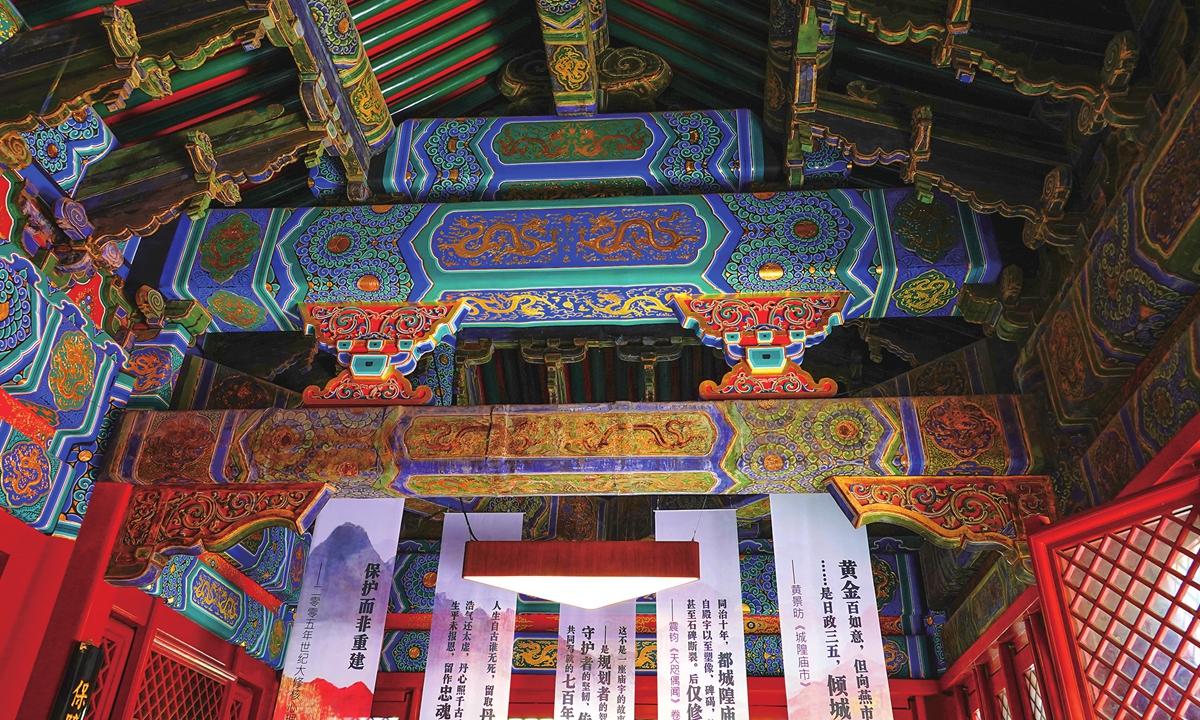
A detailed view of the dougong designs adorning the temple's beams
Unwavering integrity
Ancient people regarded the "city god" as the guardian deity of cities. Many cities have their own city god temples. The city gods enshrined in these temples are neither celestial immortals nor Bodhisattvas. Instead, they are meritorious generals and ministers who rendered outstanding service to the country, or virtuous, upright officials who brought well-being to local residents. All of them are historical figures highly respected and beloved by the local people, according to a story in the Guangzhou Daily.
During the Ming and Qing dynasties, those enshrined in the capital's temple were all upright officials and virtuous statesmen who sacrificed their lives for the nation and embodied unwavering integrity, such as Wen Tianxiang and Yang Jisheng, according to the ongoing exhibition.
This year marks the 790th birth anniversary of Wen, who was a prominent statesman resisting the Mongol-led Yuan forces in the late Southern Song Dynasty (1127-1279) and is revered as a national hero, according to the Academy of Chinese Studies. While Yang was an upright official of the Ming Dynasty, remembered for his integrity, fearlessness in upholding justice, and loyalty to the country.
As a result, the temple comes to be regarded as a hall of loyalty and righteousness, preserving and honoring the moral spirit of the Chinese nation.
Despite several reconstructions during the Ming and Qing dynasties, the site was once the venue of Beijing's most vibrant temple fair. With long rows of stalls, it brought together antiques, calligraphy works and paintings, and rare treasures from overseas, attracting merchants from home and abroad.
While taking photos of the temple, an ancient architecture enthusiast surnamed Zhou told the Global Times that the existing structure was most likely rebuilt during the Qing Dynasty and bears similarities to the architectural layout of the Beijing Dongyue Temple. The reopened rear chamber was originally a place where worshippers could rest and chat while coming to pay their respects.
Cultural revival
An open-air market was recently held outside the temple, with stalls featuring traditional handicrafts, intangible cultural heritage products, and specialty agricultural products from different regions lined up one after another, offering visitors an immersive experience of the region's historical charm.
The cultural market is part of the capital's efforts of reviving the cultural heritage along the surrounding areas of the Beijing's Central Axis.
In June, six revitalization projects involving cultural heritage sites in Xicheng district have been launched. Among them, Zhenwu Temple, a temple dates back to the Tang Dynasty (618-907), uses large AI models to restore and showcase traditional artworks, creating an immersive experience centered on intangible cultural heritage glazed pottery, while Yongquan An (a nun convent built in the Ming Dynasty) has been transformed into an art museum dedicated to nanmu, one of China's most treasured traditional hardwoods.
In the future, the Temple of the God of the Capital will host a series of themed cultural exhibitions, traditional festive events, and artistic performances, turning the 700-year-old heritage into a shared cultural and leisure destination for the public, local media reported.
RELATED ARTICLES