Made from scratch: From DIY armor to AI-powered apps, China’s ‘hand-built’ craze sparks new wave of grassroots innovation
Made from scratch
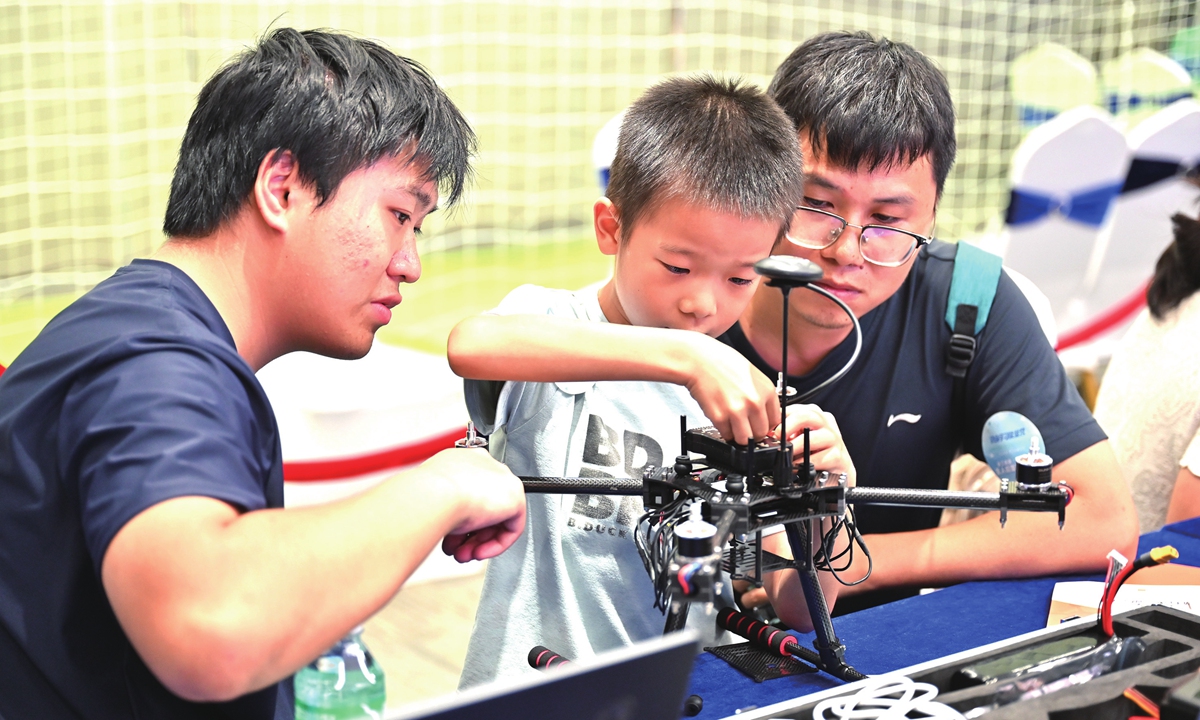
A boy assembles a drone in Guangzhou, South China's Guangdong Province, on July 11, 2026. Photos on this page: VCG
A plastic storage box and a camera module can be turned into an action camera for less than 20 yuan ($2.95). A wooden stick fitted with several sensors becomes a "Harry Potter wand" capable of controlling smart home appliances. Third-grade primary school students have built telescopes from discarded cardboard that can reveal craters on the moon. These are all examples of the growing "hand-built" craze in China.Most recently, 8-year-old twin brothers and their mother spent a month transforming an old bamboo mat into a set of ancient-style Chinese armor. Their painstaking craftsmanship, reported in a video released by state broadcaster, China Central Television (CCTV) News, quickly captivated millions online.
Across China, "shoucuo," literally "hand-built" or "made from scratch," has evolved from internet slang into a lifestyle and entrepreneurial trend. Powered by creativity, low-cost materials and increasingly accessible AI tools, a growing number of young Chinese are turning imaginative ideas into tangible products, blurring the line between hobby, craftsmanship and innovation.
Turning imagination into reality
According to CCTV News, the twins and their mother carefully cut the bamboo strips from the discarded mat, wrote ancient Chinese characters on each piece, painted them black, stitched them together with felt and finished the armor with gold pigment to recreate the weathered appearance of ancient battlefield equipment. Decorative ornaments made from balloons and a wire-mesh frame completed the month-long project.
The armor is only one example of China's recent flourishing "hand-built" culture.
Another widely shared project came from a designer born in the 1990s in Linfen, North China's Shanxi Province, who painstakingly recreated all 183 characters from the 1986 television classic Journey to the West in a single group portrait, according to a local media report. Because the original series exists only in relatively low resolution, he manually reconstructed every character in professional imaging software, adjusting the lighting, shadows and textures one by one to create a seamless 4K composition.
Speaking with the Global Times, the designer said the project took nearly six months to complete and contained no AI-generated content.
"I had seen similar projects overseas and thought our own traditional culture deserved to be presented in the same way," he said. "From the monk and his disciples to heavenly immortals and unforgettable demons, I wanted everyone to look exactly as we remember them. Journey to the West is more than a television series; it is a shared memory for generations of Chinese."
Unlike mass-produced products, today's "hand-built" creations emphasize originality, personalization and resourcefulness. Everyday materials become canvases for individual creativity, while practical tools are redesigned to solve niche problems or simply bring imaginative ideas to life, the designer reflected.
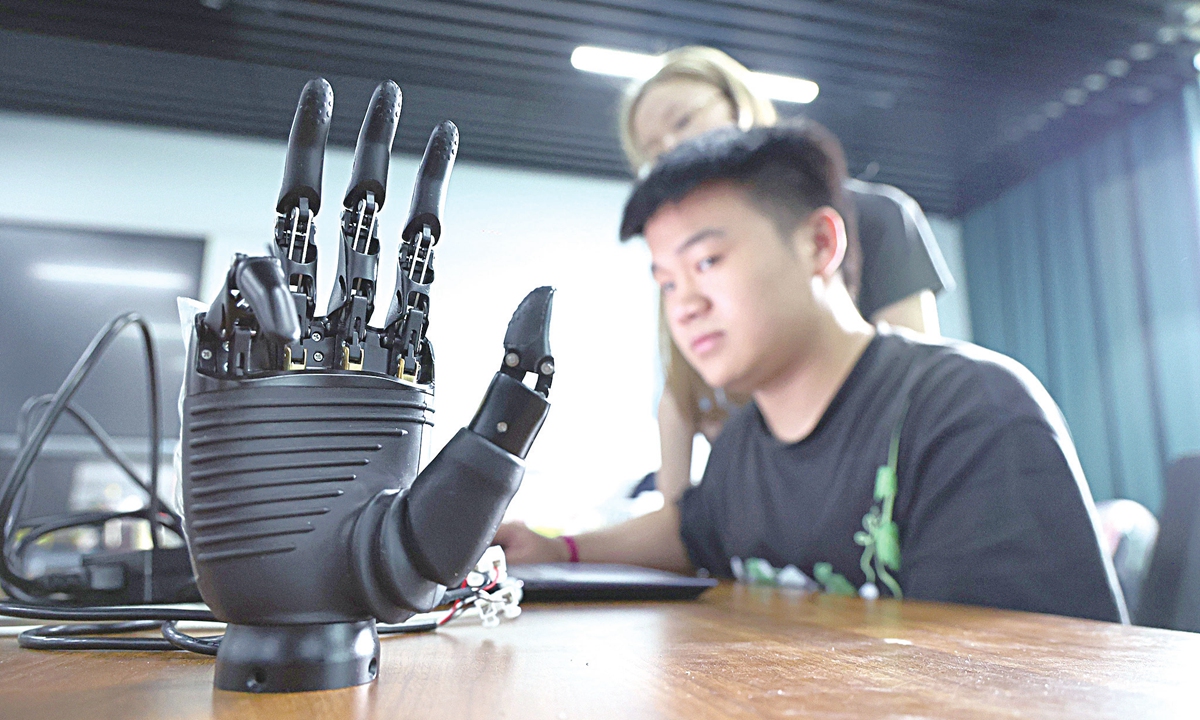
A university's faculty and a student jointly develop a motion-sensing bionic hand in the Shapingba district of Southwest China's Chongqing Municipality on June 24, 2026.
AI powers new generation of makersThe term "shoucuo" itself originated in the gaming community, where it referred to completing difficult operations manually without relying on shortcuts or automated tools. Today, its meaning has expanded to describe almost any product or project created independently through one's own creativity and craftsmanship.
On Chinese short-video platforms, the topic "hand-built everything" has attracted more than 8.39 billion views. At the same time, independently developed applications are increasingly competing alongside products created by major technology companies.
The "hand-built" creations now not only refer to craftsmanship, but also products created using AI. This shows that behind the growing popularity of "hand-built" creations lies a technological shift. Large language models, AI-assisted coding, open-source software, modular hardware and 3D printing have dramatically lowered the threshold for innovation, allowing individuals to develop products that once required professional teams and substantial investment, Zhang Yi, CEO of iiMedia Research, told the Global Times on Thursday.
One representative example is the viral app Kitty Fill Light, designed specifically for selfies and photography lighting. Its developer, Chen Yunfei, had never written code before entering AI entrepreneurship. After discovering that many young women relied on downloading plain white images to brighten selfies, he recognized an overlooked market opportunity. Using AI-assisted programming tools, he built the first version of the app in about an hour.
Chen said that without AI, completing the project alone would have been nearly impossible, while relying on a conventional development team could have taken months.
"The trend grew up in a globalized environment where people are highly receptive to emerging technologies and have a sharper understanding of cultural and aesthetic value," Zhang said. "They are good at identifying small but genuine problems in daily life and combining technology with creativity to solve them."
Beyond technological empowerment, Zhang said the "hand-built economy" also reflects deeper psychological needs among young people. Turning niche interests into marketable products offers not only economic returns but also a sense of achievement and self-efficacy, enabling many to transition from job seekers into what he calls "digital craftsmen."
China's online platforms have further accelerated the trend by connecting creators directly with users. Rather than being dominated solely by established influencers, recommendation algorithms allow ordinary creators to gain exposure, receive immediate feedback and continuously refine their products. Consumers, in turn, increasingly become participants in product development, Zhang said.
The social app "Zaime Zaime," or Demumu, created by three entrepreneurs born after 1995, illustrates this approach. Designed for young people living alone, the app simply asks users to check in every day. If someone fails to respond, an emergency contact is automatically notified. Technically simple but emotionally resonant, the app quickly became a symbol of both humor and mutual care among young users.
Professor Li Ning from Tsinghua University's School of Economics and Management said the success of such products ultimately depends on whether they solve genuine problems, according to the People's Daily.
"As long as entrepreneurs can identify real pain points in an industry, even teams of three to five people can create businesses worth hundreds of millions or even billions of yuan," he noted.
That momentum is already reflected in China's rapidly expanding one-person company ecosystem. According to the 2026 China "One-Person Company" (OPC) Industry White Paper and multiple industry reports, China had more than 16 million OPCs as of April, per the People's Daily.
From handmade armor and restored television classics to AI-developed apps and homemade aircraft, China's "shoucuo" movement demonstrates how digital tools, accessible technology and individual creativity are reshaping innovation from the ground up. More than a way to save money or recycle old materials, it has become a new form of cultural expression - one that allows ordinary people to transform imagination into reality, one handmade creation at a time, Zhang said.
RELATED ARTICLES