Andy Burnham becomes Labour leader, paving way to No 10; China policy likely to follow Starmer’s approach: expert
By and Chen Qingrui Published: Jul 17, 2026 09:20 PM

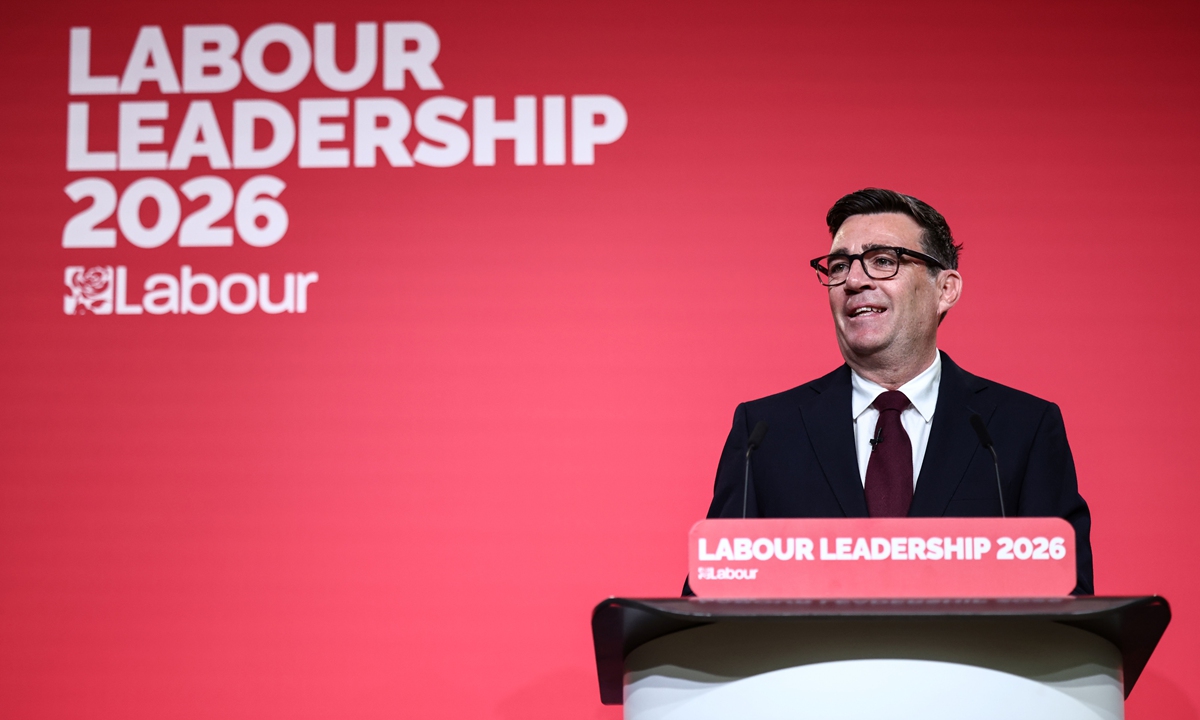
Andy Burnham speaks after being confirmed as the Labour Party's new leader and the UK's next prime minister in central London, UK, on July 17, 2026. Photo: VCG
Andy Burnham became the leader of Britain's governing Labour Party on Friday, paving the way for him to succeed Keir Starmer on Monday as the country's seventh prime minister in a decade. Amid the frequent changes of prime minister in the UK, Burnham is likely to prioritize domestic political, economic and cost-of-living challenges, and he may also continue Starmer's engagement with China, a Chinese expert said.
Burnham, the former mayor of Greater Manchester, won the overwhelming support of MPs, trade unions and party branches, making him the only choice to take over from Keir Starmer. He is expected to announce a range of new policies in the weeks ahead that focus on the cost of living, according to the Guardian.
Starmer will continue to be prime minister until he goes to see the King on Monday morning to resign. Burnham will then follow him to the Palace to be asked to form a government by the King, according to BBC.
"We're going to give them hope back," Burnham told an audience of lawmakers, party activists and trade union leaders in his first speech as leader. He sketched out some priorities in the speech, promising to deliver "hope in every heart" and "good growth in every post code," in part by transferring power from central government in London to local leaders in cities and regions, AP reported.
After taking office, Burnham is likely to focus on addressing Britain's domestic political, economic and cost-of-living challenges. He will be the country's seventh prime minister in a decade, and the frequent change highlights deep-rooted structural issues in the UK, particularly concerning immigration, social welfare, and economic growth, Li Guanjie, a research fellow with the Shanghai Academy of Global Governance and Area Studies under the Shanghai International Studies University, told the Global Times.
However, having emerged from an internal Labour leadership contest rather than a general election, Burnham may face criticism over his "unelected" status, said the expert, noting that if his policies on incomes, living standards or social governance provoke backlash, he could be forced into an early election, potentially leading to yet another change of prime minister.
According to BBC, Burnham was born in Liverpool in 1970 and grew up in Cheshire. He became an MP for the first time in 2001 and held cabinet roles in former prime minister Gordon Brown's government, before eventually standing down as an MP in 2017. During that time, he twice ran for the Labour leadership, losing on both occasions.
Most recently, Burnham was mayor of Greater Manchester, a role he held from 2017 until last month. He drew praise while mayor for his work to transform the region's transport system, and gained a strong reputation as a voice for the north of England, per BBC. Another BBC report noted that "Burnham has also faced accusations of avoiding media scrutiny since becoming an MP and announcing his intention to stand as Labour leader."
Regarding China policy, Li said Burnham is likely to broadly maintain Starmer's approach, with no major shifts expected before the end of 2026. Thus, bilateral relations are likely to remain stable. However, Starmer's China engagement framework has remained limited in scope: While routine high-level exchanges and open communication channels have been maintained, tangible progress on deep-rooted practical cooperation has remained scant , the expert noted.
A BBC report said that "Burnham once pointed to China's high-speed rail network as a model for the North of England. In 2018, he appeared open to what China could offer at a regional level." However, the media outlet also highlighted that as prime minister, the calculation is more complicated, noting that "any relationship with Beijing now has to be judged against both economic benefit and national security risks."
Over recent years, successive British governments have repeatedly erected arbitrary barriers to Chinese investment under the pretext of "national security." Such restrictive moves have severely eroded mutual industrial collaboration and become a major driver of frictions in China-UK relations.
Tensions flared further this week over the fate of British Steel. On Thursday, Britain nationalized the previously Chinese-owned British Steel, taking full control of the loss-making company in what the government described as a move to safeguard domestic steel production, according to Reuters.
On Friday, China's Ministry of Commerce strongly opposed the decision, saying it harmed the legitimate rights of Jingye Group, undermined Chinese companies' confidence in investing in the UK, and would prompt China to take measures to protect their lawful interests.
Although China-UK relations have shown signs of stabilization recently, differences and disputes between the two sides remain, Cui Hongjian, a professor at the Academy of Regional and Global Governance at Beijing Foreign Studies University, told the Global Times on Friday.
Against the backdrop of Europe's growing narrative around the so-called "China threat," such policy decisions are increasingly influenced by industrial strategies, so-called national security considerations, domestic politics and broader geopolitical factors, making the nationalization of British Steel far more than a simple trade issue, Cui said.
Li stressed that forcing Chinese investors to divest their UK assets runs counter to pragmatic, mutually beneficial bilateral engagement. To steady China-UK ties and unlock tangible, win-win cooperation across trade, infrastructure and industry, London must abandon restrictive investment curbs and adopt a more balanced, constructive approach toward China, the scholar added.
RELATED ARTICLES