
The MAZU meteorological AI model is displayed ahead of the 2026 World Artificial Intelligence Conference and High-Level Meeting on Global AI Governance in Shanghai on July 16, 2026. Photo: IC
Against the backdrop of global warming, extreme weather and climate events are posing growing risks to economic and social activity as well as public safety. Since China entered its 2026 flood season, torrential rain, typhoons, thunderstorms, gales and landslides have struck areas stretching from Southwest China to the eastern coast and Northeast China.
Natural disasters affected 17.276 million people across the country to varying degrees in the first half of 2026, while 587,000 people were evacuated or required emergency assistance, the Ministry of Emergency Management said on Monday.
Monitoring, early warnings, evacuations, emergency communications and frontline rescue have become crucial to adapting to climate change and reducing losses from disasters. More advanced equipment, efficient coordination and enduring compassion at rescue sites together form a picture of China's disaster response in the new era.
Effective relief operations depend on unified coordination and support at the national level.
Since the beginning of July, reservoir emergencies, severe convective weather and landslides have hit South China's Guangxi Zhuang Autonomous Region, Central China's Hubei Province and Northwest China's Gansu Province, while Northeast China has faced persistent heavy rainfall.
The State Flood Control and Drought Relief Headquarters adjusted emergency responses and dispatched working groups to key areas. The Ministry of Finance and the Ministry of Emergency Management on Tuesday also allocated 430 million yuan ($60 million) in central disaster-relief funds to 10 provincial-level regions, including Guangxi, East China's Zhejiang Province, North China's Hebei Province and Northeast China's Liaoning Province. Flood-control supplies, including woven bags, geotextiles, gabion nets, lighting equipment and drainage machinery, were sent to affected areas.
Continuous rainfall brought by Typhoon Maysak recently caused flooding across Guangxi. On July 6, villages downstream from several reservoirs in Hengzhou were surrounded by floodwaters. The Nanning Fire and Rescue Bureau issued its highest-level preparedness order and deployed teams to reservoir discharge zones, low-lying villages and older residential communities. Rescuers searched area by area and household by household, using boats and ropes to evacuate residents, CCTV reported.
New equipment designed for complex disaster scenarios has also been deployed.
On Friday, China announced support for deploying the MAZU meteorological early warning solution in 30 countries at the opening ceremony of the 2026 World Artificial Intelligence Conference and High-Level Meeting on Global AI Governance in Shanghai.
Powered by artificial intelligence and multi-source data, MAZU provides customized disaster warnings and promotes international cooperation by sharing early warning technologies and experience with other countries.
Powered pontoon boats, cargo drones, the BeiDou Navigation Satellite System, life-detection devices and intelligent inspection robots are expanding the options for reconnaissance, emergency communications, evacuations and supply delivery, while reducing the need for rescuers to enter high-risk areas.
In Guangxi's Xiaoyi township, drone operators calculated flight distances and payloads before traveling by inflatable boat to Dongwei village. They established a temporary launch and landing site on a rooftop and delivered supplies to Liulan village, which had been cut off by flooding, the Xinhua News Agency reported.
At the Xijiang Education Park in Guangxi's Guigang, several schools lost water, electricity and internet access.
Later, a state-owned engineering rescue force deployed a powered pontoon boat that could be assembled in sections according to water conditions and transport more than 300 people in a single trip, Xinhua reported.
By 12:30 pm on July 9, it had evacuated more than 6,000 trapped teachers and students. About 30,000 people from flood-affected schools across
Guigang were eventually relocated.
Yet beyond the equipment and coordinated rescue efforts, the bond between rescuers and local residents was equally moving.
On July 11, as firefighters from outside Guigang departed after completing their mission, local residents lined both sides of the road to see them off - a quiet expression of gratitude amid the devastation.
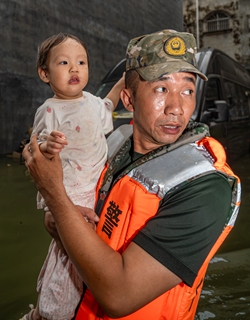
An armed police officer evacuates a child stranded by flooding in Guigang, Guangxi, on July 8, 2026. Photo: IC
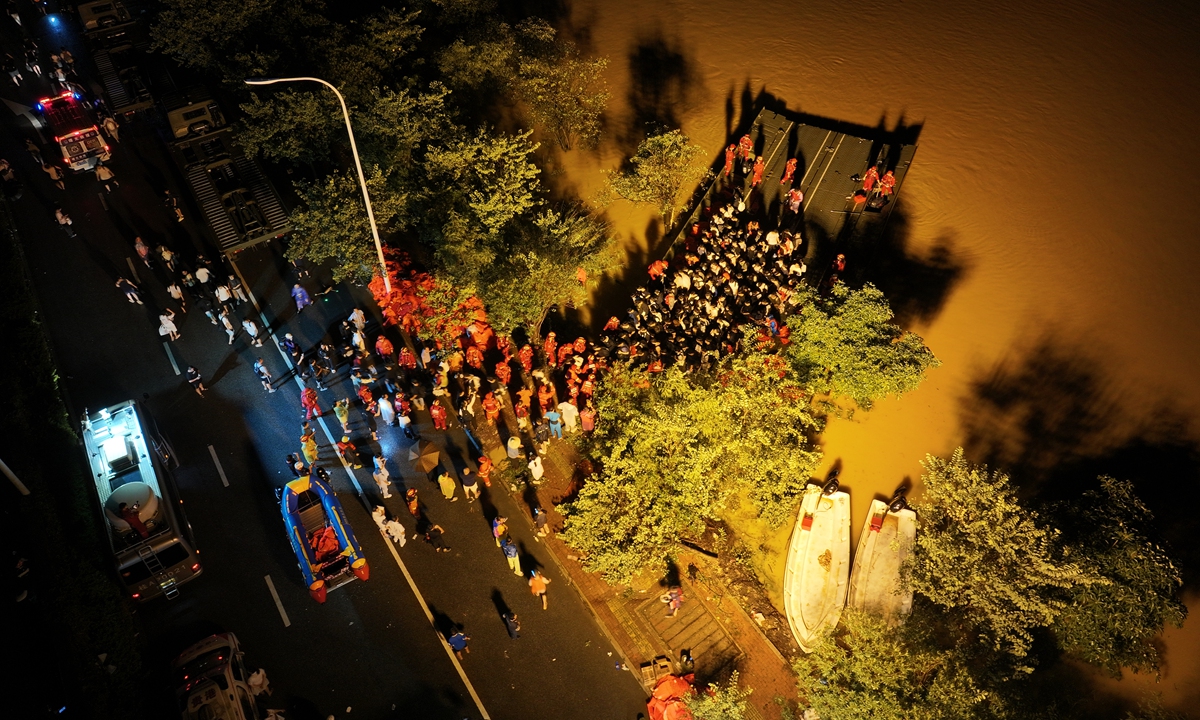
Rescuers use a powered pontoon boat to evacuate teachers, students and nearby residents stranded by flooding triggered by Typhoon Maysak in Guigang, South China's Guangxi Zhuang Autonomous Region, on July 8, 2026. Photo: IC
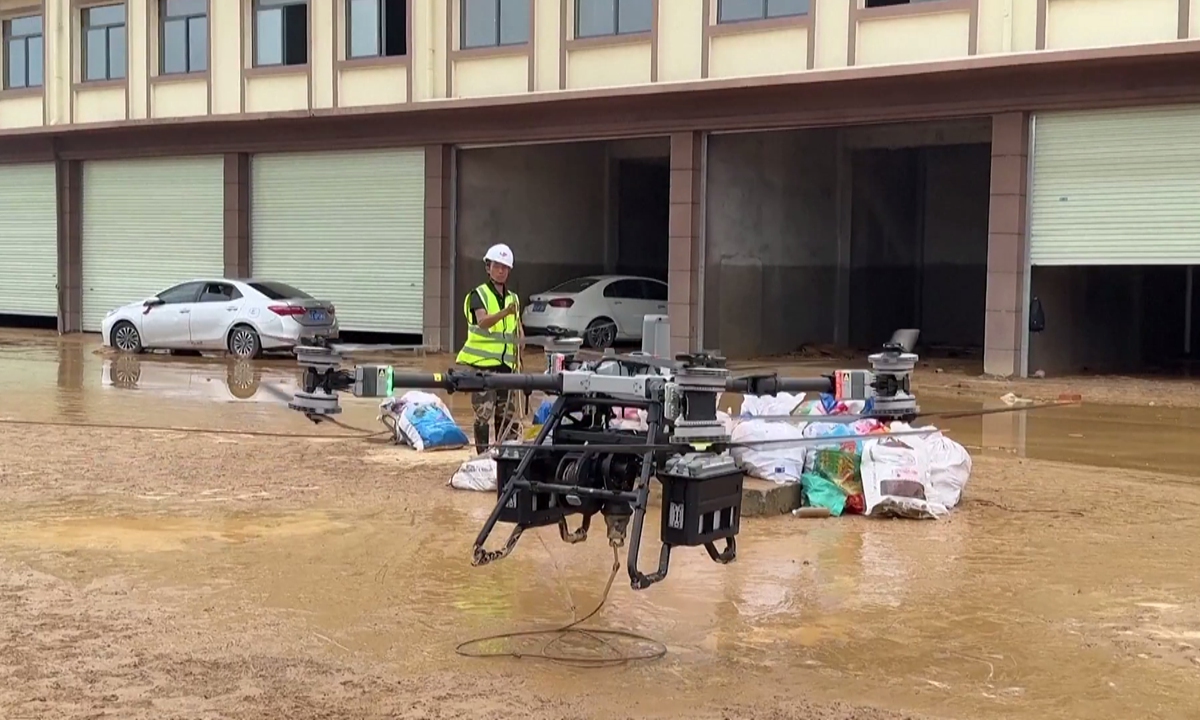
Rescue teams use a drone, heavy-load supply delivery and airborne communications support to open emergency access routes for disaster-relief operations in Hengzhou, Guangxi, in July 2026. Photo: IC

People donate money to flood-hit areas in Guangxi at the Village Super League football stadium in Rongjiang county, Southwest China's Guizhou Province, on July 8, 2026. Photo: IC
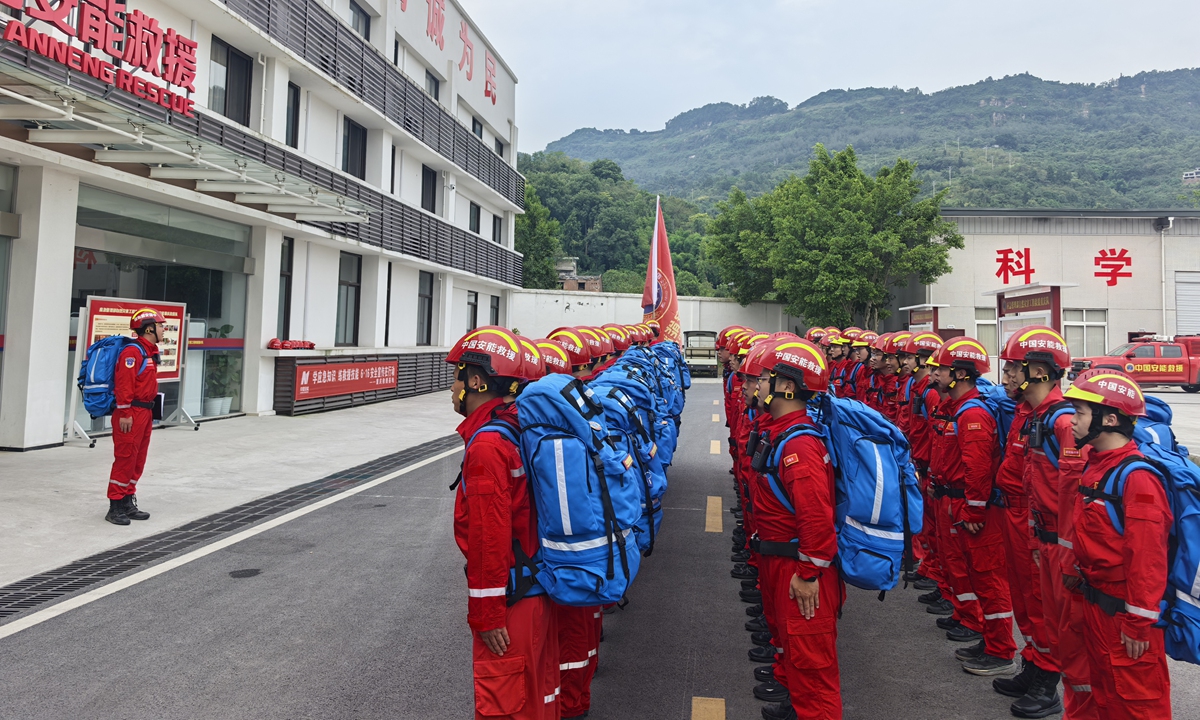
Rescuers prepare to conduct search and rescue operations after a landslide damages homes in Pengshui, Southwest China's Chongqing Municipality, on July 17, 2026. Photo: VCG
Global Times