Facing the questions of the AI era, the world looks to China for solutions: Global Times editorial
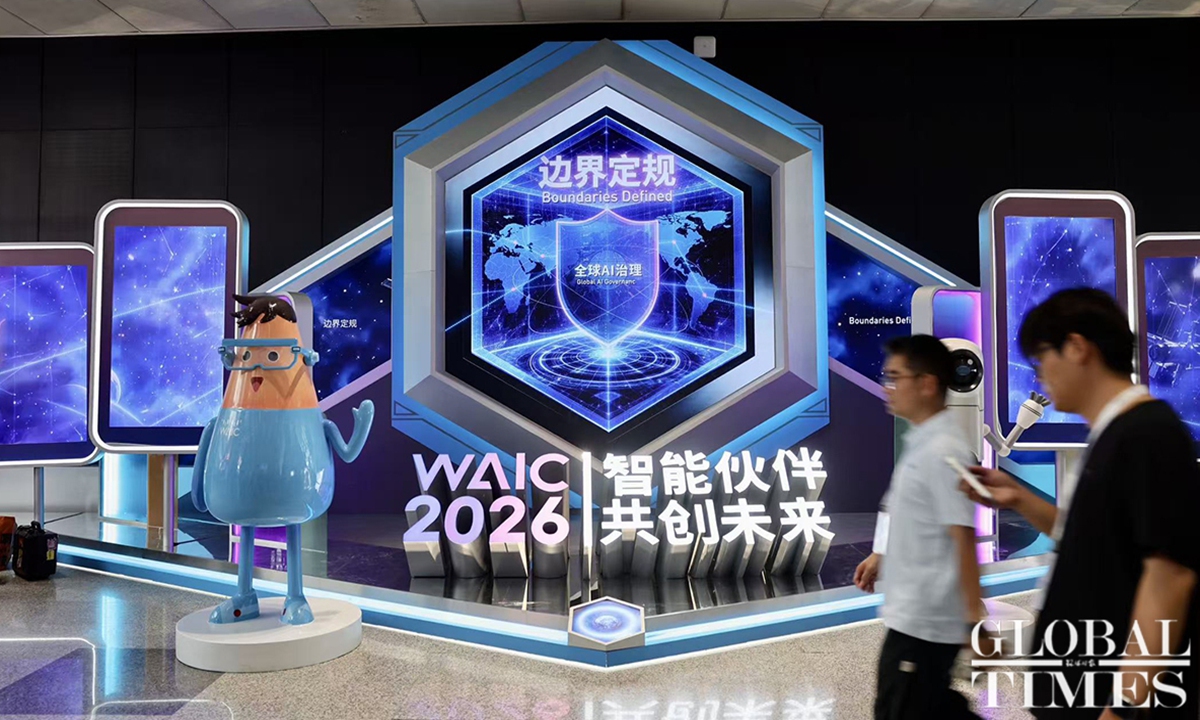
The 2026 World Artificial Intelligence Conference & High-Level Meeting on Global AI Governance kicked off in Shanghai on July 17, 2026. Photo: Chen Xia/GT
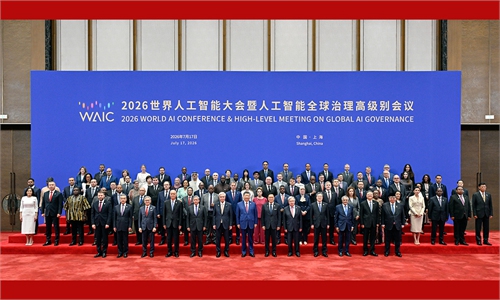
The 2026 World AI Conference and High-Level Meeting on Global AI Governance is being held from July 17 to 20 in Shanghai. President Xi Jinping pointed out in his keynote speech that all countries should take a people-centered approach and develop AI for the positive and for good. We should ensure that AI is an important driver for shared prosperity and common security. We should join hands to build a just and equitable system for global AI governance. At a critical crossroads in the development of human civilization, China has anchored itself to the right course of "for the positive and for good" and benefiting humanity. This reflects not only a profound insight into the prevailing trends of global development but also a vision that embraces the people-centered approach. The enthusiastic applause at the venue testifies to the world's embrace of and high expectations for Chinese wisdom and Chinese solutions.
President Xi raised four important proposals. First, we should adhere to the principle of openness and win-win and boost innovation-driven development. Second, we should strengthen risk-awareness and ensure that AI is secure and controllable. Third, we should encourage inclusiveness and promote mutual learning between civilizations. Fourth, we should advocate solidarity and improve global governance. Following the 2023 proposal of the Global AI Governance Initiative, President Xi has once again comprehensively and systematically articulated China's position and proposals regarding global AI governance. Focusing on the four dimensions of development, security, civilization and governance, he addressed major issues in the current landscape of global AI development and governance, contributing new insights and solutions to advancing global governance and bridging the AI and digital divides.
Technology is a double-edged sword; while it unleashes productive forces, it always brings chaos, plunder, and even war in its wake. Take Western industrial civilization. Technological breakthroughs - such as the steam engine, textile machinery, and railways - generated unprecedented material wealth and drove the rise of urbanization and global trade. However, they also caused severe social upheavals, including a widening wealth gap, rampant environmental pollution, and even fueled colonial expansion and world wars as the major powers engaged in rampant colonial expansion to vie for sources of raw materials and markets for their goods, ultimately precipitating world wars. Regions across Asia, Africa, and Latin America were plunged into a nightmare of resource plunder and cultural rupture. Beneath the "prosperity" of the two Industrial Revolutions lay the blood and tears born of unequal and unbalanced development.
Whenever a technological revolution occurs, who reaps the benefits and who defines the rules is a yardstick for measuring the height of human civilization. Currently, AI holds the promise of being humanity's greatest development opportunity, but without effective global governance, it could easily evolve into a new barrier to development and global chaos. In this context, by anchoring its technological development to the goals of promoting shared prosperity and common security, China is making clear that it will reject closed and exclusionary models of development, oppose ideological divisions and technological blockades. China treats AI technology as a "public good" - believing that the dividends of its development should be shared globally rather than serving as a tool for hegemony - thereby setting a precedent and responding to the shared expectations of the international community.
This is not only a manifestation of Chinese wisdom and Chinese solutions; it is also a demonstration of Chinese strength. China is at the forefront of AI technology and has become one of the most active and fastest-growing regions for global open-source large models. Chinese large models like DeepSeek, with their advantages of low cost, high efficiency, and open-source nature, have broken the monopoly of discourse held by certain countries. China is on the right path in the field of AI, achieving its own development while also providing development opportunities for many countries in the Global South. This further proves that new technologies should not be, and indeed do not have to be, "a game for the rich and wealthy nations."
From promoting the adoption of the UN General Assembly Resolution on Enhancing International Cooperation on Capacity Building of Artificial Intelligence by consensus, to leveraging the Belt and Road Initiative to build digital cooperation platforms that provide affordable smart infrastructure, local-language AI models, and digital talent training programs across Southeast Asia and Africa, China has consistently backed its commitments with concrete actions to promote the healthy, inclusive, and sustainable development of AI worldwide. The establishment of the World AI Cooperation Organization in Shanghai is another major step, responding to calls from the Global South and bringing together the international community to advance AI development and governance. It marks a significant milestone in the history of artificial intelligence.
The enthusiasm surrounding this year's conference exceeded expectations. The conference gathered over 1,100 participating companies, with more than 300 AI products making their global debut. Turing Award winner and foreign academician of the Chinese Academy of Sciences, John Edward Hopcroft, delivered a speech, and official representatives from over 100 countries and international organizations, as well as guests from academia and industry, attended the event. What drew them was not only the economic and technological opportunities on offer, but also China's willingness to act as a responsible major country by taking initiative at a time when the world faces critical choices. Walking with China means walking toward the future - this has become even more tangible.
AI is an invaluable asset that encapsulates humanity's collective wisdom. Guided by the well-being of all people and the common development of the world, and responding to the profound changes of our time, joining hands to build a just and equitable system for global AI governance, the proposals and initiatives of President Xi point the way forward for AI development and governance. At this pivotal moment in the rapid advance of technology, it is hoped that all parties will strengthen consensus and work with China to take a people-centered approach and develop AI for the positive and for good, so that AI can truly become a mighty force that increases the well-being of humanity and advances human civilization.
RELATED ARTICLES