Japan's push for nuclear weapons discussion could 'erode restrictions, fuel dangerous trend carrying inflammatory effects': Chinese expert
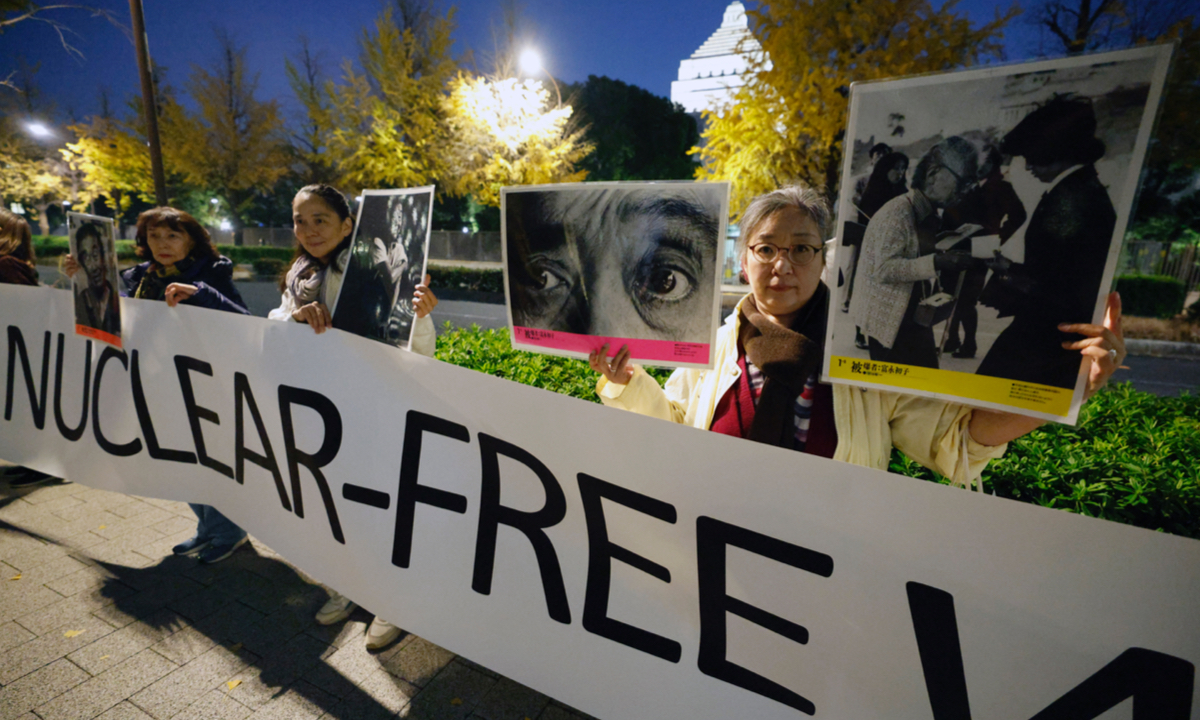
Protesters hold a banner during a rally in Tokyo, Japan, on November 21, 2025, after Japanese Prime Minister Sanae Takaichi criticized the country's traditional policy against nuclear weapons. Photo: VCG
Japan has continued to push for looser nuclear restrictions, with Defense Minister Shinjiro Koizumi calling for discussions on nuclear weapons as part of efforts to strengthen the country's so-called defense capabilities, according to media reports over the weekend.
Coupled with the Japanese government's reported bid to bolster the so-called extended nuclear deterrence provided by the US, Chinese analysts warned that Tokyo is gradually eroding nuclear restrictions and warned that this trend, fueled by growing neo-militarism, poses severe additional risks as Japan's right-wing forces are testing nuclear taboo.
Japanese Defense Minister Koizumi claimed in an online program released on Saturday that discussions on nuclear weapons were necessary to strengthen Japan's defense capabilities, according to Kyodo News. While acknowledging that the issue was difficult to discuss in Japan, he claimed it was something that "could not be avoided."
Lü Chao, an expert at the Liaoning Academy of Social Sciences, told the Global Times on Sunday that Koizumi's claim was an evident push to ease restrictions on nuclear weapons and blatant efforts chipping away at the Three Non-Nuclear Principles, which represents another step in a dangerous trend that poses serious risks to neighboring countries and global security.
Koizumi's claims were also believed to have been made with the government's review of three key security documents in mind, per the report by Kyodo News.
The expert added that Japan has failed to properly reflect on and acknowledge its past acts of aggression and wartime crimes. Japan still faces strong domestic resistance to breaking through the Three Non-Nuclear Principles, as many Japanese citizens retain painful memories of the devastation caused by nuclear weapons.
For example, Japanese civic group Peace Boat, in joint cooperation with the Citizens' Nuclear Information Center and the Japan Campaign to Abolish Nuclear Weapons, released on July 14 a statement titled "Japan Should Not Possess Nuclear-Powered Submarines."
The statement read that "Japan has long declared its responsibility, as the only nation to have suffered atomic bombings in wartime, to lead the effort toward the abolition of nuclear weapons, and under Article 2 of the Atomic Energy Basic Act it has confined the use of nuclear energy solely to peaceful purposes. To possess nuclear-powered submarines would be for Japan itself to disavow that very position."
A Japan that upholds an exclusively defense-oriented posture as a matter of national policy has no need for nuclear-powered submarines. The political and financial resources that would otherwise be spent on this debate should instead be directed toward easing tensions through diplomacy, the statement urged. "We strongly urge the government to rule out the acquisition of nuclear-powered submarines."
Break free from post-war restraints
According to Japanese media outlet Nikkei Asia on Sunday, the Japanese government will also look for ways to bolster the extended nuclear deterrence provided by the US as part of revisions to three key security documents at the end of the year. The media report also claimed that this comes in response to "China's strengthening offensive nuclear capabilities," underscored by this month's firing of a submarine-launched ballistic missile into the Pacific Ocean.
The test launch of a strategic missile by a submarine on July 6, which was part of the annual training arrangements of the PLA Navy, complied with international law and international practice, and is not directed at any specific country or target, the PLA Navy said on the day of launch.
By repeatedly hyping the so-called "China threat," the US and some Western countries have provided Japan with an opportunity to create an international public opinion environment favorable to its possession of nuclear weapons, Lü told the Global Times.
Junior coalition partner Japan Innovation Party has also proposed a review of the three non-nuclear principles. The proposal maintains the principles of not possessing and not producing nuclear weapons, while calling for the third principle of not permitting the introduction of nuclear weapons into the country to be assessed based on the current reality, according to Nikkei Asia on Sunday.
Zhan Debin, director and professor of the Center for Korean Peninsula Studies at the Shanghai University of International Business and Economics, told the Global Times on Sunday that the so-called "extended nuclear deterrence" refers to Washington extending its nuclear forces to safeguard its allies. Japan itself does not possess nuclear weapons, but in the event of a major security threat, the US promises to use all its military capabilities, including nuclear weapons, to defend Japan.
"Extended nuclear deterrence" is far more than a plain defense commitment, Zhan said, as it integrated Japan into America's nuclear architecture. Particularly as Japan debates easing the clause of its Three Non-Nuclear Principles barring nuclear weapons entry to its territory, the issue shifts beyond US protection of Japan to whether Tokyo seeks institutional loopholes for US nuclear assets to enter, be stationed in, or transit through Japan.
"The attempt by Japan reflects that right-wing forces in the country are testing nuclear 'taboos.' The Japan Innovation Party's proposal in essence makes room for US nuclear forces to be deployed in Japan," Zhan added.
Japan's real objective is not merely to counter alleged threats, but to exploit the "China threat" theory to break free from post-war institutional restraints including its pacifist constitution, the exclusively defense-oriented policy and the Three Non-Nuclear Principles, the expert added. The country also does not merely seek US protection; instead, it actively incorporates nuclear issues into the reshaping of its national security policy.
In fact, a nuclear-armed Japan would pose significant risks to the US itself, Lü added. This development should serve as a warning to Japan's neighboring countries, the international community, and some Western countries led by the US, that Japanese militarism has not disappeared.
In the short run, the US may see this as a way to appease Japan, bolster the alliance and ramp up strategic pressure on China, Zhan said. In the long term, however, this may not serve US interests.
"If Washington allows Japan to break nuclear 'taboos' and grants its right-wing forces greater leeway in security policymaking, the US may lose full control over Japan's military adventurism down the line," he added.
Izvestia, a major daily paper in Russia, also covered Koizumi's latest claim over the issue, while highlighting that back in 2025, Russian Deputy Foreign Minister Andrei Rudenko noted that the Russian side had a negative attitude toward the possibility of nuclear weapons in Japan. He stressed that the militarization of Japan can only worsen the situation in Northeast Asia, as well as lead to appropriate countermeasures from countries for which such militarization poses a threat.
Chinese Foreign Ministry spokesperson Guo Jiakun said during a press conference in December 2025 that trying to picture itself as the advocate of a world free of nuclear weapons, Japan has claimed in its own narrative to be the "victim" of nuclear weapons in WWII.
However, in fact, the Japanese side has never completely reflected on the wars of aggression it has waged, and has become the source of instability that challenges the Treaty on the Non-Proliferation of Nuclear Weapons and undermines the international nuclear non-proliferation regime. The international community must be clear-eyed about Japan's hypocritical stance on nuclear non-proliferation and disarmament, the spokesperson stressed.
RELATED ARTICLES