IN-DEPTH / IN-DEPTH
Chinese public widely endorses deeper China-ASEAN cooperation: GT survey
New momentum, more engagement
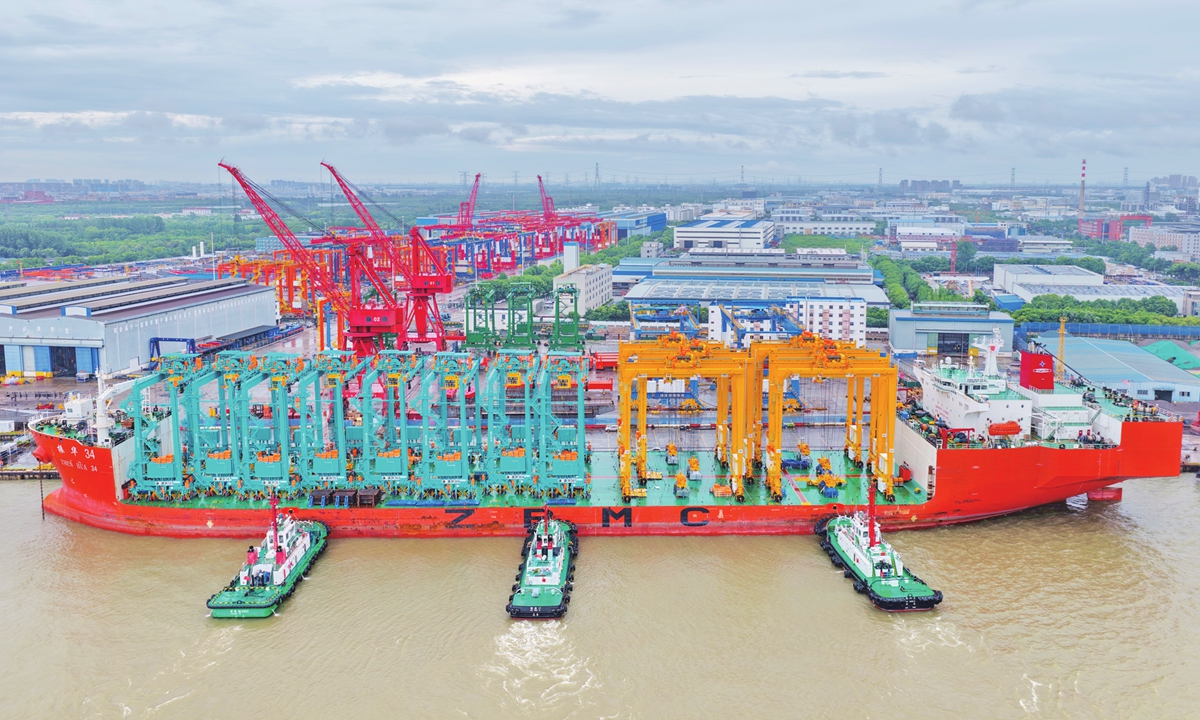
The vessel Zhenhua 34, carrying 14 rubber-tired gantry cranes, departed from Nantong Port in East China's Jiangsu Province on July 5, 2026, bound for ASEAN destinations including Malaysia, to support the smart upgrading of ports in Belt and Road partner countries. Photo: VCG
The year 2026 marks the fifth anniversary of the establishment of the China-ASEAN Comprehensive Strategic Partnership. China and ASEAN have been each other's largest trading partners for many consecutive years. A recent public opinion survey conducted by the Global Times Institute on "Chinese Public Views on ASEAN" in 2026 found that cooperation outcomes between China and ASEAN in recent years have been widely and positively received. Most respondents support deeper bilateral collaboration, express high hopes for economic and trade ties, and growing enthusiasm for people-to-people exchanges.The survey was conducted from June 12 to July 1 across 31 provincial-level regions in Chinese mainland, targeting ordinary residents aged 18 to 69. A total of 1,875 valid questionnaires were collected, with sample support from the market research firm DATA 100. The data were weighted according to the gender and age structure of internet users as reported in the 57th Statistical Report on China's Internet Development, released by the China Internet Network Information Center in February 2026. In 2022, to mark the first anniversary of the China-ASEAN Comprehensive Strategic Partnership, the Global Times conducted its first "Chinese Public Views on ASEAN" survey in Chinese mainland.
Optimistic outlook for China-ASEAN ties
In recent years, people-to-people exchanges between China and ASEAN members have grown increasingly frequent, and mutual understanding has gradually deepened. The survey found that 89 percent of respondents are aware of or have heard of ASEAN. Among them, a relative majority (49 percent) said they are "very familiar" or "somewhat familiar" with ASEAN, while another 40 percent said they have "heard of" ASEAN. The Global Times Institute carries out in-depth research among the 1,875 respondents who are aware of or have heard of ASEAN.
When asked about their overall favorability toward ASEAN, 45 percent of respondents chose "very favorable" or "favorable." When asked what comes to mind when they think of ASEAN, 56 percent cited "China-ASEAN cooperation projects," making it the most prominent impression. "Economic development and manufacturing" as well as "tourism, cuisine and natural scenery" also left strong impressions. In addition, over 30 percent of respondents were deeply impressed by "cross-border e-commerce and the digital economy" and "overseas Chinese and people-to-people exchanges."
China and ASEAN members are close neighbors with similar development philosophies and deeply intertwined interests. How does the Chinese public view ASEAN members' attitude toward China? The survey found that 39 percent of respondents believe ASEAN members hold a "very friendly" or "relatively friendly" attitude toward China, while 23 percent chose a neutral option.
Regarding the current state of China-ASEAN relations, 49 percent of respondents rated them as good, and 31 percent chose neutral - together accounting for about 80 percent. Looking ahead to the trajectory of bilateral ties, 49 percent of respondents voiced optimism, and 28 percent predicted the status quo would remain unchanged.
Ge Hongliang, deputy director of the College of ASEAN Studies at Guangxi University for Nationalities, told the Global Times that Chinese people's perceptions of China-ASEAN relations are shaped by two main factors. First, consider the broader context of major-power competition and the regional landscape. In building industrial resilience centered on ASEAN, for example, ASEAN members are cooperating with partners beyond China in sectors such as semiconductors, and Southeast Asia has become a focal point of great-power rivalry over critical minerals like rare earths. Second, in the South China Sea, frequent frictions near Ren'ai Jiao and Huangyan Dao also affect Chinese views.
Ge pointed out that overall, apart from China-Philippines relations, ties between China and other ASEAN members - particularly the building of the China-ASEAN community with a shared future - have remained stable and on an upward trajectory, with tangible progress made in areas such as the upgrade of the China-ASEAN Free Trade Area (CAFTA).
Economic and trade cooperation tops expectations

A view of Nanning International Convention and Exhibition Center, the permanent venue for the China-ASEAN Expo, in Nanning, South China's Guangxi Zhuang Autonomous Region Photo: VCG
In recent years, China and ASEAN members have deepened practical cooperation across various sectors, leveraging multilevel dialogue mechanisms and regular cooperation platforms. Trade and investment, the digital economy, and people-to-people exchanges have all continued to expand. The survey shows that 87 percent of respondents have heard of relevant cooperation frameworks or projects. Among them, 43 percent are aware of the CAFTA, and over one-third have heard of the China-ASEAN Expo, the Plan of Action to Implement the ASEAN-China Comprehensive Strategic Partnership (2026-2030), and the China-Laos Railway. Regarding the outcomes of China-ASEAN cooperation in recent years, 66 percent of respondents believe the results have been "highly effective" or "relatively effective."China-ASEAN economic and trade cooperation has gained new momentum with the signing of the upgraded protocol for the CAFTA 3.0 Upgrade Protocol. The survey shows that 99 percent of respondents believe China and ASEAN should further deepen cooperation in relevant areas. When asked about priorities, the most valued area is economic and trade cooperation and investment, chosen by 56 percent. This is followed by agricultural products and food supply chain cooperation, green development and new energy, tourism and people-to-people exchanges, and law enforcement and security cooperation - each selected by 51 percent of respondents.
The 23rd China-ASEAN Expo will be held in Nanning, South China's Guangxi Zhuang Autonomous Region, from September 17 to 21, 2026. Survey data show that 85 percent of respondents are looking forward to this year's China-ASEAN economic and trade cooperation outcomes, with 55 percent saying they are "very much" or "somewhat" looking forward to it, and 30 percent expressing that they were "expectant."
Muhammad Abdurrohim, research coordinator at the ASEAN-China Research Center of Universitas Indonesia, told the Global Times that public expectations in ASEAN members align widely with those held by Chinese citizens. First, economic and trade cooperation - expanding agricultural market access to China has long been a key foreign policy priority for ASEAN. Second, digital economy cooperation ranks high on ASEAN agendas, even more so than among Chinese respondents. As ASEAN nations push forward final negotiations on the Digital Economy Framework Agreement, the bloc sees China as an indispensable partner in fintech, cloud services and artificial intelligence. Third, infrastructure cooperation: the Jakarta-Bandung High-Speed Railway and China-Laos Railway have reshaped how local populations across Southeast Asia view their countries' partnerships with China. Fourth is green transition and industrial upgrading.
Abdurrohim also noted that ASEAN members have different priorities: Singapore focuses heavily on digital finance; Vietnam and Thailand prioritize manufacturing upgrades; Laos and Cambodia center on infrastructure development and narrowing development gaps; Indonesia concentrates on industrialization. He emphasized that a nuanced, accurate understanding of these varying national priorities will help China carry out more effective engagement and exchanges with each ASEAN members.
People-to-people exchanges gain momentum
In recent years, China and ASEAN have continued to deepen exchanges between their peoples by facilitating visa procedures, strengthening connectivity and expanding cooperation in education and tourism. Survey data show that nearly 60 percent of respondents welcomed more ASEAN citizens traveling to China for tourism, study and business activities in the future. Meanwhile, half of the respondents expressed an interest in traveling to ASEAN countries for tourism, study or business.
Ge said that China-ASEAN people-to-people exchanges have a very solid foundation, with the most crucial driving force coming from top-level institutional design. In recent years, unilateral and bilateral facilitation policies introduced by China and ASEAN members have made such exchanges more convenient. In addition to official exchange programs such as tourism years, interactions among businesses, industries and other sectors have also become increasingly frequent. Moreover, both China and ASEAN members have demonstrated the willingness and capacity in recent years to expand cross-border cooperation in tourism, education and other areas.
Ge suggested that future China-ASEAN people-to-people exchanges should be more focused on identifying specific needs. This could include making exchanges more convenient for university faculty members, researchers, students and social media influencers, thereby further advancing China-ASEAN people-to-people exchanges.
To combat transnational telecom and online fraud, the Chinese government has actively carried out law enforcement cooperation with Cambodia, Laos, Myanmar, Thailand, Vietnam and other countries in recent years, achieving notable results. Nearly 70 percent of respondents supported further deepening cooperation between China and ASEAN in non-traditional security fields, including the fight against transnational telecom fraud.
Abdurrohim said that cross-border law enforcement cooperation is one of the areas most valued by people in ASEAN countries. In particular, combating transnational online fraud rings operating across the region is an issue of deep concern to people throughout Southeast Asia.
Under the strategic guidance of the leaders of both sides, practical cooperation between China and ASEAN across various fields has continued to deepen. It has gone beyond the scope of purely bilateral or regional cooperation and become a "demonstration zone" for implementing the Global Governance Initiative.
Forty-seven percent of respondents chose trade and investment liberalization and facilitation, ranking it first, when asked, "In which areas do you think China and ASEAN should strengthen cooperation most in global governance?" This was followed by stronger China-ASEAN cooperation on international and regional hotspot issues, selected by 41 percent of respondents.
In addition, more than one-third of respondents hope that China and ASEAN would expand cooperation in safeguarding the rights and interests of developing countries, ensuring food and energy security, and addressing climate change and promoting green development.
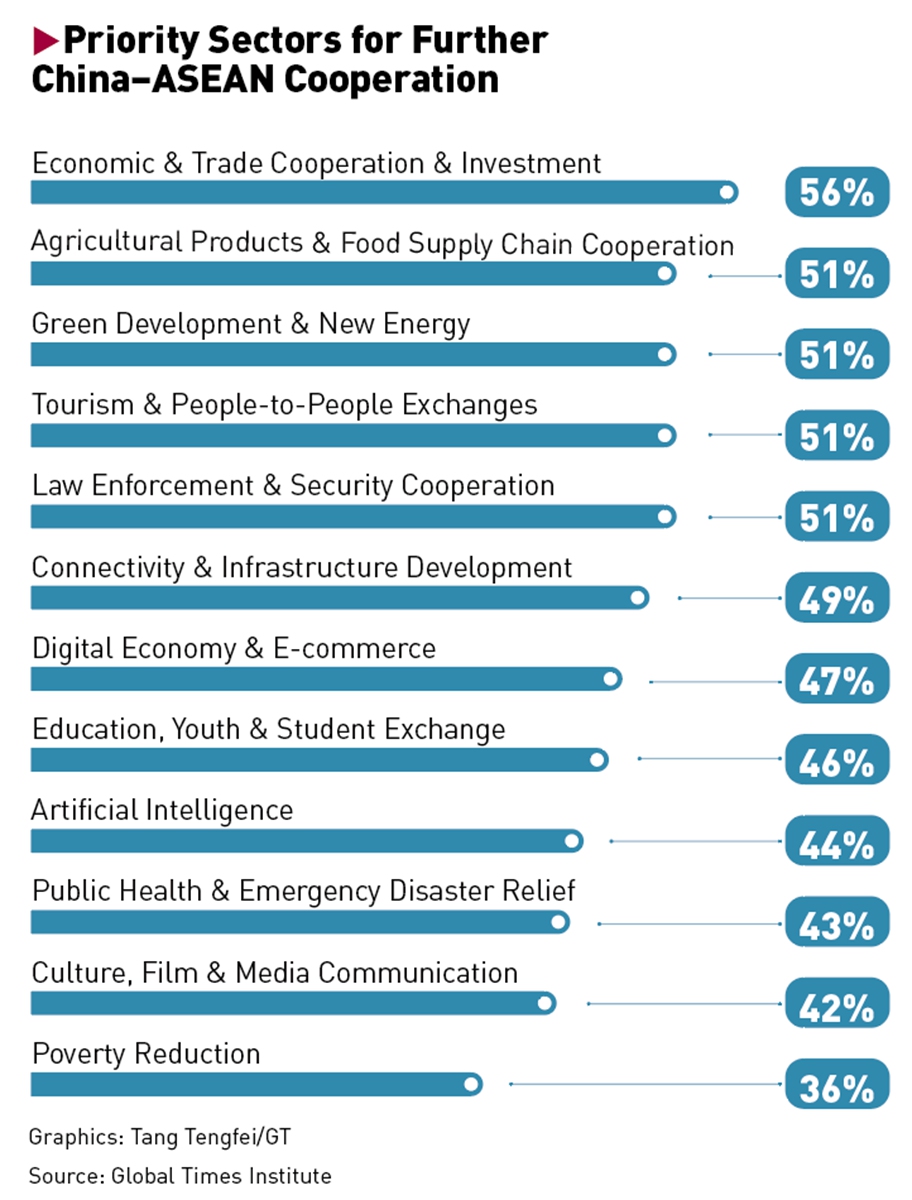
Graphic: GT
RELATED ARTICLES