WAIC highlights China's practical AI solutions, growing role in Global South cooperation
From early warnings to open models, China offers developing countries broader access to tech innovation
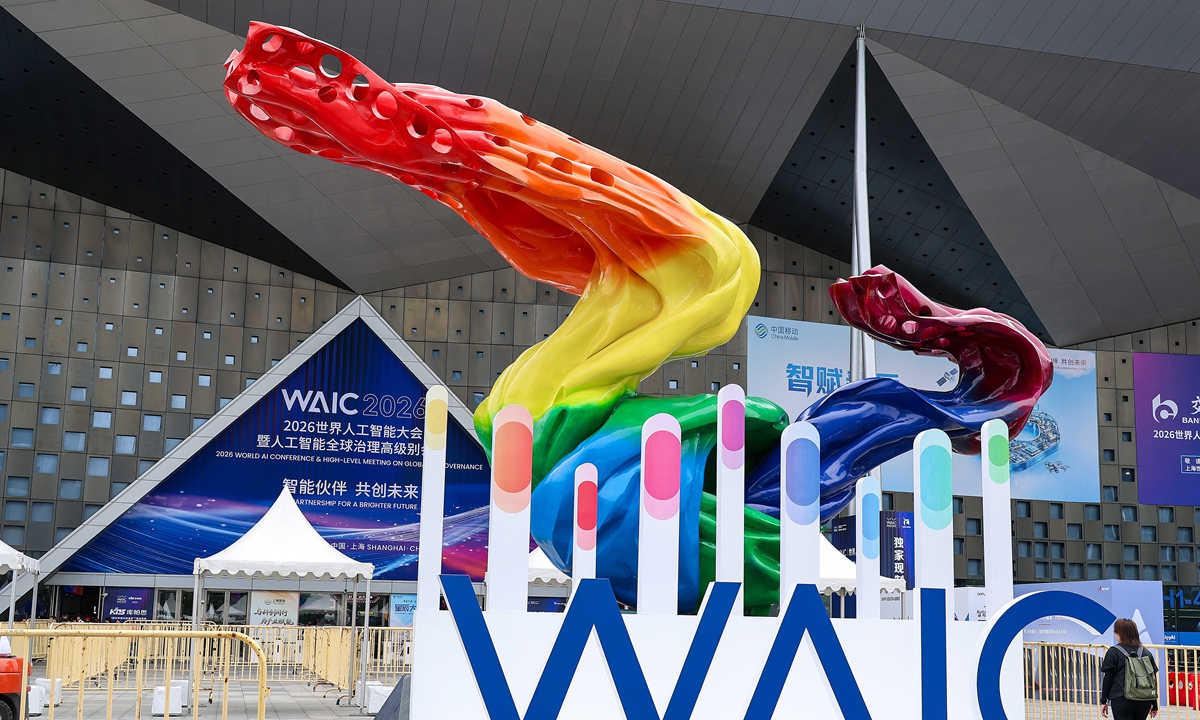
This photo shows the street installation for 2026 World Artificial Intelligence Conference in Shanghai, which is set to open on July 17, 2026, bringing together more than 1,100 companies and over 3,000 exhibits. Photo: VCG
Inside the vast halls of the Shanghai World Expo Exhibition and Convention Center, visitors from around the world crowded around booths showcasing the latest AI models, robots and intelligent devices, while just steps away, representatives from Global South countries discussed AI governance, industrial cooperation and common standards.The closely connected scenes observed by a Global Times reporter at the 2026 World AI Conference (WAIC) and High-Level Meeting on Global AI Governance showcased how AI is moving rapidly from technological demonstrations into practical applications and global policy discussions.
A senior UN official and a technology practitioner from Uzbekistan participating in the event told the Global Times that the conference, together with China's fast-growing ecosystem of open-source models and customizable public-service solutions, is providing developing countries with AI options that are more "accessible, affordable and applicable."
AI applications move into real world
A series of new applications unveiled on the third day of the conference showed how AI is already being used in areas that directly affect public safety.
At a Sunday forum, China Earthquake Administration released an earthquake-science AI agent, a large model for seismology, an intelligent earthquake-processing system and authoritative benchmark datasets, covering key fields including earthquake monitoring, forecasting, early warning and disaster prevention.
By 2028, the plan aims to establish effective AI support for earthquake prevention and disaster-reduction operations and reinforce China's early advantages in the field, according to CCTV News.
Another project that drew attention at the conference was MAZU, China's AI-powered meteorological early-warning solution.
The name MAZU - Multi-hazard, Alert, Zero-gap and Universal - also evokes Mazu, a widely revered guardian of the sea and weather in China's coastal culture. The solution integrates Fengyun meteorological satellites, AI forecasting models and other technologies into a chain covering monitoring, forecasting, warning and public services.
Science and Technology Daily described the broader early-warning initiative behind MAZU as the world's first national-level action plan launched in response to the UN's Early Warnings for All initiative. The system is being developed as a shared, customizable and sustainable international public good for developing countries.
At WAIC on Friday, the China Meteorological Administration formally handed over MAZU Djibouti 2.0 to the African country. The upgraded version includes an intelligent monitoring and warning terminal equipped with an integrated meteorological chip and forecasting model. It will work with the MAZU Djibouti 1.0 urban multi-hazard early-warning agent donated by China in July 2025, forming an integrated system that links observation, forecasting and warning, according to the Xinhua News Agency.
The upgrade improves forecast resolution from nine kilometers to three kilometers, provides forecasts up to three days in advance and updates them every six hours, Xinhua reported. It is expected to enter operation in Djibouti by the end of this year.
The solution can also be adapted for cities, ports, airports, renewable-energy facilities, tourist attractions and other areas highly exposed to severe weather. Through a platform offering selectable technologies and customized services, China aims to make similar systems available to more developing countries, Xinhua said.
Tailored applications, together with China's open-source foundation models, are offering inclusive public goods and locally adapted solutions to the Global South. Zou Ciyong, Deputy to the Director General and Managing Director of the Directorate of Technical Cooperation and Sustainable Industrial Development at the United Nations Industrial Development Organization (UNIDO), told the Global Times that as wide gaps remain between developed and developing countries in AI capabilities, Global South countries have an urgent need and strong desire to share in the economic and social benefits brought by the technology.
The day before WAIC opened, representatives from 29 countries signed an agreement in Shanghai establishing the World Artificial Intelligence Cooperation Organization (WAICO), an independent intergovernmental organization headquartered in the city. It aims to promote international cooperation and global governance on AI, ensuring that AI is beneficial, safe and fair.
Zou said WAICO provides developing countries with a platform through which they can participate in AI cooperation and capacity building instead of remaining on the sidelines of technological change.
Both the UN and China advocate multilateralism and multilateral cooperation, he said. WAIC and WAICO give more countries access to the global AI conversation, while UNIDO has also held discussions with relevant Chinese departments over the possibility of using WAIC as a platform for more institutionalized exchanges in the future.
Accessible, affordable and applicable
For developing economies, the appeal of China's AI ecosystem lies not only in the capabilities of its models, but also in whether they can be accessed, adapted and afforded.
"China's open-source AI models create a great opportunity for Central Asia and other developing regions," Azamat Karamatov, CEO of IT Park Uzbekistan, told the Global Times on the sidelines of WAIC.
"Open-source AI makes advanced technology more accessible. It helps startups, universities, developers, and businesses to build new products faster and solve local challenges," Karamatov said.
That impression has been reinforced by the growing range of high-performance Chinese models, including DeepSeek, GLM and Qwen.
On Thursday, Chinese AI startup Moonshot AI unveiled Kimi K3, an open-weight model with 2.8 trillion parameters, native multimodal capabilities and a context window of 1 million tokens. The company said the model was designed for long-horizon coding, knowledge work and deep reasoning.
Third-party evaluations from Artificial Analysis and Arena.ai show the model performing on a par with leading models in the US, such as OpenAI's GPT and Anthropic's Claude. In these independent benchmarks, Kimi K3 ranked first in web interface engineering, outperforming Anthropic's Fable system in blind human-preference tests, according to the BBC.
The pricing has generated almost as much attention as the performance. Moonshot priced K3 at $15 per million output tokens, compared with $50 for the same volume from Claude Fable 5, Fortune reported.
"I believe China's open AI ecosystem is changing the global innovation landscape. By making advanced foundation models openly available, Chinese companies are enabling startups, researchers, and businesses around the world to innovate faster," Karamatov said.
Karamatov's assessment reflects a broader pattern of AI cooperation between China and Central Asian countries. In an October 2025 report, the China-Global South Project, an independent multimedia initiative, said Beijing seek to position China as a development partner for emerging economies by providing training, infrastructure support and access to AI technologies, with Central Asia becoming a prominent testing ground for this approach.
In Uzbekistan, Shanghai-based AI firm LinkWise has partnered with Uzbekistan's Ministry of Digital Technologies to build a Modular Intelligent Computing Center. The center will serve as a deployable and flexible "AI brain" to support Uzbekistan's ambitions in digital governance, smart cities, and industrial modernization, according to China-Global South Project.
The open-weight strategy has also generated resistance in some US technology and policy circles.
Dean Ball, head of strategic futures at OpenAI, argued on the X platform that a future in which AI is treated as a "public good" rather than a market product could become a "dystopian hellscape." He also suggested that the Trump administration might create regulatory uncertainty around the use of Chinese open-weight models in order to discourage regulated US enterprises from adopting them.
Zou said AI can support industrial upgrading, improve efficiency and conserve resources. However, he said the expansion of national-security restrictions in some countries, together with broader anti-globalization trends, is creating obstacles to AI development and international cooperation.
AI systems are trained and improved using resources drawn from the global internet and cannot ultimately be confined by national borders, Zou said. Both the opportunities and challenges brought by the technology - including governance and safety - therefore require joint exploration by the international community.
This, he said, is why WAICO can play an important role in addressing the challenges accompanying AI development and why the UN welcomes progress toward more inclusive global cooperation.
Back on the exhibition floor, new models flashed across giant screens and robots continued to draw crowds. But beyond the excitement of each new release, the discussions in Shanghai pointed to a broader test for the AI era: whether increasingly powerful technology will remain concentrated in a few hands, or become a practical tool that more countries can afford, adapt and use.
RELATED ARTICLES