After May diplomatic blitz, China pivots June toward global business, trade, investment
Summer Davos, supply-chain expo and Qingdao summit to highlight economic cooperation
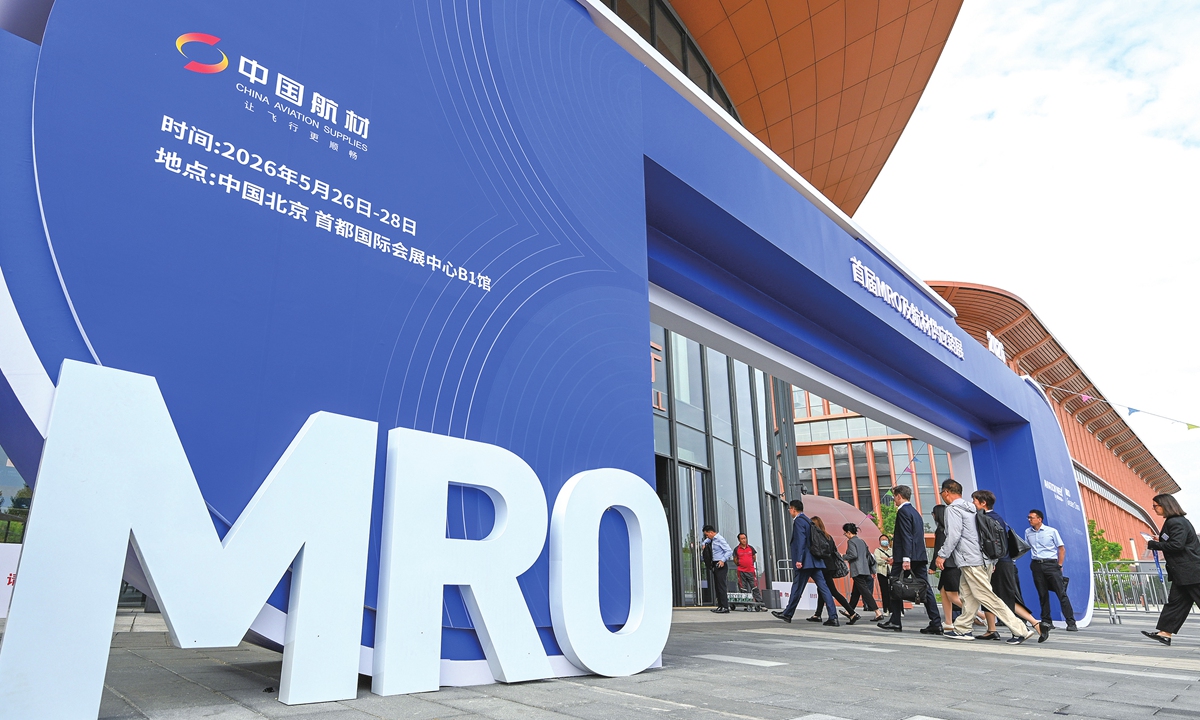
The MRO Greater China, the largest domestic aviation aftermarket event in China, kicks off at the Capital International Exhibition Center of China, in Beijing on May 26, 2026. The international exhibition featured over 8,000 professional visitors and 200 exhibitors. Photo: Chen Tao/GT
After a bustling May dominated by high-level diplomacy, China is pivoting its June agenda toward global business, trade, and investment. As a series of major economic platforms kicks off this summer, analysts say the packed schedule underscores Beijing's drive to turn its opening-up pledges into action, providing greater stability to global industrial and supply chains at a time of uncertainty.
Economic cooperation will be highlighted by several premier international gatherings in June. The shift will be on full display at the Summer Davos Forum in Dalian, Northeast China's Liaoning Province, the seventh Qingdao Multinationals Summit in East China's Shandong Province, and the fourth China International Supply Chain Expo (CISCE) in Beijing.
The 17th Annual Meeting of the New Champions of the World Economic Forum (WEF), widely known as the Summer Davos Forum, will be held in Dalian from June 23 to 25 under the theme "Innovating at Scale." More than 1,500 leaders from business, government, civil society and academia will attend.
Amid rapid geo-economic and geopolitical shifts, the meeting will focus on how innovation and policy can unlock new growth, enterprise and jobs, with the next phase of China's economic trajectory among its key themes, according to the World Economic Forum.
Before Summer Davos, the fourth CISCE will be held in Beijing from June 22 to 26, bringing together Chinese and foreign companies, industry institutions and other participants from across the global supply-chain ecosystem.
Qingdao, an eastern Chinese coastal city, will add a multinational focus to the June lineup. Co-hosted by the Ministry of Commerce (MOFCOM) and the Shandong Provincial People's Government, the seventh Qingdao Multinationals Summit will be held from June 15 to 17, MOFCOM Vice Minister Yan Dong said on Tuesday.
The three major platforms carry added significance in the opening year of China's 15th Five-Year Plan period (2026-30), as they respond to global businesses' long-standing interest in China's vast market and innovation space while sending a clear signal, amid rising protectionism, that China remains committed to open cooperation and global supply-chain stability, Chinese economists said.
Shared opportunities
Against the current international backdrop, geopolitics, energy security and clean energy have become key concerns for participants at the Summer Davos Forum, while this year's event will also focus on China's 15th Five-Year Plan, artificial intelligence, innovative technologies, demographic trends and healthcare, said Gim Huay Neo, Managing Director and Chair of Greater China at the WEF, during a visit to Dalian on Thursday, the host city, according to the Dalian municipal government website.
This year's Summer Davos Forum will also include two special events: a chemical industry leaders' summit attended by 17 chairmen and CEOs from leading Chinese and foreign companies, and an investor community summit bringing together top global investors, per the municipal government.
As the world's first national-level exhibition dedicated to supply-chain cooperation, the CISCE has become a closely watched international economic and trade event and a global public good shared by businesses worldwide.
So far, 676 Chinese and foreign exhibitors from 85 countries, regions and international organizations have confirmed participation in this year's CISCE, with Fortune Global 500 companies and industry leaders accounting for more than 65 percent of the total, according to the China Council for the Promotion of International Trade (CCPIT) on Friday.
The Qingdao summit will also bring together a large number of multinational corporations. So far, 435 corporate guests have confirmed attendance, including 355 representatives of overseas multinational corporations from 36 countries and regions, such as members of the Association of Southeast Asian Nations (ASEAN), the European Union and South Korea, Wen Nuan, vice governor of Shandong Province, said on Tuesday.
The summit will also put stronger emphasis on practical outcomes and diverse formats, with 23 parallel events covering investment promotion, trade matchmaking, industry exchanges and regional cooperation to further unlock cooperation potential, according to Wen.
The intensive rollout of these platforms is a key step by China to use high-level opening-up to offset global economic uncertainty and help stabilize industrial and supply chains, especially amid rising geopolitical tensions and faster supply-chain restructuring, Su Jian, a professor at Peking University's School of Economics, told the Global Times on Tuesday.
"These events send a clear signal of continued institutional opening-up, helping reduce policy uncertainty and transaction costs for multinationals operating in China and strengthening their long-term investment confidence," Su said, adding that the strong presence of overseas companies shows global capital's continued recognition of China's vast market and complete industrial system.
Fabrizio Costa, Secretary General of the Italian Chamber of Commerce in China, told the Global Times on Tuesday that events like the Qingdao Multinationals Summit and the CISCE are crucial platforms for Italian companies to connect with local partners and better understand China's evolving market dynamics.
"Despite global headwinds, the Italian business community continues to view China not just as a vital market, but as a strategic hub for supply chain resilience and innovation," Costa said.
During the 15th Five-Year Plan, China's high-quality development will offer multinational companies cooperation advantages that are difficult to replace elsewhere, Song Ding, a research fellow at the China Development Institute, told the Global Times on Tuesday.
As the world's largest trading nation, China offers a vast market, complete industrial chains, ample capital, technological strengths and new trade models such as cross-border e-commerce which helps foreign companies expand in higher-value sectors, Song added.
Global confidence
The outline of the 15th Five-Year Plan set out major arrangements for building a modern industrial system and promoting international industrial and investment cooperation, while also calling for greater efforts to attract and utilize foreign investment.
As China enters the opening year of the 15th Five-Year Plan, the Italian Chamber of Commerce in China sees strong potential for deepened cooperation, particularly in green technologies, automation, and high-end manufacturing, Costa said, adding the chamber look forward to concrete policy support that facilitates two-way trade and investment, especially in sectors where Italian excellence meets China's development goals.
Recent data backs up that confidence. More than 20,000 foreign-invested enterprises were newly established in China in the first four months, up 6.8 percent year-on-year, while actual foreign investment in high-tech industries rose 20.3 percent from a year earlier, according to MOFCOM.
The American Chamber of Commerce in China's 2026 survey found that nearly 60 percent of surveyed US companies planned to increase investment in China, while the British Chamber of Commerce in China said British firms were more optimistic about 2026 than in any year since before COVID-19, with most planning to maintain or raise investment.
"These fully show that China is not only a stabilizer of the global economy, but also a must-choose destination for multinationals' future-oriented planning," MOFCOM Vice Minister Yan Dong said on Tuesday, inviting multinational corporations from around the world to deepen cooperation in industrial upgrading, scientific and technological innovation, green development and the digital economy.
Recent overseas reports have highlighted business voices that see China as both a major market and a source of industrial innovation.
Reuters recently quoted JPMorgan's Global Chair of Investment Banking Anu Aiyengar as saying that global companies are increasingly eager to partner with innovative Chinese firms, noting that "there's so much innovation" happening in areas such as biotech and technology.
The Financial Times on Friday quoted Robert Cisek, head of Volkswagen brand's China operations, as saying, "We need to accept that China is setting the pace of innovation in many industries."
Luiz Awazu Pereira da Silva, former deputy general manager of the Bank for International Settlements, stressed in a recent interview with the Global Times that "China's growth trajectory has become systemically important for the global economy amid global uncertainty, as it is one of the few economies with the scale, policy capacity and external linkages to act as a major stabilizing force."
RELATED ARTICLES