How Hong Kong can turn its unique advantages into winning strengths amid global sci-tech transformation: Hai Feng
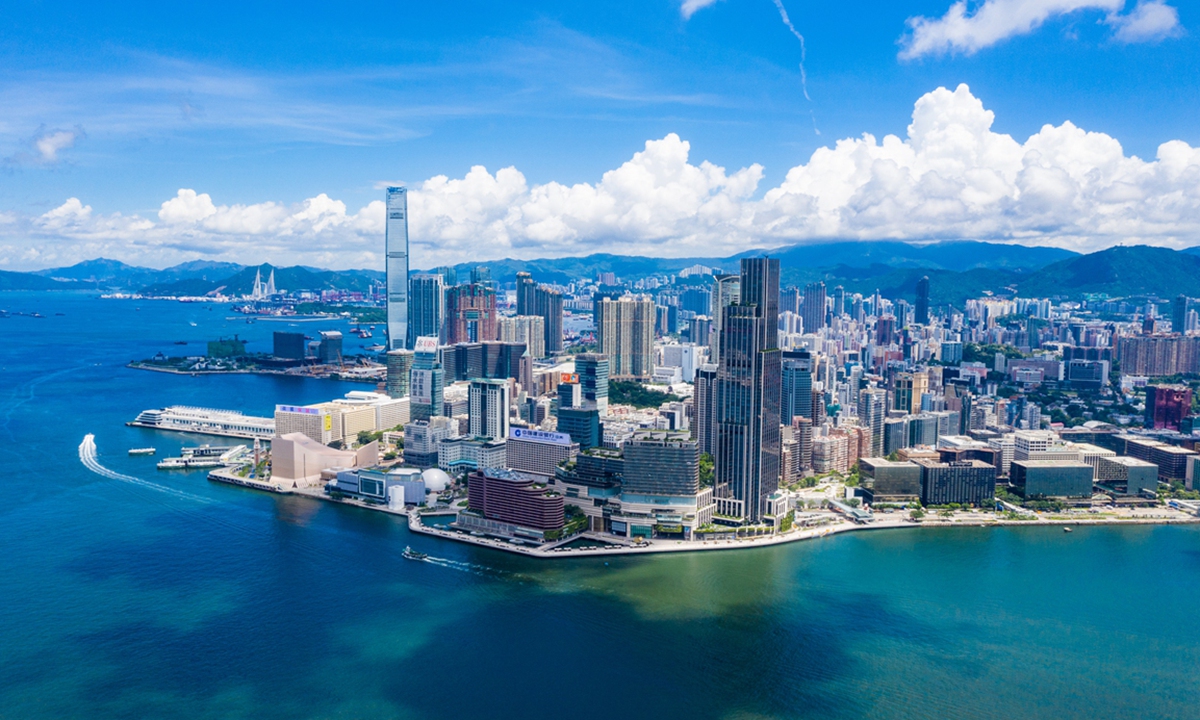
A view of Kowloon City, Hong Kong Photo: VCG
Recently, the national science and technology award conference and the World AI Conference (WAIC) have sent out the same strong message: the new round of global competition is, at its core, a contest of technological innovation capabilities. Whoever can seize the commanding heights of science and technology will gain the initiative in future development.
Nowadays, the underlying logic of competition among global cities has fundamentally changed. Original research, commercialization of scientific achievements, talent attraction, technology finance and innovation ecosystems are becoming the key sources of competitiveness. Technological innovation has become the main battleground of global competition. For Hong Kong, as one of the world's most competitive economies, technological innovation is not merely a matter of industrial upgrading, but a strategic question concerning the city's future positioning, development space and competitive edge. Amid this global wave of sci-tech transformation, the key question is how Hong Kong can break through and turn its unique advantages into genuine development strengths.
For decades, Hong Kong has built its distinctive position on finance, trade, shipping and professional services. This system has shaped Hong Kong's success and is Hong Kong's traditional advantage. However, as emerging industries such as AI, the digital economy, green technology and biomedicine rapidly rise, the marginal benefits of the old growth model are gradually diminishing. For Hong Kong, how to transform its traditional strengths into new drivers of growth has become a crucial challenge of the times.
At the same time, Hong Kong's development opportunities are clear and unique. Its future path does not lie in simply replicating other models or building another manufacturing hub. Instead, Hong Kong should leverage its own strengths to become a key "connector" between global innovation resources and China's innovation system - which is the true significance of building an international innovation and technology hub. Hong Kong should neither copy the development paths of mainland cities nor remain confined to the traditional framework of an international financial center. Rather, it should become a bridge for global sci-tech capital entering China, an interface for China's cutting-edge technologies to reach the world and a platform that effectively connects international rules with national development strategies. Hong Kong's uniqueness lies not in "being like someone else," but in being irreplaceable.
This positioning is supported by three major advantages. First, Hong Kong has strong capabilities in basic research. Several world-renowned universities have accumulated substantial expertise in areas such as AI, biomedicine, new materials and advanced manufacturing, while maintaining extensive international research cooperation networks and continuously producing high-level scientific achievements.
Second, Hong Kong has a mature common law system, strong intellectual property protection mechanisms and an international business environment under "one country, two systems" framework. These advantages make it naturally attractive for cross-border technology transactions, scientific collaboration, determination of ownership rights over research and the global expansion of technology companies.
Third, as an international financial center, Hong Kong has a comprehensive financing system that can better channel advantages in venture capital, private equity, public listings and cross-border capital allocation into the entire innovation process. Technological innovation has never been driven by a single breakthrough alone; it is the result of the combined forces of technology, capital, institutions and markets. Hong Kong possesses precisely what is needed to integrate and allocate diverse resources.
More importantly, Hong Kong's unique value must be understood within the broader context of national development and the coordinated development of the Guangdong-Hong Kong-Macao Greater Bay Area (GBA). The accelerated development of the Hong Kong Park of the Hetao Shenzhen-Hong Kong Science and Technology Innovation Cooperation Zone has opened new strategic opportunities for Hong Kong. If Hong Kong's strengths in research, institutions and international connectivity can be deeply integrated with Hetao and the GBA's industrial capacity, application scenarios and manufacturing strengths, a complete innovation chain can be formed: "research in Hong Kong, transformation in Hetao, application in the GBA and global expansion." This is not merely regional cooperation, but a key pathway for Hong Kong to build its own core competitiveness while contributing to China's pursuit of greater self-reliance and strength in science and technology. Hong Kong's future breakthroughs will not come from acting alone, but from embedding its strengths into a broader innovation system guided by national strategies.
Turning this vision into reality depends on whether Hong Kong can truly recognize change, adapt to change and pursue change. Recognizing change means fully understanding that technological innovation is the primary engine shaping the future. Adapting to change means addressing practical bottlenecks by making sustained efforts in areas such as attracting and retaining talent, commercialization of scientific achievements, pilot-scale testing platforms, intellectual property mechanisms and the attraction of leading enterprises. Pursuing change means demonstrating greater determination and courage in advancing institutional coordination, policy innovation and the integration of innovation resources, transforming the "Lion Rock Spirit" into practical momentum for embracing technological frontiers and breaking away from outdated development paths.
Ultimately, Hong Kong's mission amid the global sci-tech transformation is to become a uniquely valuable "connector" of resources, a "multiplier" of value and a regional innovation hub. The Hong Kong of the future must use technology to enhance finance, innovation to reshape industries and openness to connect with the world. Whoever is first to transform unique advantages into irreplaceable innovation capabilities will secure a strong position in the new round of global competition. For Hong Kong, the most important question is to seize this opportunity and make full use of it to achieve a new leap forward in development - allowing the "Pearl of the Orient" to continue shining brightly in the new era of global sci-tech competition.
The author is a commentator on international affairs. opinion@globaltimes.com.cn
RELATED ARTICLES